Etruria |
Roman Empire |
Invasions of Modern Whites into Europe |
Holy Roman Empire |
________________________________________
The language of the Western Roman Empire (27 B.C. - 476 A.D.) was Latin. |
|
|
 |
Update:Apologies for not explaining how eye color can be determined by DNA. Of course Genetics and a whole host of other things are explained in the Special Subjects Pages, but then again we don't want to overtax our readers. Under the heading of "Why reinvent the wheel" The U.S. Department of Health & Human Services - U.S. National Library of Medicine: has a reasonably race neutral (for Albinos) page on the subject - they still "IMPLY" lies. https://ghr.nlm.nih.gov/primer/traits/eyecolor
Is eye color determined by genetics?A person’s eye color results from pigmentation of a structure called the iris, which surrounds the small black hole in the center of the eye (the pupil) and helps control how much light can enter the eye. The color of the iris ranges on a continuum from very light blue to dark brown. Most of the time eye color is categorized as blue, green/hazel, or brown. Brown is the most frequent eye color worldwide. Lighter eye colors, such as blue and green, are found almost exclusively among people of European ancestry. Eye color is determined by variations in a person’s genes. Most of the genes associated with eye color are involved in the production, transport, or storage of a pigment called Melanin. Eye color is directly related to the amount and quality of Melanin in the front layers of the iris. People with brown eyes have a large amount of Melanin in the iris, while people with blue eyes have much less of this pigment. A particular region on chromosome 15 plays a major role in eye color. Within this region, there are two genes located very close together: OCA2 and HERC2. The protein produced from the OCA2 gene, known as the P protein, is involved in the maturation of melanosomes, which are cellular structures that produce and store Melanin. The P protein therefore plays a crucial role in the amount and quality of Melanin that is present in the iris. Several common variations (polymorphisms) in the OCA2 gene reduce the amount of functional P protein that is produced. Less P protein means that less Melanin is present in the iris, leading to blue eyes instead of brown in people with a polymorphism in this gene. A region of the nearby HERC2 gene known as intron 86 contains a segment of DNA that controls the activity (expression) of the OCA2 gene, turning it on or off as needed. At least one polymorphism in this area of the HERC2 gene has been shown to reduce the expression of OCA2, which leads to less Melanin in the iris and lighter-colored eyes. Several other genes play smaller roles in determining eye color. Some of these genes are also involved in skin and hair coloring. Genes with reported roles in eye color include ASIP, IRF4, SLC24A4, SLC24A5, SLC45A2, TPCN2, TYR, and TYRP1. The effects of these genes likely combine with those of OCA2 and HERC2 to produce a continuum of eye colors in different people. (THE ABOVE ARE ALL ALBINISM GENES!).
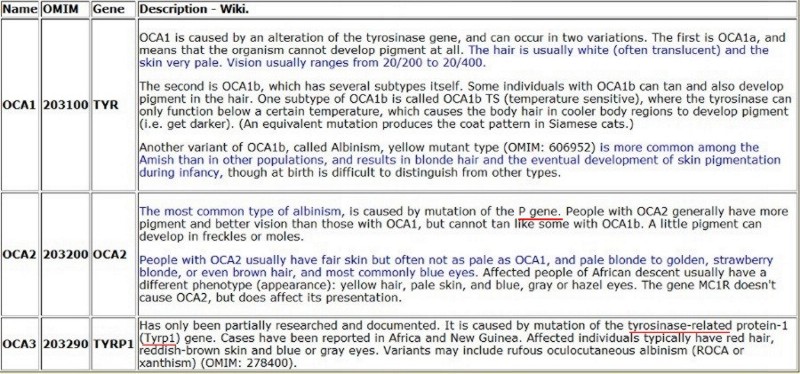
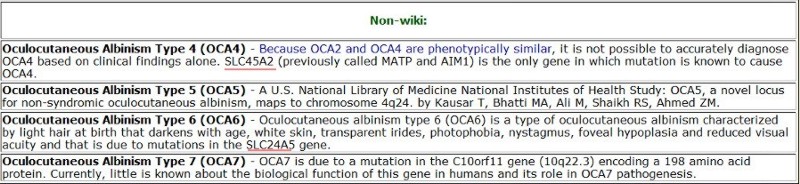
TYPES OF ALBINISM (There is currently seven identified).
Researchers used to think that eye color was determined by a single gene and followed a simple inheritance pattern in which brown eyes were dominant to blue eyes. Under this model, it was believed that parents who both had blue eyes could not have a child with brown eyes. However, later studies showed that this model was too simplistic. Although it is uncommon, parents with blue eyes can have children with brown eyes. The inheritance of eye color is more complex than originally suspected because multiple genes are involved. While a child’s eye color can often be predicted by the eye colors of his or her parents and other relatives, genetic variations sometimes produce unexpected results. Several disorders that affect eye color have been described. Ocular Albinism
is characterized by severely reduced pigmentation of the iris, which
causes very light-colored eyes and significant problems with vision.
Another condition called Oculocutaneous Albinism
affects the pigmentation of the skin and hair in addition to the eyes.
Affected individuals tend to have very light-colored irises, fair skin,
and white or light-colored hair. Both Ocular Albinism and Oculocutaneous Albinism result from mutations in genes involved in the production and storage of Melanin.
Another condition called heterochromia is characterized by
different-colored eyes in the same individual. Heterochromia can be
caused by genetic changes or by a problem during eye development, or it
can be acquired as a result of a disease or injury to the eye. End
quote.
How it all WorksMelanin is the substance that makes Black People Black. All Earth's creatures who live in Sunshine, produce it in their bodies to protect them against the harmful effects of the Suns Rays. Creatures who don't produce Melanin are called Albinos: from Latin albus (White), from Spanish albo (White) - "Hence White People".
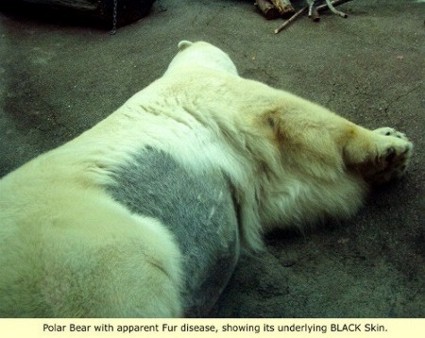
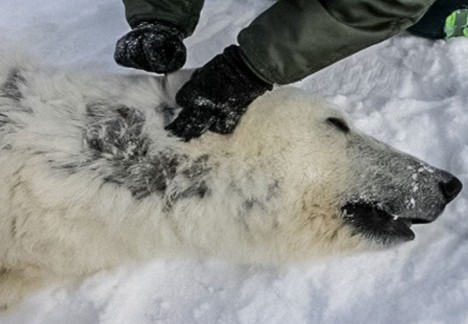
Even White Polar Bears have BLACK SKIN!
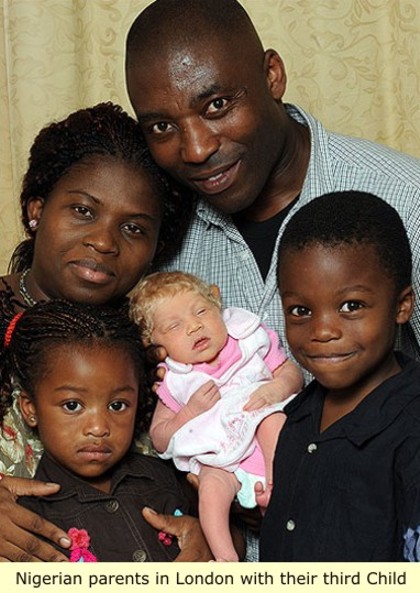
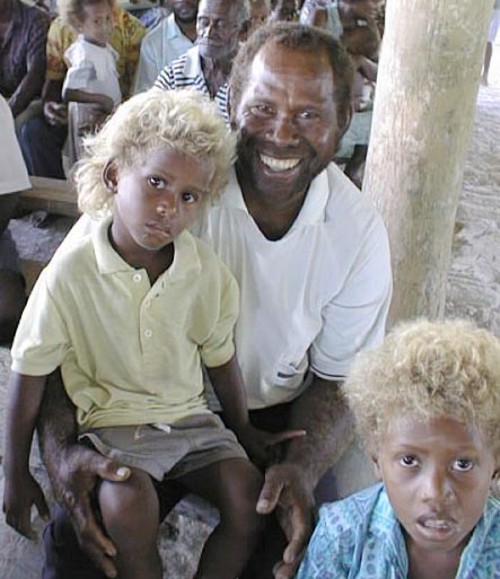
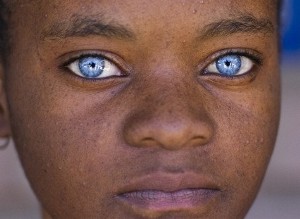
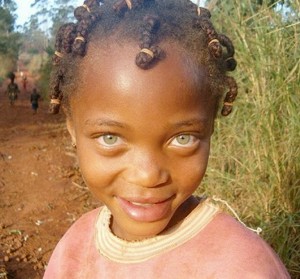
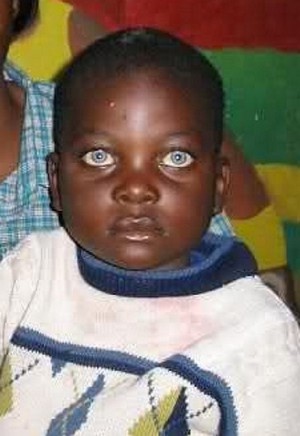
Though ALL White people were originally Black People, not all Black people with damaged color genes turn completely into White people. Sometimes ONLY their Eye-Color or Hair-Color, or Hair "Type" genes are effected (Straight hair is also recessive). In which case THIS is what happens to them.
Many people refuse to believe anything, unless it is accompanied byScientific Test Results, so here are the Scientific Test Results.
|
The Nonsense that White People are Cold Adapted HumansOne of the Albinos most outrageous lies is that they are “WHITE SKINNED” because they are a “COLD ADAPTED” People who EVOLVED light Skin to better absorb Sunlight for vitamin “D” synthesis. That is a ridiculous lie, and it is thoroughly and scientifically debunked Here: << Click here >> |
The Mediterranean Race
Before going on, let us revisit where we came from has far as historical Albino teachings are concerned. With their victory and ascension several hundred years ago, the Albinos realized that in order to have a viable human race of their own moving forward, they would need to have a newly created religion to call their own, and which they could write to serve their purposes, and a “Creation Myth” that would explain why they are so different from the rest of Humanity: {Answer from Wikipedia section titled “White People”}: White population = 850,000,000+ (which is about) 11.5% of the total world population. Mongols (Chinese, Japanese, Korean, etc.) 21%: The other 67.5% or 5.9 Billion are Blacks and non-European residing Mulattoes (think North Africa, the Middle East, Arabia, Brazil, Cuba, Puerto Rico, etc. (The world population is 7.5 - 7.7 billion). _________________________________________________Those numbers for whites may come as a shock to those used to Albino media, implying by what they allow us to see, that the world is just chock full of THEM. But no, there is and always was, very few of them. This is an excerpt from Benjamin Franklin’s 1751 essay: “America as a Land of Opportunity”. Quote - Which leads me to add one Remark: That the Number of purely white People in the World is proportionally very small. All Africa is black or tawny. Asia chiefly tawny. America (exclusive of the new Comers) wholly so. And in Europe, the Spaniards, Italians, French, Russians and Swedes, are generally of what we call a swarthy Complexion; as are the Germans also, the Saxons only excepted, who with the English, make the principal Body of White People on the Face of the Earth. I could wish their Numbers were increased. But of course Albino fertility was such that all they could add was millions of Mulattoes from the surviving Blacks that were not shipped off to slavery in the Americas. The lighter of which invariably wanted to be accepted as pure White, since that was the new ruling class. As an example: In Puerto Rico where the original people were the Black Taíno people: according to census figures: 76% of the population describe themselves as White. Click here for a link to Benjamin Franklin’s 1751 essay: “America as a Land of Opportunity”. _________________________________________________
Of course as we all know, or should know by now, all European Whites originated in Asia. Specifically they are the Albinos of India's Dravidians, who moved further North after the "Out-of-Africa migrations, to avoid India's strong Sunlight, which can be deadly to Albinos. And who were the only Albinos stupid enough to breed amongst themselves, thereby cementing their weakness to the Sun and inability to Farm their own food below 40 degrees latitude - which of course necessitated their enslavement of all pigmented people they ran across in the lower latitudes. (The scientific study immediately following explains the path Africans took to finally settle Europe after the last - and lingering - Ice Age).So now on to some funny Albino nonsense before going on to serious history:
|
Which proves that the
Eastern Roman Empire (the Byzantine) was Black, and by corollary, the
Western Roman Empire also; is presented in the "Anatolia" section of
this site. The study also explains indirectly, why the Eastern Orthodox
Catholic Church, which was not overcome by the Albino Turks from Asia
until 1453, still presents it's Saints and other personages of honor as
Black Skinned, while the Roman Catholic Church, which was overcome by
the Albino Germanics from Central Asia much earlier, (476 A.D.),
presents all related personages as White. This dichotomy is
demonstrated by portraits of people Sainted before the schism. Note the
case of Saint Vladimir the Great, who was a prince of Novgorod, grand
prince of Kiev, and ruler of Kievan Rus' from 980 to 1015. Vladimir's
father was prince Sviatoslav of the Rurik dynasty. (In Russia as
everywhere else, the original Monarchs were Blacks).
 |
 |
 |
The Great Schism (1054
A.D.) was the break of communion between what is now the Roman Catholic
Church and the Eastern Orthodox church, which has lasted since the 11th
century. THEY (Albinos) tell us that the irreconcilable issues were:
The source of the Holy Spirit, whether leavened or unleavened bread
should be used in the Eucharist, the Bishop of Rome's claim to
universal jurisdiction, and the place of the See of Constantinople in
relation to the Pentarchy.
But considering the great
upheavals in Europe which were precipitated by the Mongols empting-out
Asia of all of its Albinos, and chasing them into Black Europe: (the
study establishes the truth that Europe was Black also): doesn't it
seem more credible that the schism in the Catholic Church was really
about RACE?
Adherents of the Orthodox Church are of course, themselves Albinos: just Slav’s instead of Germanic’s. So it really would be too much to expect them to depict some of their Black Saints with Negroid features, (Blacks of course have Caucasian, Mongol, and Negroid features). The fact that they depict them “Dark” shows that they are at least “Trying”.
Sometime during the 19th century, the Albino people decided to revise Mans history. In their new history: they (the Albinos) became the native peoples of Europe, and in a totally mindless example of intellectual Greed, they also declared that they were also the creators of mans original civilizations - including Egypt.
This revising of history lasted through the 19th. and twentieth centuries. Now in the 21st. century, some institutions are trying to undo that two centuries of lies (perhaps in an effort to lessen the shock of publications like this one). In this case, it is one of the formerly foremost purveyors of Albino lie History - National Geographic. In April of 2013, National Geographic published a study which "Admits" that Africans were the Original settlers of Europe. And Also "Admits" that MODERN Europeans are newcomers. But in "Normal" Albino lie fashion, they refuse to admit that modern Europeans are Central Asian Albinos. But because many people, including some Blacks, won't believe anything unless a White person says so, we include it in our presentation.
On the matter of credibility: On first reading, readers of these pages generally feel amazement, the concept of Blacks being the original settlers, and builders of the first civilizations everywhere, including Europe, is particularly unsettling to them. Both Black and White, because they were taught that there were no Blacks in Europe until the Romans brought them. Then some Blacks correctly say: Uh huh, I knew the Whites were lying, and then go on to enjoy their edification. But Whites remain incredulous, they say: this is simply Blacks with no accomplishments, trying to steal White accomplishment and history! They say, if this was true, my Teachers and Professors would have taught it to me. So either this is lies, or the information is so new that my Teachers and Professors don't know about it yet!
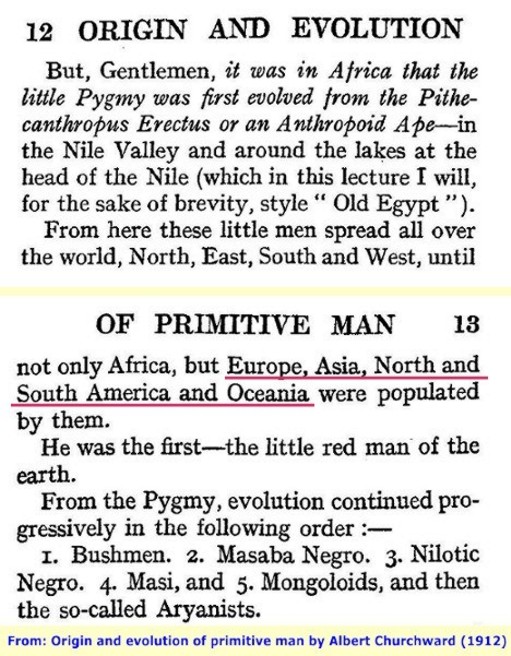
Well No, though it may be comforting to believe that your Teachers and Professors are of sufficient character that they would not lie to you, the facts do not support that conclusion. The fact is that European scientists had evidence, and knew from earlier that the 19th century, of the Black mans central role in settling and establishing civilization in Europe and everywhere else. The exhibits below attest to the fact that this knowledge was known over a hundred years ago. So either your Teachers and Professors are indeed liars, or they were very poorly educated.
 |
PREHISTORIC MAN AND HIS STORY.By Professor G. F. SCOTT ELLIOT, M.A., B.Sc., F.L.S., F.R.G.S. With Seventy Illustrations and Diagrams. Demy 8vo. 7/6 net. THE NEGROID OF GRIMALDI The Aurignacians found the Moustierian or Neander-thaler in France, and during all the changes sketched above, the former seem to have held their own in that country. After the Wurm Ice Age the Aurignacians modified their weapons and mode of life, and, after the theory which we have adopted, became the men of La Madeleine. These Aurignacians and their Magdalenian descendants pervaded all Central and Southern Europe.
Their remains have also been discovered in Valetta (Malta), in
Phoenicia (Nahr Antelias), and elsewhere, as we shall try to show
later. But during this long period of time two other races also
succeeded in entering France and Italy. These were a “ negroid,”
perhaps pygmy, folk and the men of Solutrean. We have seen that the Aurignacian was originally an African, and if he traversed North Africa on his way from Egypt and Mesopotamia, it would have been a very remarkable fact if he had not come in contact with the African pygmy or his ancestors, for the Bushman, Wam-battu, and the other pygmies are the oldest African race known to us. The “ negroids ” discovered by Dr. Verneau in the Grotte du Grimaldi, though differing greatly from modern Bushmen, show that the Aurignacians were acquainted with a negroid stock, which may perhaps be assumed to be an ancestor of, or allied to, the pygmy. It is difficult to say exactly what was the relation between the Aurignacian and this “ negroid ” race. Moreover, since the discovery of this burial, characteristic
skulls of the same negroid affinity have been found in Spain, in
Brittany (of Neolithic date), at Sierra (not earlier than the
thirteenth century), in Sardinia, at Ostorf, and perhaps in Caithness. |
 |
 |
 |
 |
 |
 |
 |
 |
 |
 |
 |
 |
 |
 |
 |
 |
Neolithic = 10,200 B.C. to 4,500 B.C.
|
 |
 |
 |
At this time we do not know what the Invading Turks and Slavsdid to the Black people of Eastern Europe: after the destruction of theBlack Eastern Roman Empire (Byzantium) in 1453. |
 |
Note: we do understand that the average person - after a lifetime of the Albino lie that they (Albinos) are native to the Black Mans Ancient Home of Europe - finds this material hard to believe. So, under the heading of: "Strange Bedfellows" We have this quote from the "Race Experts" at "STORMFRONT:"Quote: Today's Central Asians are extensively mixed-race with both White and East Asian blood and the White element is older since the Whites were there first and are the indigenous people of Central Asia. |
 |
 |
 |
 |
Update 2014:Eureka! The Albinos have finally admitted where they come from!
As you ponder what this admission means, you might also consider what nonsense like this means: If you Google "Where do White people come From" the second result that you will get is this Livescience article; (the first result is Stormfront - go ahead and read it for a laugh). Why Did People Become White? QUOTE: Vitamin D plays an important role in bone growth and the body's natural protection against certain diseases, and the inability to absorb enough in areas of less-powerful sunlight would have decreased life expectancies in our African ancestors. The further north they trekked, the more vitamin D they needed and the lighter they got over the generations, due to natural selection. Also: While people of all skin types have the ability to produce the same amount of vitamin D in their systems, “highly pigmented (Black) people will need to stay in the sun around 6 times longer than light people in order to synthesize the same amount of vitamin D,” Juzeniene said, and a lack of the vitamin — something occurring among many American children right now, partly because they don't get out much — can make humans more susceptible to everything from heart disease to internal cancers. That is of course "Pure" lie: In the last century, cases of Rickets (often caused by lack of Vitamin D) was epidemic in Europe and North America. So much so, that they had to start adding Vitamin D in the manufacture of their Milk, Cereals, Cheeses, and such. This was NOT done for Blacks - who don't need it, it was done for Albino people, who desperately needed it. THE REASON FOR SUCH RIDICULOUS STATEMENTS AND LIES IS THIS: If Africans went into Europe circa 45,000 B.C. and STAYED Black. Then modern Europeans MUST have ALWAYS been WHITE! See: the section "Indus Valley-2" and other pages for the history of Europeans. |
HOWEVER! Just as one group of Albino people had decided to admit that they came from Central Asia, and had ALWAYS been White, and thus derived from Dravidian Albinos. Other groups were pressing ahead with new lies to buttress European claims of being Black Africans who turned White because of Vitamin D deficiency. But these new claims have a twist, one would suppose to keep up with the times.
The "Supposed" New research is reported by YahooNews.com from LiveScience. Link to the on-line Newsstory
And the Daily Mail U.K. online. Link to the on-line Newsstory
Nature - International weekly Journal of science (no comment) also carried the story. Link to on-line Newsstory
The LiveScience Headline says: 7,000-Year-Old Human Bones Suggest New Date for Light-Skin Gene
And the Daily Mail U.K. Headline says: Light skin in Europeans stems from ONE 10,000-year-old ancestor who lived between India and the Middle East, claims study
The reason for these nonsensical proclamations is THIS, as summed up by LiveScience:
 |
 |
This drawing depicting a "Dark White Man" is of course the typical Albino falsification of history and science. The fact is that YOU CAN NOT do a Forensic Facial Reconstruction by "DRAWING" it! Making a facial reconstruction can "ONLY" be done by a doctor of physical and forensic anthropology with extensive training in anatomy (both medical and artistic). These facial reproductions draw on the science behind the morphology (shape) of the face as well as a knowledge of materials. Reconstructions start with a SKULL (or mold) and includes laboriously using "shaped" clay to fill-in for Muscles and tissue (including skin) on the skull until it is complete. Only after this process is complete, can you see what the individual might have looked like.
 |
. Hunter-gatherers, some of them blue-eyed, who came from Africa more than 40,000 years ago
They would have looked like THIS:
. Middle Eastern farmers who migrated west much more recently
They would have looked like THIS:
. A mysterious population whose range may have spanned northern Europe and Siberia
We have no idea who that could be, unless they are talking about "Modern" Europeans AFTER they had migrated from Central Asia.
The La Brana skeleton's haplogroup was reported as Mtdna U5: (the same as 12,700 year old Cheddar Man in England, and some in the 3,000 year old Lichtenstein Cave in Lower Saxony, Germany).
 |
 |
The Albinos always lie, Just as the Albinos were lying BEFORE with their first mock-up of Cheddar Man man which showed him as an Albino, they are lying again with their assertion that Cheddar Man had "Straight Hair and Blue Eyes": these two attributes were falsely added to indicate some commonality with European Albinos. Note the list of Genes below which the scientists looked at. None of them are indicators of STRAIGHT HAIR OR BLUE EYES! Though Blue eyes and Blonde hair are COMMON with (OCA2 - Oculocutaneous albinism type 2), Cheddar man is negative for them. Btw - ALL of the genes they looked at were "Oculocutaneous Albinism" genes. That is how scientists know whether or not a Skeleton is Black or White: Simply put, if they are NOT Albino: {i.e. they do not have those Albino mutations}, then they are Black (White people are merely the Albinos of Black people). Note also the lying nonsense about Vitamin D, and People in the Arctic being Pale. Those lies are debunked below. |
Dienekes reports the Y-haplogroup as Y-dna C6. That however is not confirmed, but if true, it relates La Brana in Spain to Australian aborigines, the Lani and Dani people of Western New Guinea (100% & 92%), as well as many other Pacific Islanders and Asians.
NOTABLE QUOTE FROM THE STUDY:
Pigmentation genes in the Mesolithic genome. The SNPs around the two diagnostic variants (red arrows) in these two genes were analysed. The resulting haplotype comprises neighbouring SNPs that are also absent in modern Europeans (CEU) (n5=112) but present in Yorubans (YRI) (n5=113). This pattern confirms that the La Brana 1 sample is older than the positive-selection event in these regions.
[The Yoruba people are an ethnic group of southwestern Nigeria and southern Benin in West Africa].
 |
 |
 |
 |
 |
Egyptians, Sumerians, Mohenjo-daroans, Harappans, and Cretans, Elamites, and Nubians, were literate 3,000 years, 4,000 years, who knows how many thousands of years, before the world ever heard of Greeks or Romans. And there is ample evidence of their literacy.Yet there is not one single entry: describing any of the people of their times, whether it be friends, foes, or invaders: or even more incredulously, there is not one single entry describing invading Whites in any of their literature.Contrast that with Greek and Roman writings, in which these NEWLY literate people, after suffering through the "Dark ages" caused by the Albinos invasion, describe EVERYTHING and EVERYONE - except themselves!These discrepancies are of course, not accidental, nor for lack of material. Hopefully, the White man has simply withheld this material, and not destroyed it.
On a related matter:We the lied-to and oppressed, often comfort ourselves by believing that things are getting better, and perhaps in some ways that is so. But in regards to the Albinos trying to steal Black history, well, in that regard things are definitely getting worst! It comes as a shock to some, that the current, and very false assertion by the Albinos that they are native to Europe, is NEW! Surprisingly, Albino scholars of only a hundred years ago, freely admitted that Albinos MOVED into Europe, and were NOT native to those lands. While they were in error on other things, some even correctly identified the Albino homeland as Central Asia. Please note this example: The North American ReviewThe North American Review (NAR) was the first literary magazine in the United States. Founded in Boston in 1815 by journalist Nathan Hale and others, it was published continuously until 1940.
Please note this entry from:The North American Review Volume 0139 Issue 334 (Sept 1884)
MORE!
ANCIENT TYPES OF MAN
The Uganda Protectorate (1902) by Harry Johnston. CHAPTER XIV Remains which have been found in Sicily, in Sardinia, and the Pyrenees (France), including a curious little statuette fashioned by men of the Stone Age discovered in the last-named locality, hint at the possibility of men of this Pygmy Negro type having spread over part of Europe: it has been even hinted by more than one anthropologist of authority that a Dwarf negroid race may have, at one time, existed in Northern Europe, and by an exaggeration in legend and story of their peculiar habits—habits strangely recalling the characteristics of the little Dwarf people of the Congo of the present day—have given rise to the stories of kobolds, elves, sprites, gnomes, and fairies.
MAN'S PLACE IN NATURE AND OTHER ANTHROPOLOGICAL ESSAYS
In order to neglect no point respecting the form of this fossil skull, we may observe that, from the first, the elongated and narrow form of the forehead attracted our attention. In fact, the slight elevation of the frontal, its narrowness, and the form of the orbit, approximate it more nearly to the cranium of an Ethiopian than to that of a European.
CIVILIZATION OR BARBARISM: AN AUTHENTIC ANTHROPOLOGY The
Grimaldi Negroids have left their numerous traces all over Europe and
Asia, from the Iberian Peninsula to Lake Baykal in Siberia, passing
through France, Austria, the Crimea, and the Basin of Don, etc. In
these last two regions, the late Soviet Professor Mikhail Gerasimov, a
scholar of rare objectivity, identified the Negroid type from skulls
found in the Middle Mousterian period. |
 |
 |
A subsequent DNA study by David Reich & Svante Pääbo titled: "An early modern human from Romania with a recent Neanderthal ancestor:" Terms the specimen "Oase-1" and re-dates it to 37,000–42,000-years-old. Oase-1 belongs to the Y-dna haplogroup F, which is carried by most males in Eurasia today. The Mtdna = N. Study quote: We then find that the Oase 1 individual shares equally as many alleles with early Europeans, as with present-day East Asians and Native Americans. |
Etruria is probably the best example: aside from Britain; (Click here for British History) of the White Mans attempts at creating a false history for himself, and in that process, obliterating actual history. In its traditional foundation myth, Romulus and Remus are Rome's twin founders . They are descendants of the Trojan prince and refugee Aeneas, and are fathered by the god Mars or the demi-god Hercules on a royal Vestal Virgin, Rhea Silvia (also known as Ilia), whose uncle exposes them to die in the wild. They are found by a she-wolf who suckles and cares for them. The twins are eventually restored to their regal birthright, acquire many followers and decide to found a new city - Rome. The Romans are also known as Latin's: But the Latin's (or Latini, as they called themselves) were an "Original" people of ancient Italy. Quite different from the White invaders from Central Asia.
The most common hypothesis is that the Italic peoples migrated into the Italian peninsula from Central Asia, sometime during the Italian Bronze Age (ca. 1800-900 BC). The most likely route for the "so-called" Italic migration was from the Balkan peninsula along the Adriatic coast. But it is already accepted that the original Europeans were Black people (and no, they did not turn into White people because of vitamin D deficiency), Note People like the "Iceman" below, whose mitochondrial DNA belongs to the K1 subcluster of the mitochondrial haplogroup K, which appears abundantly in ancient North Africa. Also, the Latin's already existed in Italy BEFORE the White people we erroneously call Romans arrived - thus the people we call Romans could not have been italics either!
 |
 |
 |
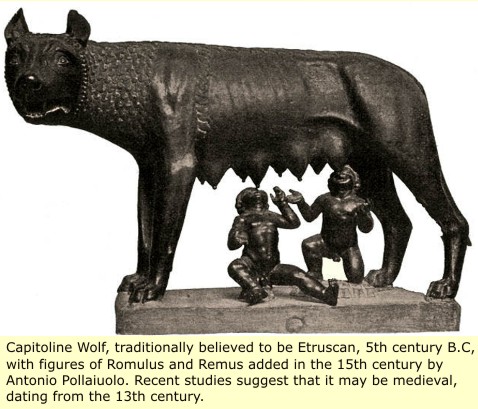
Logically then: if the people who were originally called Romans, are descendants of Black Anatolians (Troy), and if the other name that we know them by (Latin's) are a "Native" Black Italian people: then just WHO were the White people from Central Asia who usurped these names, and what name did they go by? In the process of creating their "False" history, Whites, as usual, destroyed the writings of the ancients (the last being the Etrusca Disciplina, the Etruscan books of cult and divination, which were collected and burned in the 5th century), and created "False" artifacts to backup their false historical claims (note Capitoline Wolf below). The stupid irony in all of this, is that not only have Whites wiped out the true history of the original Italians, they also wiped out their own history.
 |
As is always the case with Europeanized history, there has always been an attempt by European Academics and researchers to establish a genetic link between modern White Europeans and Europe’s Original Black inhabitants. To that end, there has been no lack of Bogus and mis-attributed Artifacts, along with the requisite bogus history. But today, a new breed of researchers have taken the stage; a group less insecure and more honest - but still not completely honest: Though they present the data, they still present it in a confusing and obfuscating way, and they still can't seem to bring themselves to actually say it, i.e. The first Europeans were Black People and we are Albinos from Central Asia! Note the studies below: there must be some type of Phobia, peculiar only to White people.
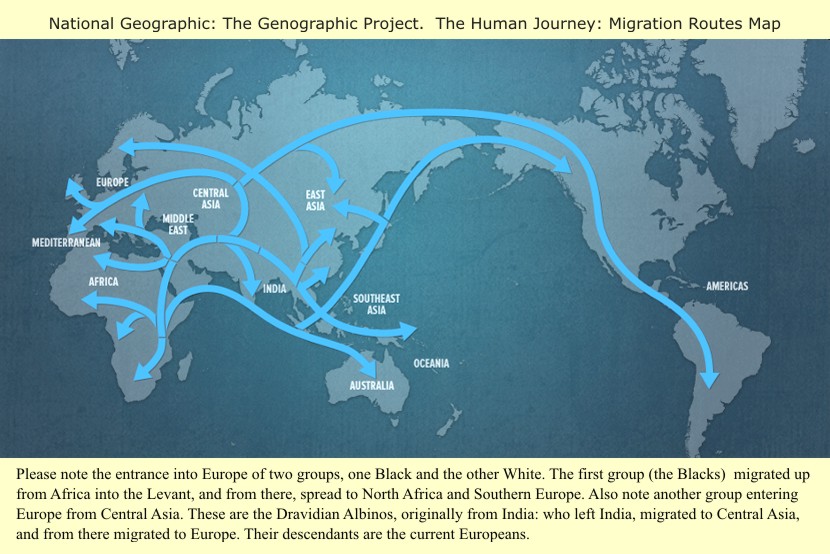
As we know, there are three direct ways of entering Europe from Africa:
(1) Cross the Strait of Gibraltar and Enter in Spain, or Cross in Anatolia/Turkey (2) at the Bosphorus (now known as the Istanbul Strait) or (3) the Dardanelle's (formerly known as Hellespont).
We know that modern Africans (The Khoisan like Grimaldi)
first entered Europe by way of the Strait of Gibraltar (circa 45,000
ya), because the oldest skeletons are found in nearby France/Monaco.
At about 7,500 ya, African FARMERS moved into Europe by way
of Anatolia. These "NEW" Africans mixed with the Grimaldi Africans who
were already there. Out of this mixture was born the modern Black
European. For centuries, since they first "Usurped" rule in Europe, the
Albinos have tried to convince the world that they are "Original"
Europeans. It's a lie, and even their own scientists prove it.
 |
 |
Various tests show that the Tuscans (see next study below) are the Etruscans’ closest neighbors in terms of genetic distances. Despite that broad similarity, however, Etruscans and Tuscans share only two haplotypes. This finding is difficult to interpret in the absence of data on any other European population of the pre-classical period. One possible interpretation is that all or most European populations of that time period were as different from their modern counterparts as the Etruscans appear to be. This would imply either extensive gene flow or a high rate of extinction of mitochondrial haplotypes, both processes causing a drastic change of the mitochondrial pool in the last 2,500 years. More importantly, a result of that kind would force us to reconsider the universally held assumption that patterns in the DNA of modern individuals reflect the evolutionary processes affecting their prehistoric ancestors. Alternatively, should other ancient populations prove similar to comparable modern ones, one should conclude that the Etruscans’ mitochondrial sequences underwent extinction at a particularly high rate and look for an explanation for that. Until more ancient DNA data become available, both scenarios will remain possible, although we favor the latter.
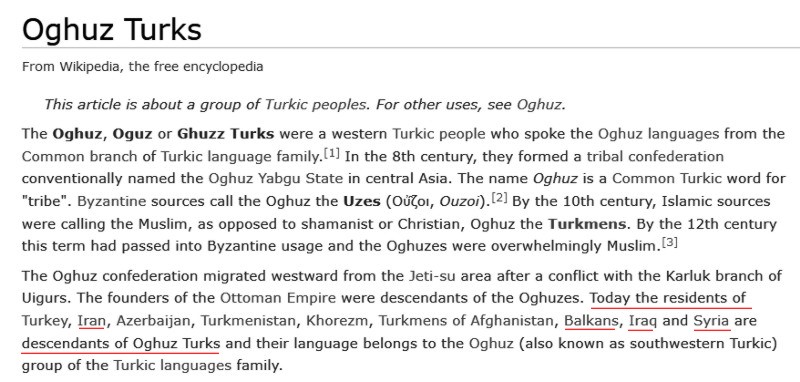
Etruscans show closer relationships both to North Africans and to Turks than any contemporary population. In particular, the Turkish component in their gene pool appears three times as large as in the other populations. (Note: The Turks are an Albino people from Asia - now heavily admixed with the indigenous Black people of Anatolia - who first entered the west in the 6th. century A.D, and later conquered Anatolia, then called the Byzantine or Eastern Roman Empire in 1453. Obviously what these liars are seeing is the genes of the original Black Anatolians - NOT the Turks!
Albino scientists can't help but lie: because the alternative is to admit that they are Albinos, and invaders of Europe. So the say obfuscating things like this, see above: "Various tests show that the Tuscan's are the Etruscans’ closest neighbors in terms of genetic distances". The problem for them, is that they have no way to cross reference other studies to see if the author is furthering the Albino lies, or trying to tell the truth. In this case, there is another study debunking that lie.
Other DNA Results:
Paglicci site Southern Italy
(Paglicci 23), dated 28,000 years BP Mtdna haplogroup H.
(Paglicci-12), dated 24,000 years BP Mtdna haplogroup N*
(Paglicci 25), dated 23,000 years BP Mtdna haplogroup HV.
Ötzi the Iceman, northern Italy 5,300 years BP Mtdna haplogroup K, Y-dna G2a2b.
King Tutankhamun of Egypt, Y-dna haplogroup R1b1a2.
King Ramesses III of Egypt, 3,200 BP Y-dna haplogroup E1b1a.
Grimaldi at Mal’ta Siberia, dated 24,000 BP Mtdna haplogroup U, Y-dna R.
Kostenki Russia, dated 34,000 BP Mtdna haplogroup U2.
News story from the Science Daily — For the first time, Stanford university researchers have used statistical computer modeling to simulate demographic processes affecting the population of the Tuscany region of Italy over a 2,500-year time span. Rigorous tests used by the researchers have ruled out a genetic link between Ancient Etruscans, the original inhabitants of central Italy, and the region's modern day residents.
The findings indicate (as is obvious from the pictured artifacts), that the Ancient Etruscans had little in common with the people who later came to Italy, said Joanna Mountain, assistant professor of anthropological sciences. The findings as documented in ''Serial Coalescent Simulations” indicate a Weak Genealogical Relationship Between Etruscans and Modern Tuscans. The study was published May 15, 2006 in the online version of the National Academy of Sciences. Uma Ramakrishnan, a former Stanford postdoctoral fellow, and Elise M. S. Belle along with Guido Barbujani of the University of Ferrara in Italy, co-authored the paper with Mountain.
To date; the Etruscans are the only pre-classical European
population that has been genetically analyzed, Mountain said. Two years
ago, Italian geneticists extracted maternally inherited mitochondrial
DNA from the bones of 27 people called Etruscans found in six different
necropolises (burial sites) in Tuscany. The female lineage was
investigated because, unlike the male Y chromosome, many copies of
mitochondrial DNA are found in each cell and thus are easier to
extract, Mountain explained. The finding is important because it
questions the common assumption that residents of a particular place
are descendants of its earlier inhabitants, Mountain said.
Note: This story has been adapted from a news release issued by Stanford University.
 |
Click here for a link to the study (pdf).
They are Albinos, many now admixed with the indigenous Black Europeans they found in Europe: and who they eventually conquered and exterminated: or shipped to the Americas. They originally left Africa with, and as the Albinos, of the Black Dravidians now in India. Physically the only difference between a Black Indian, and a European, is that the European has no, or little, "Melanin" in their skin. Simply looking at a Dravidian, and a Dravidian Albino, bears this out.
 |
The Bhatti tribe of Pakistan still produces Albinos identical to the original Germanics (see their descriptions in the writings of the Roman historian Tacitus). (Note: Pakistan was originally part of India).
 |
The National Geographic "Genographic Project" is an ambitious attempt to answer fundamental questions about where we originated and how we came to populate the Earth. The Genographic Project is a multiyear research initiative led by National Geographic Explorer-in-Residence Dr. Spencer Wells. Dr. Wells and a team of renowned international scientists are using cutting-edge genetic and computational technologies to analyze historical patterns in DNA from participants around the world to better understand our human genetic roots.
 |
 |
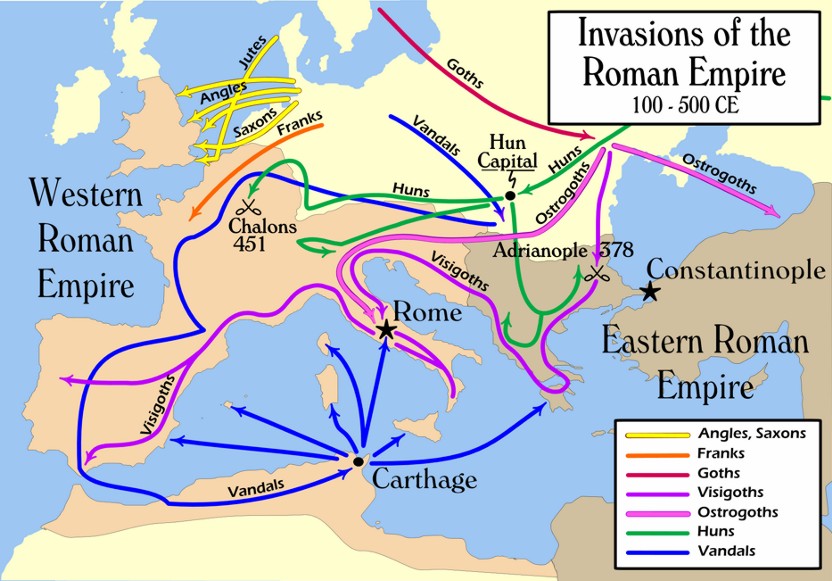
Note: The "Migration Period" referenced, reflects only the movements of "MODERN ALBINO EUROPEANS": it does NOT reflect the incursions of the first Albinos from Central Asian (circa 1,200 B.C.) who became a part of the Black Greek and Roman civilizations.
Also note: the above Wiki article is not intended as a citation, it is merely to demonstrate that even some Albinos academics acknowledge that their people are NOT native to Europe "Proper". However, in true lying Albino fashion, the Wiki article goes on to say:
 |
To put the above paragraph into lucid though, let us paraphrase:
"God laid down the Albinos in Scandinavia and said "Go forth and Multiply".
No word on how they got to Scandinavia, or where they came from, so obviously God just dropped them there!
This is totally in keeping with the various Albino founding myths:
First they were the original Europeans.
Then they were the original Black Europeans, but they turned White because they weren't getting enough vitamin "D".
When we said, that's nonsense, you're Albinos: they said
that they're NOT Albinos because Albinos have "BAD EYESIGHT" and they
don't. (They never explain why the Africans with "GOOD EYESIGHT" are
still Albinos, but they aren't. (Shouldn't we call those many African
Albinos who overwhelmingly have good eyesight "Europeans" or some such
thing)?
 |
And now they say that White Europeans: what, grew out of a "Cabbage patch" in Scandinavia, and from there conquered the world?
| Haplogroup R (Y-DNA) In human genetics, Haplogroup R is a Y-chromosome DNA haplogroup, a subgroup of haplogroup P, defined by the M207 mutation. This haplogroup is believed to have arisen around 26,800 years ago, somewhere in Central Asia or South Asia, where its ancestor Haplogroup P is most often found at polymorphic frequencies. Cambridge University geneticist Kivisild et al. (2003) suggests that southern and western Asia might be the source of this haplogroup: Given the geographic spread and STR diversities of sister clades R1 and R2, the latter of which is restricted to India, Pakistan, Iran, and southern central Asia, it is possible that southern and western Asia were the source for R1 and R1a differentiation. The R haplogroup is common throughout Europe and western Asia and the Indian sub-continent, and in those whose ancestry is from within these regions. It also occurs in North and Sub-Saharan Africa. |
 |
Summarizing the above:
The
preceding were scientific lies created by Albinos, and scientific
truths uncovered to refute them, in the never-ending Albino efforts to
hide their true origins and diseased condition (Albinism). As regarding
modern skin color: the simple fact is that as the Central Asian Albinos
came into Europe, some Black men were having sex with the females, (no
doubt why some Albino men seem to have a natural resentment towards
Black men). The results of those copulations were Mulatto offspring:
but the color of subsequent offspring changed with the color of the
participants as follows: First Generation: Assuming continued mating with ONLY Albinos. Second Generation: Third Generation: Fourth Generation: With each generation the original mulatto becomes lighter and lighter. But generally speaking, Quadroons are indistinguishable from everyday MODERN Albinos, because modern Albinos are in fact HIGHLY admixed already. (Remembering Tacitus's description of the Germanics being "Blue-eyed Redheads"), there is not that many of them left.
Note that only European Albinos do that! |
On the Island of Malta, the Ghar Dalam culture is the earliest known phase of Malta culture. At the Cave Ghar Dalam the earliest evidence of human settlement on Malta, some 7,400 years ago was found. Because of debris left by these ancient Humans, this cave is also a veritable depository of semi-fossilized remains and extinct species such as dwarf elephants and hippopotami which roamed the island some 250,000 years ago, ostensibly when it was still part of the mainland.


It is suggested that a rise in sea level stranded these large mammals on the island and that the lack of food caused the dwarf versions to evolve. This theory is however challenged by the existence of Pygmy Hippopotamus native to the forests and swamps of western Africa – particularly in the country of Liberia.
 |
During the neolithic Age from 5,000 to 4,500 B.C, the cave was also one of the sites used by a new wave of man who crossed to the Maltese islands from Sicily via a land bridge. By 3,600-3,000 B.C, Temples began to be constructed, simply at first, but then increasingly more sophisticated. So that by 3,000 B.C, construction had become very sophisticated: such as the immense stone blocks and the intricate facades of Hagar Qim.


During the Temple building phase, Egyptian influence on the Maltese is evident in the manner in which they built their tombs and temples and buried their dead. (However, the nature of their statuary, particularly their “Mother Goddesses” which are depicted as Steatopygia females, indicates ethnic commonality with the peoples of the Cyclades islands in the Aegean Sea, and the civilization at Catal Huyuk in Anatolia (Turkey). These civilizations trace their begins to the ancient Khoisan of Southern Africa (Grimaldi man); who were the first “Fully Modern Humans” to cross over to Europe in about 45,000 B.C). Click here for more on Grimaldi Man >>>
This phase of Malta culture came to a sudden end at about
2,000 B.C, possibly as a result of invasions. The culture that replaced
it, of Mycenaean flavor, is evidenced today only by fragmentary
remains; Bronze Age tools and weapons have been found at Borg in-Nadur
(near Birzebbuga) and Tarxien Cemetery (near Paola), while Iron Age
relics from about 1,200 to 800 B.C, include cart ruts at Bingemma (near
Nadur Tower).
 |
At around 700 B.C, the White Greeks settled on Malta, especially around the area where Valletta now stands. A century later; Phoenician traders, who used the islands as a stop on their trade routes from the eastern Mediterranean to Great Britain, (from where they obtained Tin, which when smelted with copper (from Cyprus) created the durable metal alloy bronze; Strabo states that there was a highly lucrative Phoenician trade with Britain for tin). They also joined the natives on the island. The Phoenicians inhabited the area now known as Mdina, and its surrounding town of Rabat, which they called Maleth. The later arriving Romans, who also lived in Mdina, referred to it (and the island) as Melita.


Cyrus the Great conquered Phoenicia in 539 B.C. After the fall of Phoenicia proper; the area came under the control of the Phoenician colony in North Africa called Carthage, (which was founded in 814 B.C, under Pygmalion, King of Tyre), it's remains are a suburb of Tunis in present-day Tunisia. During this time, the people on Malta mainly cultivated olives and carobs, and produced textiles.
During the First Punic War (wars with Rome) of 218 B.C, tensions led the Maltese people to rebel against Carthage and turn control of their garrison over to the Roman Republic consul Sempronius. Malta remained loyal to Rome during the Second Punic War and the Romans rewarded it with the title Foederata Civitas, a designation that meant it was exempt from paying tribute or the rule of Roman law, although at this time it fell within the jurisdiction of Sicilia province. Finally, in 146 B.C, after a third war with Rome, Carthage suffered total destruction. It was rebuilt as a Roman colony in 44 B.C. The ancient Phoenician language survived in use as a vernacular in some of the smaller cities of North Africa at least until the time of St. Augustine, bishop of Hippo (5th century A.D). Click here for the story of Hannibal >>>
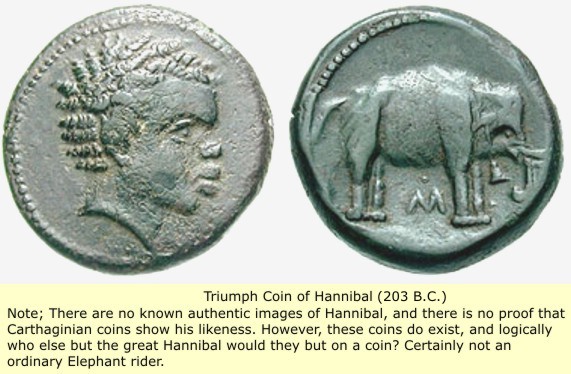 |
Around 100 A.D, the Maltese Islands were a thriving part of the Roman Empire, being promoted to the status of Municipium under Hadrian. The Bible in the Acts of the Apostles, relates that during 60 A.D, Jesus Christ's apostle Saint Paul, was shipwrecked on the northern shore of the island at Saint Paul's Bay, being received by the person who would be known to posterity as Saint Publius, and stayed in Malta for three months, introducing Christianity and performing various miracles.
When the Roman Empire split into Eastern and Western divisions in the 4th century, Malta fell under the control of the Greek speaking Byzantine Empire from 395 to 870 A.D, which ruled from Constantinople. Although Malta was under Byzantine rule for four centuries, not much is known from this period. There is evidence that Germanic tribes, including the Goths and Vandals, briefly took control of the islands before the Byzantines launched a counter attack and retook Malta.
Euphemius was a Byzantine admiral, Probably born in Messina Sicily, and may have been non-White; at about 826 A.D, he proclaimed himself emperor in Syracuse, and the whole territory of the islands. He was subsequently defeated by Byzantine troops and escaped to Ifriqiya (North Africa), where he asked for help from the Arabs to take Sicily and Malta from the Byzantines. In 827 A.D, he returned to Sicily with a large Arab fleet. Euphemius was killed later that year during an attack on Enna, but the Arabs were successful in taking the Islands.
The Arabs introduced new irrigation methods, new fruits and
cotton, and the Siculo-Arabic language was adopted on the islands, and
from Sicily to Southern Italy: it would eventually evolve into the
Maltese language. The native Christians were allowed freedom of
religion, but had to pay an extra tax. The Normans from the Duchy of
Normandy successfully invaded Sicily and the Maltese Islands in 1091
A.D, and "Roger I" was warmly welcomed by the native Christians. The
Maltese offered to fight for him and in response Roger reportedly tore
off a portion of his flag, half-red half-white, presenting it to the
Maltese; this formed the basis of the flag of Malta.
The Catholic Church was re-instated as the state religion, with Malta under the See of Palermo. Norman architecture sprung up around Malta, especially in its ancient capital Mdina. Tancred of Sicily, the last Norman monarch, made Malta and Gozo a feudal lordship or fief within the kingdom, and a Count of Malta was instituted. The kingdom passed on to the House of Hohenstaufen from 1194 until 1266 A.D, and Malta was part of the Holy Roman Empire of the German Nation for 72 years. It was under Holy Roman Emperor Frederick II of Hohenstaufen (1194 – 1250 A.D.), that all remaining Muslims were expelled from Malta (in 1224 A.D.) and the entire Christian male population of Celano in Abruzzo, was exported to Malta to replace them - Thus Malta became a purely White Island.
 |
Etruscans were members of the ancient civilization of Etruria, a country in what is now Italy. Their urban civilization is though to have started well before 800 B.C. But it's true beginnings cannot be ascertained, because their literature, especially the Etrusca Disciplina, the Etruscan books of cult and divination, were collected and burned in the 5th century A.D. by White Christian elements. Some say the Etruscans were originally pelasgians (the original people of Greece), some say that they were Phrygian migrants from Anatolia. But both of those theories seem to miss the fact that the entire area was inhabited by Black people, since about 45,000 B.C, when Grimaldi man first entered Europe. Therefore there is absolutely no reason why the Etruscans could not have evolved In situ.
All that remains of Etruscan writings are inscriptions like this. |
 |
If past behavior is any guide, the ridiculous dating of Etruscan civilization to 800-900 B.C, by White people, is in response to the Etruscans being scientifically proven to be Black people. That very late dating, would serve to make it seem that they were not truly "Ancient". The Etruscans called themselves "Rasenna" which was syncopated to Rasna or Raśna. Those that joined the "Sea People" exodus were known as the Tyrrhenians.
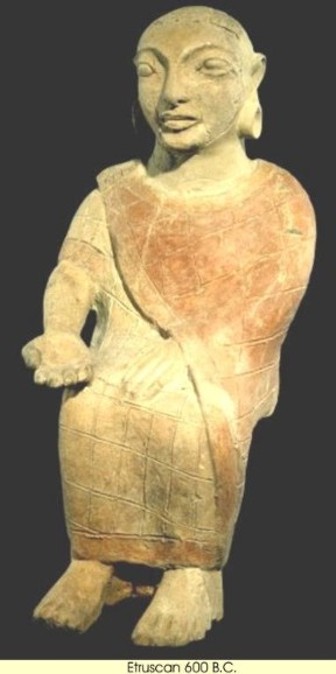
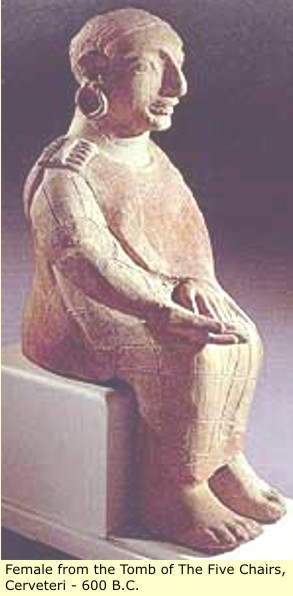
The Etruscan pendant (below), which has several Swastika symbols (an ancient sign for good luck), connects Etruscans with ancient Nubia (Sudan) on whose pottery it is first found: and also the Indus valley civilization, as well as the Mesopotamian civilizations. The design of their chariots is similar to Egyptian Chariots - one rider, two horses.
 |
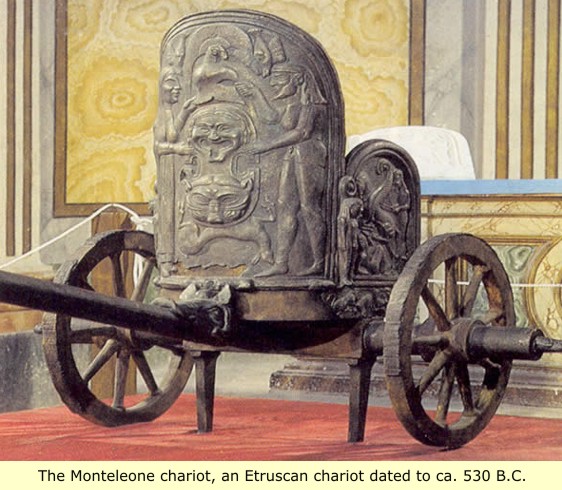 |
 |

The Etruscan cities were large, and in all ways comparable to cities of the other great ancient civilizations. Etruscan state government, like others of those times, was a theocracy (the king was deified, and considered a god). Their religion employed elaborate cults and rituals.
Very little is known about their social and civic structure, except that their city-states weren't particularly unified. The heads of Etruscan cities, apparently at times, met to discuss military and political affairs. But apart from this, the Etruscans could be considered, as many ancient sources describe them, “duodecim populi Eturiae” or “the twelve peoples of Eturia”, (the twelve peoples, referring to the twelve major city-states).
 |
| ^Whites can't help lying. A fisherman dressed like that, what kind of a fisherman could afford such a fine statue? |
 |
 |
Although the divisions between the Etruscan states were not as extreme as those found in other areas; like Sumer, where they were constantly at war with each other. Still, these individual Etruscan states were strange in that they apparently felt no obligation to cooperate with each other, and provide aid to each other in times of need. Consequently they had no mechanism to unify, when faced with a common threat.
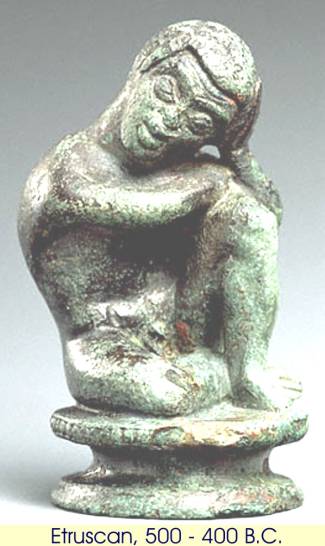

Their agriculture was advanced and efficient, and their trading and commercial relationships were far ranging and profitable. Mining and the commerce of metal, especially copper and iron, led to the enrichment of the Etruscans and to the expansion of their influence in the Italian peninsula and the western Mediterranean sea.
 |
 |
 |
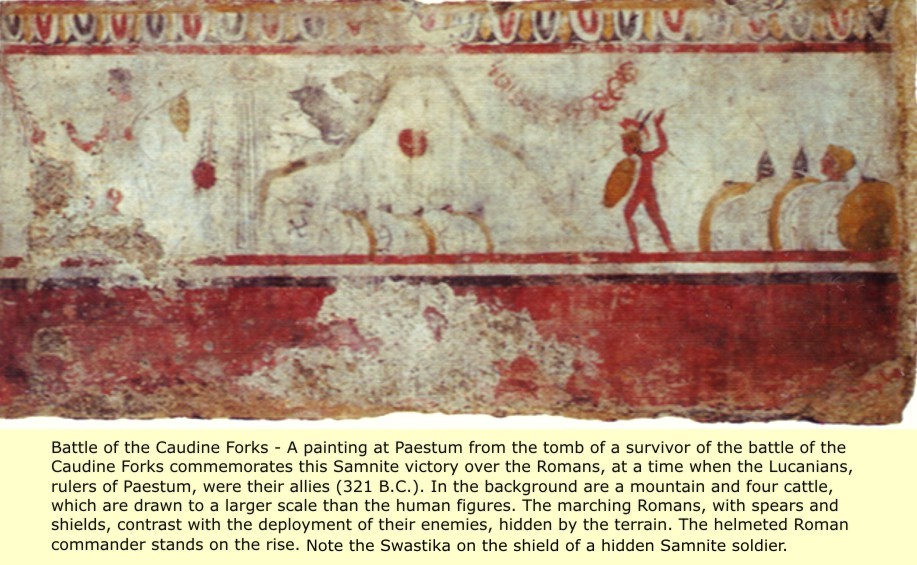
Around the end of the 7th century B.C, colonists from the Greek city of Sybaris founded the city of Paestum near Naples (and originally known as Poseidonia). Outside of archaeological evidence very little is known about Paestum during its first centuries. Archaeological evidence indicates that the city was expanding with the building of roads, temples and other features of a growing city. Paestum is also renowned for its painted tombs, mainly belonging to the period of the Lucanian rule, while only one of them dates to the Greek period. It was found, on 3 June 1968, in a small necropolis some 1,5 km south of the ancient walls. The burial monument was named Tomb of the Diver (Italian: Tomba del tuffatore) after the enigmatic scene, depicted on the covering slab, of a lonely young man diving into a stream of water.
Paestum tomb painting |
 |
 |
 |
 |
Those wishing to pursue an understanding of the Human Journey, and Specifics of the ancient East African migrations, which led to Modern Man's colonization of the entire world; please visit the National Geographic – Genographic Project – Atlas of the Human Journey. Though as one would expect, when it comes to European and Anatolian (Turkey) settlement, it is not only inaccurate, it is often Racist. But what would you expect? http://www.nationalgeographic.com/genographic/atlas.html
Please visit the "Additional Material Area" for many more photographs of each civilization, and related material <Click> |
| < Back | Home | Next > |