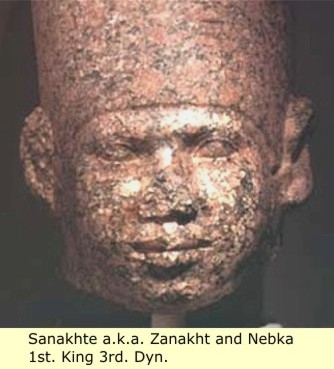
 Sanakhte
ncient Egypt |
Nubia |
Assyrian Empire |
Persian Empire |
Middle East |
Alexanders Empire |
Ottoman Empire |
In order to get "almost" all of the people introduced in an understandable way, we sometimes had to move ahead in time. We are now back in Egypt, to pickup their story we have to go back a few thousand years.
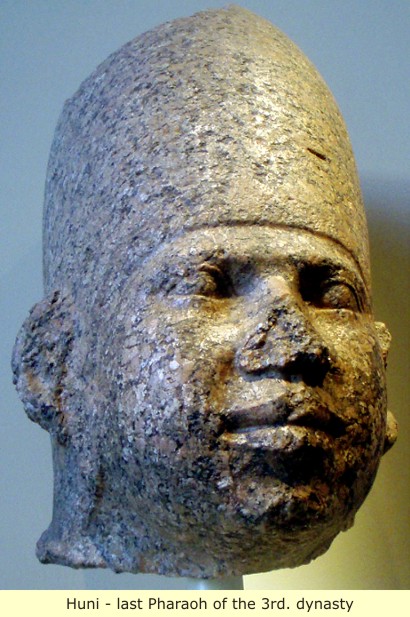
When last we left Egypt, King Narmer had just united upper and lower Egypt. We pickup from there.
SanakhteSo now, we are back in Egypt and by now Egypt has been moving right along, it has gone through two dynasties and many kings. Its religion has become more refined, its society even more organized, and much more affluent. We start with Sanakhte, uncertainty swirls around the placement, and also the events of the 3rd Dynasty king known as Sanakhte (Sanakht). He may have been Nebka, who was known to manetho, and listed on both the Turin Cannon and the Abydos king list as the first king of this dynasty. However, this is problematic to say the least, for we base our belief that he was Nebka on a source that lists his Horus name Sanakhte, together with a second name that ends with the element "ka".
Most of the information we have on this king refers to him as Nebka. In fact, some sources list the two as separate kings, with Nebka founding the 3rd Dynasty and Sanakhte ruling later, perhaps after Khaba However, despite this, mud seal impressions bearing the name of Nethery-khet Djoser from the Abydos tomb of the last king of the 2nd Dynasty Khasekhemuy and connected with the burial seem to suggest that Khasekhemuy's widow and her already ruling son Djoser were in charge of the king's burial. On the basis of sealing from the tomb of Khasekhemwy, which name her as "Mother of the King's Children," the wife of the last ruler of the 2nd Dynasty seems to have been one Nimaethap.
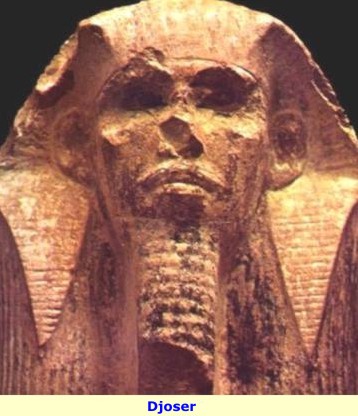
By now, the king of Egypt has the wealth and power to undertake monumental building projects. And so it is, that Netjerikhet Djoser (Zoser), the second King of Egypt's 3rd Dynasty, and his grand vizier and architect "Imhotep" set about to build the first Monumental stone structure ever created, the Step Pyramid.
 |
 |
 |
 |
 |
The quality of this photograph is poor, because it is a very old B&W photograph which had to be enlarged. |
 |
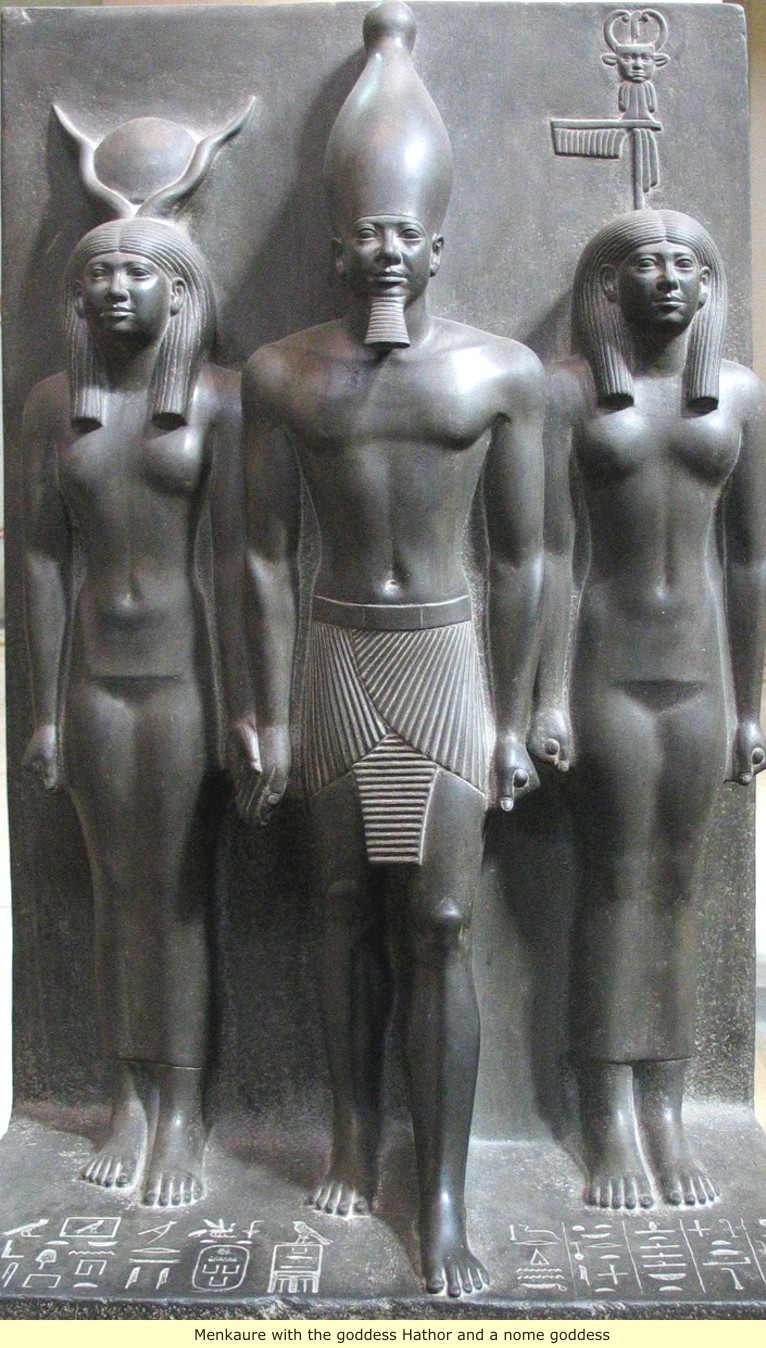
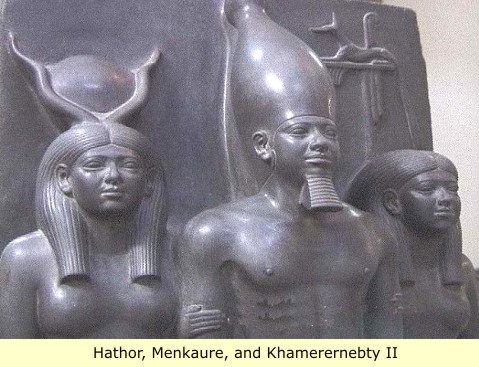
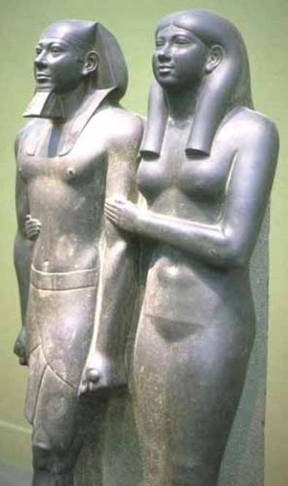
Here is a modern picture of the same stela, as it sits in the Cairo Museum. Funny thing though, now it is said to be Menkaure, 5th king of the fourth dynasty, and the Nose is different. What are we to make of this? Seems "Improvements" were made over the years, but is that legal? (Tongue firmly in Cheek). The Turks in Egypt are just full of surprises! |
 |
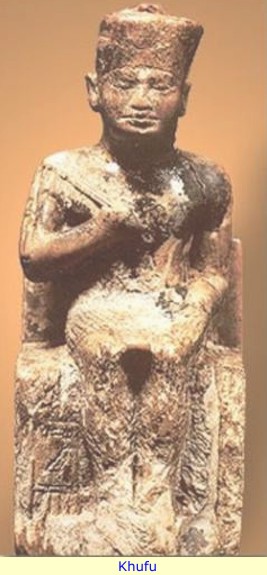
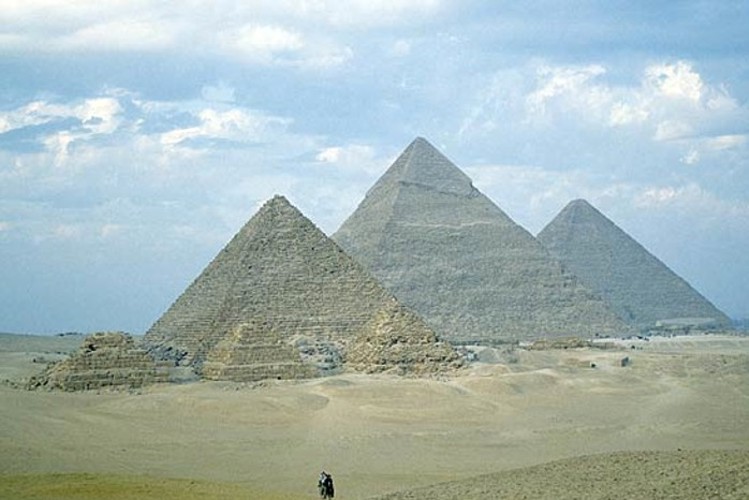
However, it will be Djosers grandson Khufu, 2nd king of the 4th dynasty, {no one is sure why the kingship of Sneferu, caused a new dynasty to begin}, who will became Egypt's best-known pyramid builder. For it is he, who will build the Great Pyramid at Giza.
 |
 |
Herodotus, (who wrote his histories and commentaries on Egypt around 450 B.C, centuries after Khufu had reigned around 2585 B.C.), recorded this about the King:
"Kheops brought the country into all kinds of misery. He closed the temples, forbade his subjects to offer sacrifices, and compelled them without exception to labor upon his works. The Egyptians can hardly bring themselves to mention Kheops so great is their hatred." It was even said that Khufu sent one of his daughters into a brothel so that she could raise revenue to build the pyramid, also asking each client for a block of stone so she could build her own pyramid. No evidence exists for such a story, though there are smaller pyramids, which probably belonged to the half-sister/wives of Khufu, and he did have at least three daughters of record.
It is also from his time that we know that Egyptians had ships capable of trans-continental travel, many of these ships {150 ft. in length}, were found buried in Khufu's tomb.
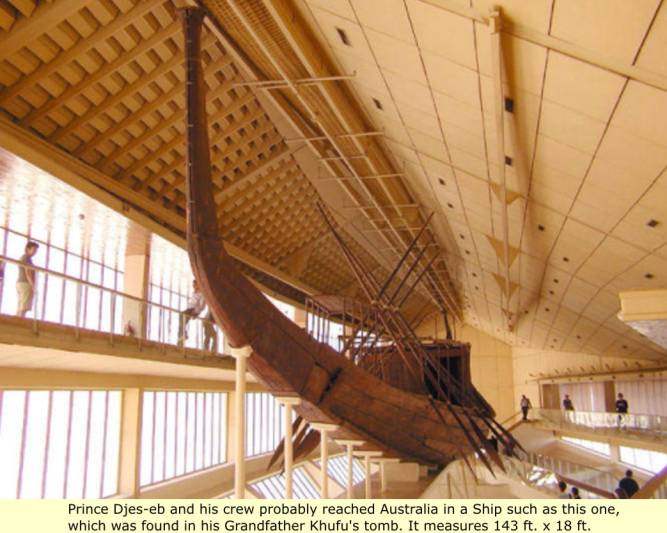 |
In Australia, there is a stella and writings chronicling the trials and travails of Khufu's grandson "Prince Gjes-eb", who had been shipwrecked in Australia. The chronicle tells of how the prince had been bitten by a poisonous snake and died, and that the rest of the crew was without hope. But, something really curious here, in the chronicle the writer says, "For two seasons he made his way westward, weary, but strong to the end". Where could they have been coming from, where after "two seasons", they had still only made it to as far west as Australia? Click here for the full text of the Egyptian Ship-wreak in Australia. <<Click>>
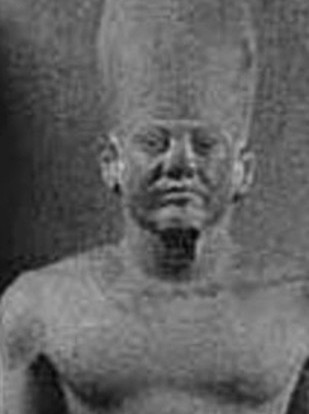
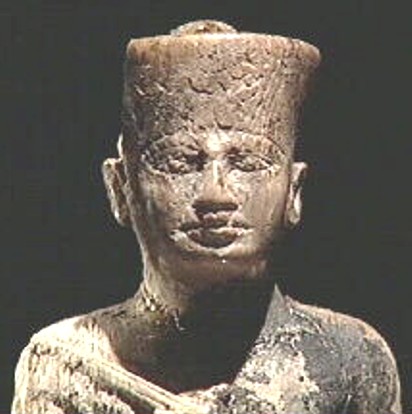
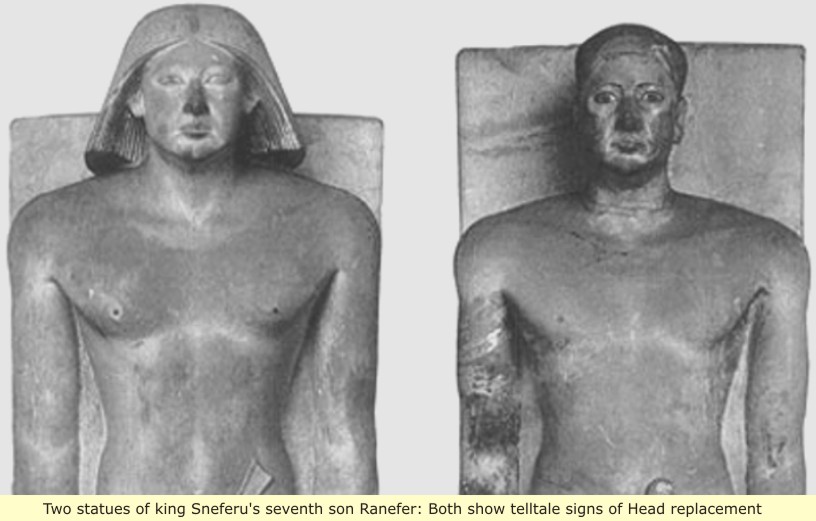
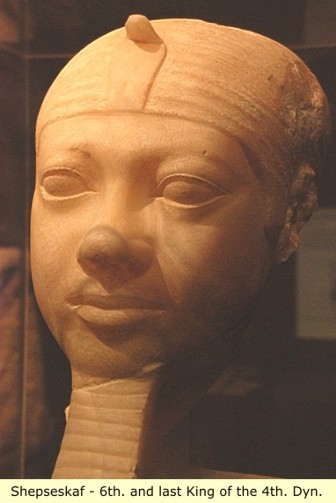
We don't know why Whites, and their Turkish co-conspirators in Egypt, like the Egyptian antiquities Minister Hawass, like to pick on the family of king Sneferu/Snofru for their falsifications. (Hawass famously said that Egyptians weren't Black, they were, er something else: Martians maybe?). In the Prehistoric page, we demonstrated how Whites and their co-conspirators, the Turks of Egypt: found a "Headless" statue of Hemiunu, Sneferu's grandson, they then placed a new head on it with a White mans face, and declared it an "Authentic" artifact. Now here is their latest outrage against our intelligence, they want us to believe that the face of Sneferu's seventh son Ranefer, seen below, is authentic.
The Father - king Sneferu/Snofru |
The Brother - king Sneferu's first son Khufu |
king Sneferu's seventh son Ranefer???? |
 |
 |
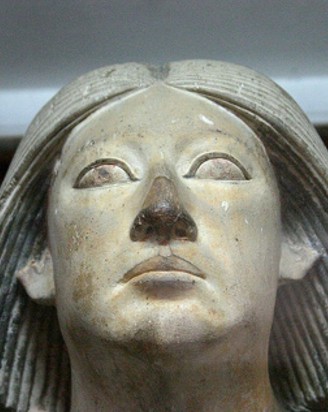 |
Of course, there is now way that face could belong to king Sneferu's seventh son Ranefer. So what happened? Liars rarely have much imagination, so they continually do the same things, and so it is with Ranefer's statue. As with Hemiunu's statue, those pathetic liars simply placed a head with a White face on it. Note the fuller pictures of Ranefer's statues below, both show signs of head replacement/modification.
 |
 |
 |
 |
As with many of the very earliest Pharaoh's, even though they may have left some of the grandest of all monuments in Egypt, they left little in the way of inscriptions, and so we know very little about them. Khafre (Chephren), the builder of the second pyramid on the famous Giza Plateau near Cairo is a fine example. His birth name was Khafre, which means "Appearing like Re". He is also sometimes referred to as Khafra, Rakhaef, Khephren or Chephren by the Greeks, and Suphis II by Manetho. He was possibly a younger son of Khufu (Cheops) by his consort, Henutsen, so he was required to wait out the reign of Djedefre, his older brother, prior to ascending to the throne of Egypt as the fourth ruler of the fourth Dynasty.
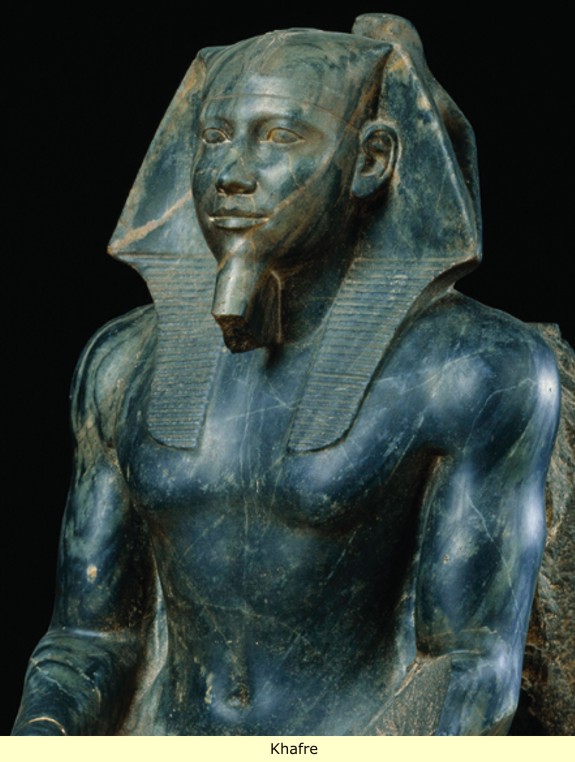 |
However, there is disagreement on this matter. There are rumors of a problem with the succession of Khafre. Some authorities maintain that Djedefre may have even stole the throne, perhaps as a younger brother of Khafre, and that Khafre may have even murdered him. Much of this speculation originates from the fact that Djedefre broke with the Giza burial tradition, electing instead to locate his tomb (pyramid) at Abu Rawash. However, there is little real evidence to support such a conclusion, and in fact, Khafre continued Djedefre’s promotion of the cult of the sun god Re, by using the title “ the Son of the Sun” for himself and by incorporating the name of the god in his own.
We will end the 4th dynasty by mentioning that The last and smallest of the Great Pyramids at Giza was built by pharaoh Menkaure, 5th king of the fourth dynasty.
 |
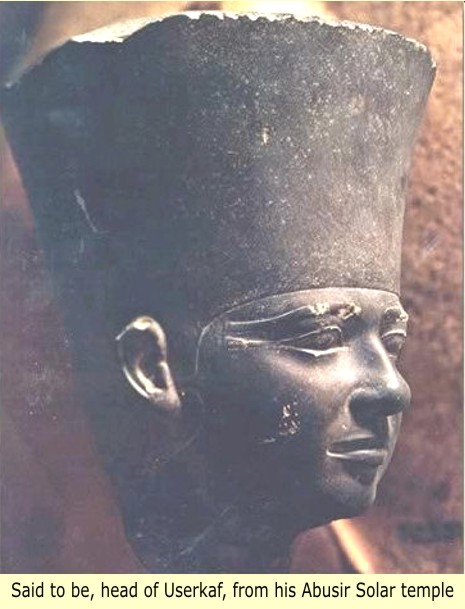
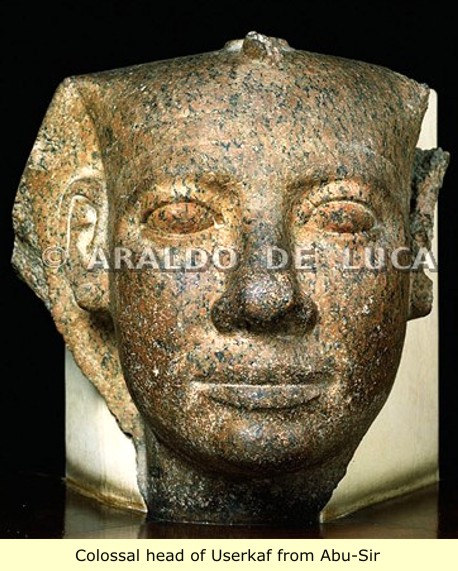
Userkaf, traditionally the first ruler of the
5th Dynasty, is like most of the other kings of the dynasty, not well
attested. We are even uncertain of his father, though he may have been
a priest. His mother was probably Neferhetep, making him the grandson
of Djedefre who succeeded Khufu. We believe he was married to
Khentkaues I, who is buried at Giza. This marriage may have legitimized
his claim to the throne. We believe that Khentkaues I was probably
Menkaure's daughter and perhaps a half sister of Shepseskaf. Oddly,
nowhere in her tomb is Userkaf mentioned. There was apparently another
queen, who's pyramid lies close to the pyramid of Userkaf at
Saqqara. It should be noted that resources on Userkaf are rather
confusing. Some allow Neferhetep to be his wife, rather then mother,
while others even ascribe to Khentkaues I being his mother, rather then
his wife. However, the majority seem to suggest the relationships as
first set out above.
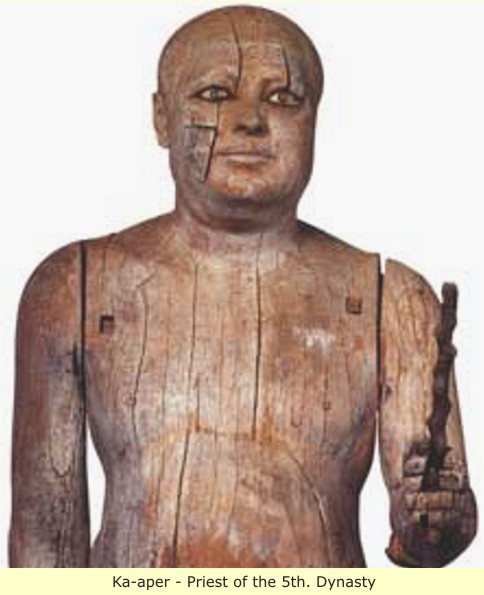
Userkaf was the king’s birth name, meaning, "His Soul is Powerful. He was also known as Weserkaf and may possibly be known in some literature as Ouserkaf, or Oeserkaf. His Horus name was Iry-maat, meaning "He who puts Maat into Practice". He may have come to the throne as an older man, for we are told his reign only lasted seven years, though as usual, the actual dates of his reign very from Egyptologist to Egyptologist.
 |
 |
 |
 |
 |
 |
 |
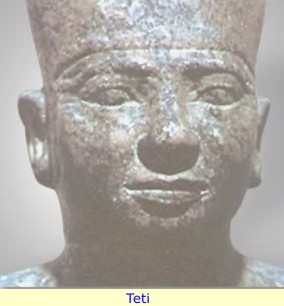
It is with the beginning of the 6th dynasty, that the groundwork is laid for the problems to come. There was apparently accession problems following the death of King Unas, last king of the 5th dynasty. It is believed that Teti, 1st. king of the 6th. dynasty, secured his position by marrying one of king Unas's daughters "Iput I". The length of Teti's reign is sometimes given as 13 years and other sources list it as 33 years. In any event, according to the Manetho, the king was murdered by his guards for mysterious reasons.
The accession of his son Pepi, seems to have been held up by a usurper named Userkare. His reign was short-live however, and Pepi ascended the throne after about one year. When Pepi ascended the throne he was still quite young and his mother Iput I, may have acted as his regent, he reigned for about 50 years. In about year 42 of his reign, there was apparently a harem conspiracy against his life, by one of his queens named "Were-Imtes". Some say that it was not one of his queens behind the plot, but rather the mother of the usurper Userkare. In any event the plot was uncovered, and the plotters punished.
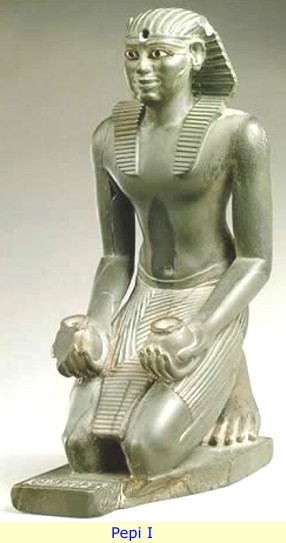
During Pepi's reign, there was apparently many disturbances in Canaan. Five campaigns are attested to by this inscription in the tomb of Weni the Elder.
His majesty sent me to lead this army 5 times to subdue the land of the Sand Dwellers, every time they rebelled, with these troops. I acted so that his majesty praised me for it. Told that there were rebels amongst these foreigners at the 'Nose-of-the-Gazelle's-head' I crossed in ships, together with these troops. I put to land at the back of the height of the mountain range to the north of the land of the Sand-Dwellers, while (the other) half of this army were traveling by land. I turned back, I obstructed all of them and slew every rebel amongst them.
From the autobiography of Weni the Elder
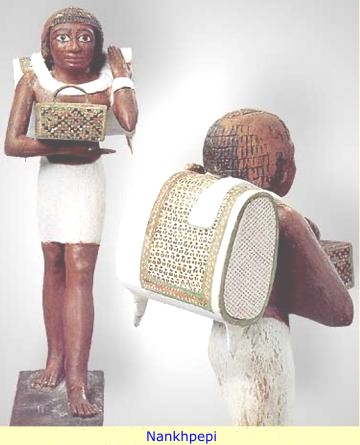
An indication of the unsettled nature of Pepi I's reign, is the duties of one "Nankhpepi", who was the supervisor of Upper Egypt, and chancellor of the king of Lower Egypt, plus the governor of the fourteenth Nome of Upper Egypt. Apparently along with the beautiful backpack, he also wore many hats.
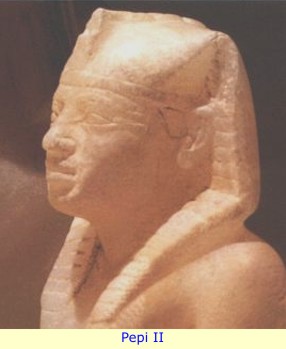 Upon
his death, Pepi I was succeeded by his eldest son Merenre I, who died
unexpectedly. He was succeeded by his younger half brother, Pepi II.
His reign of possibly 94, (some Egyptologist believe 64), years was the
longest in ancient Egyptian history. He seems to have come to the
throne at about the age of six, and would therefore have lived until
the age of one hundred.
Upon
his death, Pepi I was succeeded by his eldest son Merenre I, who died
unexpectedly. He was succeeded by his younger half brother, Pepi II.
His reign of possibly 94, (some Egyptologist believe 64), years was the
longest in ancient Egyptian history. He seems to have come to the
throne at about the age of six, and would therefore have lived until
the age of one hundred.
Pepi II maintained diplomatic and commercial relations with Canaan, and made several trips and campaigns south to pacify Nubia. There were also many trading expeditions into central and east Africa.
Upon his death Pepi II may have been succeeded by a son named Merenre II, but perhaps for only one year. According to Manetho, he was married to a Queen Nitocris, who succeeded her husband to become the last ruler of the 6th Dynasty. However, very little archaeological evidence of Merenre II, or Nitocris exists.
The Turin Papyrus places 'Nitocris' after Pepi II and
possibly Merenre II and an unknown pharaoh towards the end of the 6th
dynasty. This 'Nitocris' is also mentioned by both Herodotus and
Manetho as a queen, but cannot be identified with any historical
pharaoh. These events reported by Herodotus cannot be verified and may
be fanciful.
Herodotus:
The name of the woman who reigned was the same as that of the Babylonian queen, namely Nitocris.
Of her, they said that desiring to take vengeance for her brother, whom
the Egyptians had slain when he was their king and then, after having
slain him, had given his kingdom to her,--desiring I say, to take
vengeance for him, she destroyed by craft many of the Egyptians. For
she caused to be constructed a very large chamber under ground, and
making as though she would inhabit it but in her mind devising other
things, she invited those of the Egyptians whom she knew to have had
most part in the murder of her brother, and gave a great banquet. Then
while they were feasting, she let in the river upon them by a secret
conduit of large size.
Of her they told no more than this, except that, when this had been
accomplished, she threw herself into a room full of embers, in order
that she might escape vengeance.
 |
 |
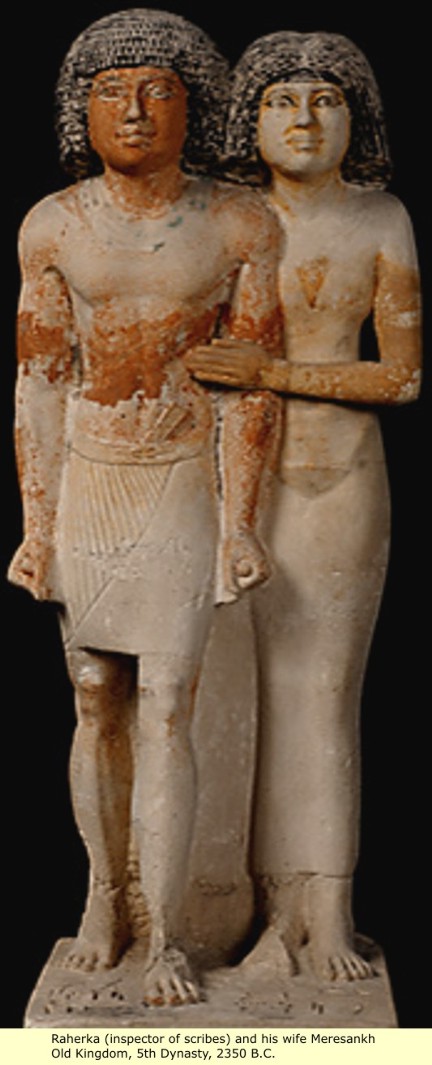
It is always the case, that when there is a king of extraordinary length of reign, the result will be weak kings to follow and eventually chaos. The demise of the 6th dynasty, because of dissension and weak kings, marks the onset of what is called, the First Intermediate Period. These intermediate periods, are times when Egypt is not a united country, but rather independent cities or regions. In these periods, the term dynasty is assigned to the kingship lines that have the most power, or sometimes to a group of disparate rulers.
 |
 |
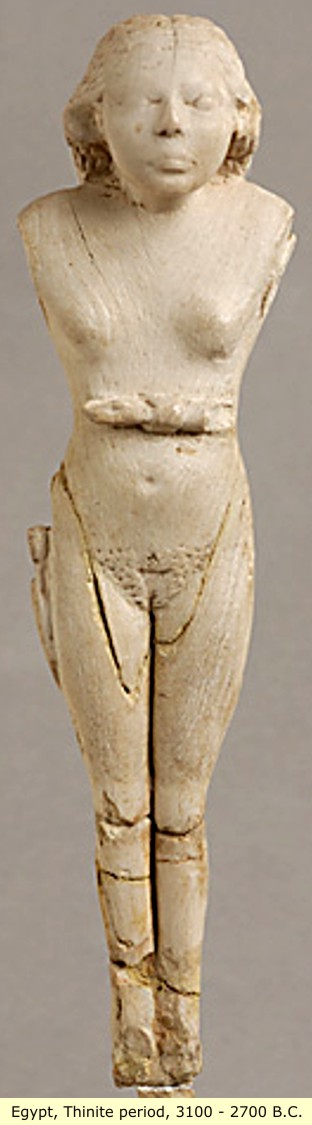 |
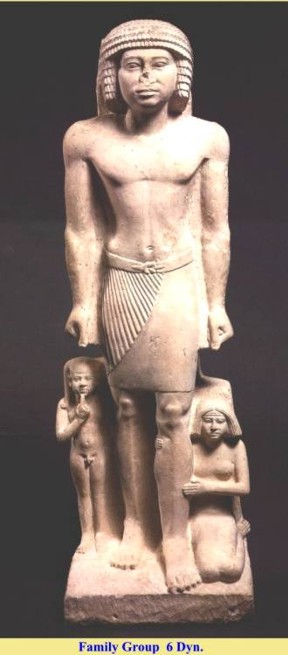
The end of the Old Kingdom brought on a period of chaos, bloodshed and anarchy. Resulting from the collapse of the monarchy, and the rivalries of the provincial feudal lords or 'nomarchs'.
This situation may also have been fomented by Asiatic's, who had infiltrated into the Delta (northern Egypt). From the beginning, Egyptian kings had gone into Canaan to subdue people who they variously called, Troglodytes, San dwellers or vile Asiatic's. It appears that at this time, these people are making a concerted effort to breed dissension in Egypt. However in this case, it is unclear if these mischief-makers are native Canaanite's or Amorites from the desert.
Things continued this way throughout the Seventh Dynasty (2181-2173 B.C.). During this brief period, over 70 rulers were said to have laid claim to the throne of Egypt. The Eighth Dynasty (2173-2160 B.C.), followed the same pattern. Civil disorders multiplied, and then a drought struck Egypt. Valuable insight into this period can be gleaned from a papyrus in the Leyden collection, called "Admonitions of an Egyptian Sage". Excerpts from the papyrus follows..
Admonitions of an Egyptian Sage
The bowman is ready. The wrongdoer is everywhere. There is no man of yesterday. A man goes out to plow with his shield. A man smites his brother, his mother's son. Men sit in the bushes until the benighted traveler comes, in order to plunder his load. The robber is a possessor of riches. Boxes of ebony are broken up. Precious acacia-wood is left asunder.
{The general upheaval has reversed the status of rich and poor:}
He who possessed no property is now a man of wealth. The poor man is full of joy. Every town says: let us suppress the powerful among us. He who had no yoke of oxen is now the possessor of a herd. The possessors of robes are now in rags. Gold and lapis lazuli, silver and turquoise are fastened on the necks of female slaves. All female slaves are free with their tongues. When their mistress speaks it is irksome to the servants. The children of princes are dashed against the walls.
Out of the turmoil and weak Kingships, principalities within the realm rose up to challenge the authority of these weak kings. One Achthoes, the ruler of Heracleopolis, seized control of Middle Egypt, and founded the Ninth Dynasty of lower Egypt (2160-2130 B.C.).
 |
Troop of Egyptian Soldiers -
From the Asyut tomb of Prince Mesehti -
11th dynasty |
These kings of Heracleopolis maintained control over lower (northern) Egypt, through the Tenth Dynasty (2130-2040 B.C.). Meanwhile, the rulers of Edfu and Thebes, fought over control of Upper Egypt. The battle over Upper Egypt was won by Thebes and its ruler Inyotef Sehertowy, founded the Eleventh Dynasty (2133 B.C.), with the aim of extending his power over all the land. There ensued a north-south battle for control of Egypt, which ended with the victory of Nebhepetre Mentuhope II, who re-united the country under one king, and launched the period known as the Middle Kingdom.
 |
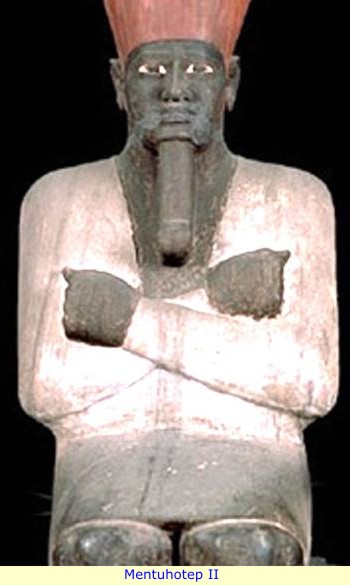
Montuhotep II was king for about 50 years, though much of his reign involved military campaigns, some building work was done. His greatest building work however, was his own temple and tomb, located on the west bank at Thebes. It is located in the cliffs at Deir el-Bhari, next to the famous temple of Queen Hatshepsut.
 Rebuilding
from the second intermediate period, was only begun in earnest by his
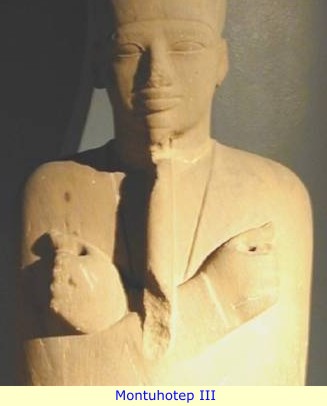
son and successor, Montuhotep III. He demonstrated a preference for the
arts as well as building. He also reopened trade with the Red Sea
region.
Rebuilding
from the second intermediate period, was only begun in earnest by his
son and successor, Montuhotep III. He demonstrated a preference for the
arts as well as building. He also reopened trade with the Red Sea
region.
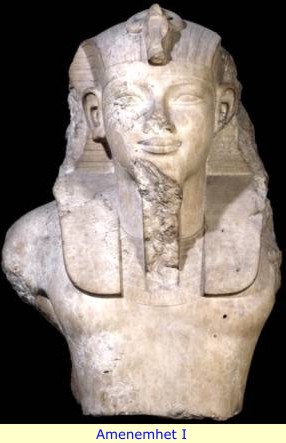
But it was Amenemhet I, the first ruler of the 12th Dynasty, (who may have been a usurper), that some Egyptologists credit with the full recovery from the First Intermediate Period and the transition into the Middle Kingdom. Which was a period of great prosperity.
Amenemhet I appears to have been a wise leader, he set about to correct the problems of the First Intermediate Period, and he took steps to protect Egypt's boarders from invasion and to assure a legitimate succession, {he was the first king to establish a co-regency with his son, Senusret I}. Yet he was murdered in an apparent harem plot, while his co-regent was leading a campaign in Libya. We find two literary works, the Tale of Sinuhe, and the Instructions of Amenemhet I, reflecting this king's tragic end. One literary work from the time of his son Senusret I, presents the account of Amenemhet I's murder, supposedly provided by the king himself from beyond the grave:
It was after supper, when night had fallen, and I had spent an hour of happiness. I was asleep upon my bed, having become weary, and my heart had begun to follow sleep. When weapons of my counsel were wielded, I had become like a snake of the necropolis. As I came to, I awoke to fighting, and found that it was an attack of the bodyguard. If I had quickly taken weapons in my hand, I would have made the wretches retreat with a charge! But there is none mighty in the night, none who can fight alone; no success will come without a helper. Look, my injury happened while I was without you, when the entourage had not yet heard that I would hand over to you when I had not yet sat with you, that I might make counsels for you; for I did not plan it, I did not foresee it, and my heart had not taken thought of the negligence of servants.
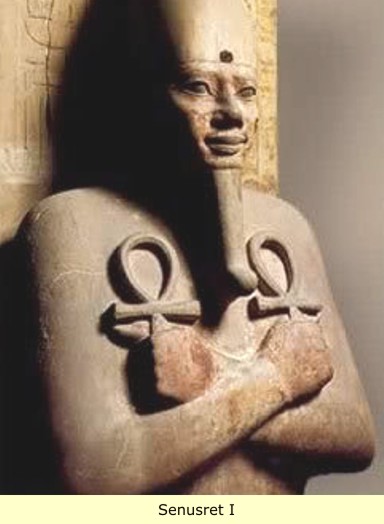
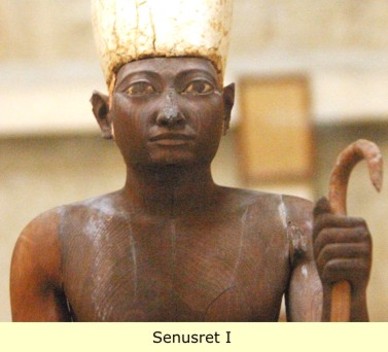
Apparently, his foresight in creating the co-regency with his son proved successful, for Senusret I, succeeded his father, and there seems to have been little or no disruption in the administration of the country. For this is first time that we know of in Egyptian history that a prince, Senusret I, was made a co-regent in the 20th year of Amenemhet I's rule, and so was by the time of his father's death he was firmly established as the heir to the throne. Therefore, regardless of the intentions of the conspirators, he managed to ascend the throne with little difficulty.
Senusret I probably ruled Egypt for a period of about 34 years after his father's death. This was a period in Egypt's history where literature and craftsmanship was at its peek. We believe he may have been a co-regent with his father for perhaps ten years. He probably ruled Egypt from about 1956 through 1911 B.C. It was a period of affluence, and a remarkable time for mineral wealth, gold and fine jewelry was produced in abundance. Jewelry masterpieces have been found, particularly in the tombs of the royal ladies at Dahshur and Lahun, attributable to his reign.
 |
 |
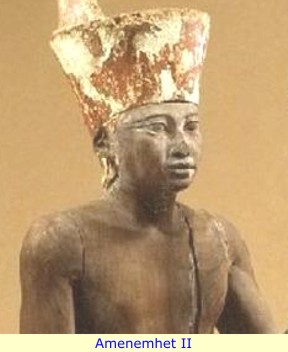 |
Amenemhet II was the son of Senusret I and
one of his chief queens, Nefru. He was the third ruler of Egypt's 12th
Dynasty. Like his father, he served the first part of his reign as
co-regent (perhaps for only two years) with Senusret I. His co-regency
may have been short, but we are told that during this co-regency
Amenemhet II led a Nubian expedition. Apparently, Amenemhet II also
took his son - Senusret II as a co-regent, but also for only a brief
time before his own death. Amenemhet II apparently ruled Egypt for a
period of some 30 years after his co-regency. The Oxford History of
Ancient Egypt gives his reign as lasting from 1911 through 1877 B.C
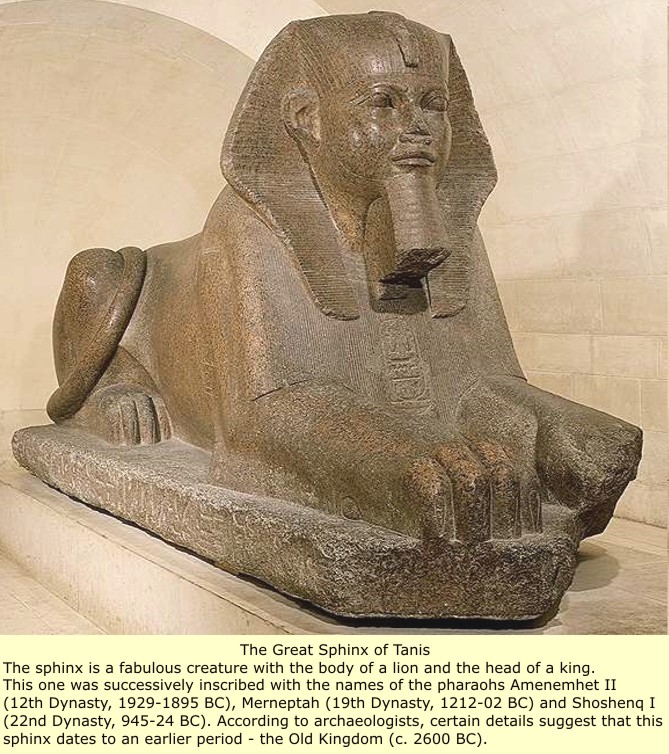 |
Amenemhet II, grandson of Amenemhet I, continued the recovery by reestablishing Egypt's prominence in foreign affairs and trade. Recovered artifacts attest that he exchanged gifts with other rulers in the Mediterranean region. We find jewelry inscribed with his name in royal tombs at Byblos in Canaan. Bronze boxes found at the temple of Montu at Tod inscribed with his name, contained a large number of silver cups of Aegean origin. Also found were cylinder seals and lapis Lazuli amulets from Mesopotamia. In addition, Egyptian artifacts from this period has been found in Crete at Knossos, and Minoan pottery, called Kamares ware, has been found in a tomb at Abydos in Egypt.
Senusret II, the birth name of the fourth king
of Egypt's 12th Dynasty means "Man of Goddess Wosret". It was the name
that seems to enter the royal linage because of this king's non-royal,
great, great grandfather, the original Senusret and father of the
founder of the Dynasty, Amenemhet I. Senusret II's name is also found
in various references as Senwosret II, or the Greek form, Sesostris II.
 |
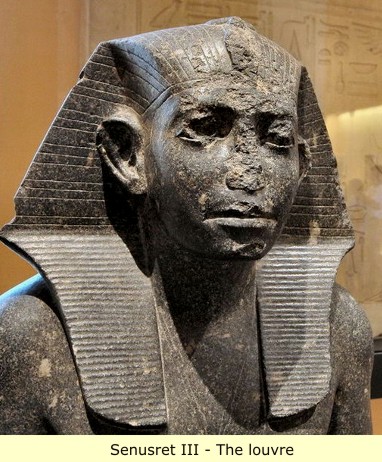 |
Senusret III's predecessors, had not been extremely active in Nubia militarily, and some Nubian groups had gradually been moving north, past the Third Cataract. Accordingly, Senusret III initiated a series of devastating campaigns in Nubia very early in his reign (perhaps year 6), in order to secure his southern borders and protect the trading routes and mineral resources. Apparently the Nubians were a troublesome lot during his reign, for Senusret III would again have to mount campaigns in at least the years 8, 10, 16 and 19 of his reign.
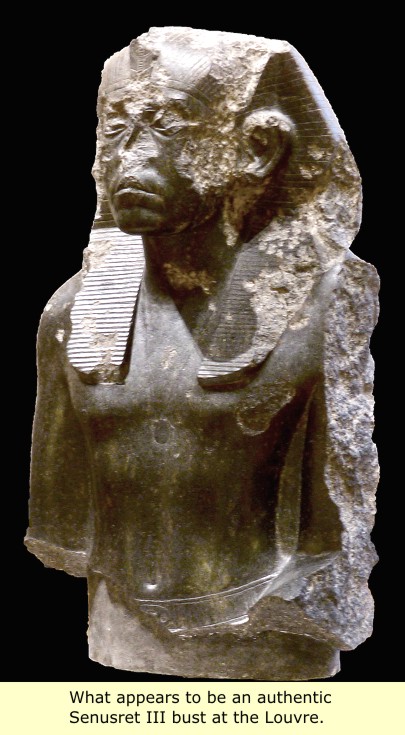 |
 |
Regardless, these campaigns seem to have been for the most part successful, for the king had inscribed on a great stele at Semna, erected in year 8 of his rule - now in the Berlin museum - "I carried off their women, I carried off their subjects, went forth to their wells, smote their bulls; I reaped their grain, and set fire thereto". In other words, he killed their men, enslaved their women and children, burnt their crops and poisoned their wells. The stele also provides that no Nubians were allowed to take their herds or boats to the north of the specified border. To facilitate these military actions in Nubia, he had an existing bypass canal around the First Cataract (rapids) at Aswan, originally dug in Old Kingdom time by Merenre, and which Pepi I had cleared, broadened and deepened it.

Amenemhet III was the son of Senusret
III and the last great ruler of the Middle Kingdom. Amenemhet III
appears to have shared the throne with is father as co-regent for at
least a while before the death of his father. The king's principle
wives were buried in his pyramid at Dahshur in their own chambers, a
very unusual feature at this time. The Chief wife was probably Aat. The
second queen we are unsure of. We also know of a daughter named
Neferuptah and of course his successor who was probably his son,
Amenemhet IV. However, Amenemhet IV may have been a grandson, but in
any event, Amenemhet III probably made him a co-regent. It is also
possible that the queen who ruled as the last pharaoh of the 12th
Dynasty - Sobkhotpe IV, was also his daughter.
Every king before him or after him in the 12th Dynasty, with perhaps the exception of the last female ruler, would either be named Amenemhet, as the dynasty's founder was, or Senusret, the first of whom was probably the non-royal father of Amenemnet I. Amenemhet III was the 6th ruler of the 12th Dynasty, and may have reigned for as long as 45 years. According to Clayton he ruled from 1842 through 1797 B.C. It was a good thing he ruled this long, because his first tomb, his pyramid at Dahshur, started collapsing about the time it was finished. It took about 14 or 15 years to build, and he had to start completely over with a new pyramid near to the Fayoum at Hawara. At Hawara, we believe the complexity and splendor of his mortuary temple made it commonly known as the Labyrinth.
This seventh king of the 12th Dynasty was probably the son of Amenemhet
III. He co-ruled with Amenemhet III and a temple at Medinet Madi in the
Faiyum was probably built by both kings. Due to his father’s long
reign, Amenemhet IV was old when he assumed the throne. He had no male
heir and was succeeded by his sister, Neferusobek.
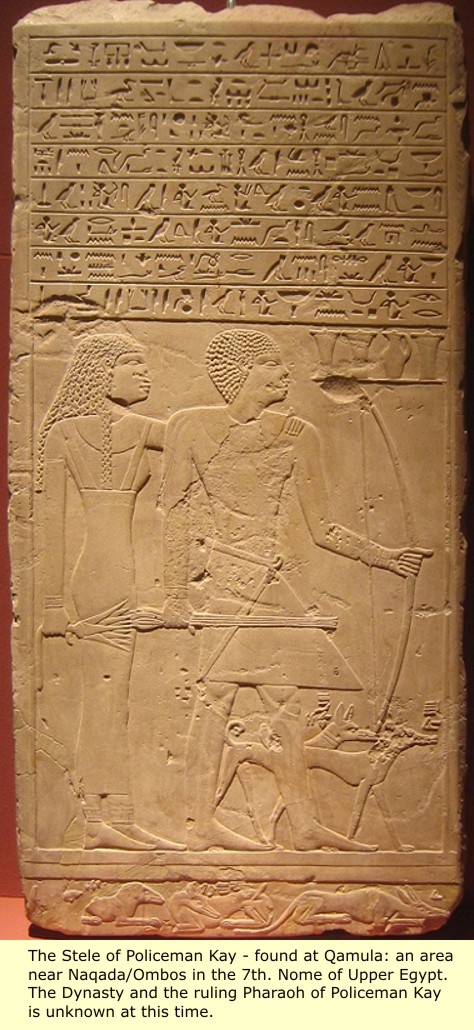 |
The first historical account of a Policeman
Text from the Stele:1) A sacrifice which the king offers to Anubis who is on his mountain, who is at the place of embalmment, lord of the hallowed land, (so that he make) a mortuary offering of bread, beer, cattle and fowl.2) to the revered one, chief of the desert police, chief of the western (and rebellious?) desert, Kay, justified.3) Who says: I was a respected citizen at the head of the army on the day of difficulty, praised by4) His lord and his court. I reached the western oasis, searched all its paths5) And returned the fugitive I found there. The soldiers were safe,6) There were no losses. That which was entrusted to me returned happily. I was appointed7) By my lord to protect them, as his deputy having his trust, to be competent and8) Execute the order of my lord, (I), the praised and revered one, Kay, justified.Note that Policeman Kay uses Dogs to help him track criminals. |
Egyptian King and Ruler listThe ancient Egyptian Kinglist is very fluid, as new attestations for previously unknown kings or Queens are discovered (such as newfound Serekhs or Cartouches), the list is updated. Chronological dates are educated guesses.
|
2nd Dynasty Kings (2890-2686 B.C.) Hetepsekhemwy (Hotepsekhemwy) 3rd Dynasty Kings Sanakhte (Nebka) 2650 - 2630 4th Dynasty Kings Snefru 2575 - 2551 5th Dynasty Kings Userkaf 2465 - 2458 6th Dynasty Kings Teti 2345 - 2333 FIRST INTERMEDIATE PERIOD7th and 8th Dynasty Kings (2150 - 2135 B.C.) Netrikare |
FIRST INTERMEDIATE PERIOD7th and 8th Dynasty Kings - Continued.. Merenhor Neferkaure
9th and 10th Dynasties (2135 - 1986)
Merikare 11th Dynasty
Mentuhotep II 2055 -2004
|
Please visit the "Additional Material Area" for many more photographs of each civilization, and related material <Click> |
|
NOT OUT OF AFRICA
Professor Mary Lefkowitz, Professor in the Humanities at Wellesley College Massachusetts is a Jewish woman from New York. It's been 28 years (1996) since her "Not Out of Africa" book was published, and we are amazed at the number of Black people who still don't know that it is PURE NONSENSE with her accusing Blacks of doing exactly what Albinos routinely do concerning history. AND WE DON'T LEGISLATE AGAINST TEACHING ALBINO CHILDREN ABOUT ALBINO ANCIENT HISTORY - THERE IS NONE! But Hey Gov. Ron DeSantis - sooner or later your Albino Children will learn the truth, what will you do then? In "Not Out of Africa" the Professor said that she "comprehensively" exposes how Afrocentrism became an excuse to teach myth as history."
As you can see she/they (Albinos) placed a picture of what they supposed was a WHITE GREEK man on the cover to show us what the REAL creators of Civilization looked like in "THEIR FANTASY'S" (we hope you can detect that it is a PLASTIC bust). Of course most Greeks were Black as were most people in ancient Europe, even after the Sea Peoples exodus. (We assume that you know that Africans started settling Europe after the "Last Ice Age" from about c.45,000 B.C.). If not, we cover it here in many different pages. Amazon review capsule: Not Out of Africa has sparked widespread debate over the teaching of revisionist history in schools and colleges. Was Socrates black? Did Aristotle steal his ideas from the library in Alexandria? Do we owe the underlying tenets of our democratic civilization to the Africans? Mary Lefkowitz explains why politically motivated histories of the ancient world are being written and shows how Afrocentrist claims blatantly contradict the historical evidence. Not Out of Africa is an important book that protects and argues for the necessity of historical truths and standards in cultural education. In other words, Mary is asking: “Who are you going to believe, me or your own lying eyes?” By Chico Marx - Jewish actor. From the Robert T. Carroll (a PhD) Book review quote: What is offensive about Afrocentrism is not that its advocates assert such things as that Socrates and Cleopatra were black Africans or that Aristotle stole his ideas from the library at Alexandria when he visited Egypt. What is offensive is not that they claim that the ancient Greeks took everything they are known for from the Egyptians, and that those Egyptians were black Africans. What is offensive is that these claims are put forth as articles of faith. Any challenge to them is seen as racist. CAN YOU BELIEVE THAT AT THIS "LATE" DATE, ALBINOS STILL BELIEVE THAT EGYPTIANS WERE WHITE?? Continue: What is offensive is that these claims are not based on scholarly research, evidence and argument from evidence. Nor are they based on a sincere desire to discover historical truth. They are based on unsubstantiated opinions of mythmakers and fiction writers. They are based on the possibility they are true. They are based on a desire for them to be true. They are based on a preconceived notion that white scholars have conspired from time immemorial to repress the truth that everything good about Western civilization came out of Black Africa. They are based on the desire to give African-American children self-esteem and pride. By Robert T. Carroll, November 27, 1996 OUR ANSWER IS QUITE SIMPLE: "A picture is worth a thousand words." That adage is believed to stem from an article by Fred R. Barnard in an advertising trade journal of 1921 promoting the use of images in advertisements". THAT IS WHY Realhistoryww has thousands of photos of Real ancient People and Real ancient Artifacts with written documents to back them up. Unlike Albino bullshit which they assume you will believe, just because they are ALL-KNOWING Albinos, or at least that is what you have been trained to believe. Quote: They are based on a preconceived notion that white scholars have conspired from time immemorial to repress the truth that everything good about Western civilization came out of Black Africa. Answer: YOU are Albinos, that is a disease; you are NOT normal nor natural, and you have NOT existed from time immemorial, your OWN scientists have set your time of existence at 6,000 - 12,000 years. Speaking to Blacks: Mary Lefkowitz is a Professor, Robert T. Carroll is a PhD, yet both of these "Ignoramuses" falsely believe that Albinos are native to Europe and that the Greeks, Romans, etc. were Albinos just like THEM - which of course is part of their nonsense history.
Was the above quote designed to give BLACKS: a desire to give African-American children self-esteem and pride - By Robert T. Carroll OR Albino children self-esteem and pride? The Smithsonian Institution is the world’s largest museum, education, and research complex, with 21 museums and the National Zoo—shaping the future by preserving heritage, discovering new knowledge, and sharing our resources with the world. The Institution was founded in 1846 with funds from the Englishman James Smithson (1765–1829) according to his wishes “under the name of the Smithsonian Institution, an establishment for the increase and diffusion of knowledge.” We continue to honor this mission and invite you to join us in our quest. People! The worlds greatest "EDUCATIONAL INSTITUTION" (he,he) wrote that nonsense below the little Albino girl putting on her Sun Block above, yet you still believe them?? In case you didn't know; CENTRAL ASIAN ALBINOS: Germanic's, Slavs, Turks, (who modern Albino liars call Greeks and Romans) entered Europe as ILLITERATE NOMADS; some as Slave Soldiers of Black Arabs called MAMLUKS! << See Wiki - The Migration Period >> |
| < Back | Home | Next > |


