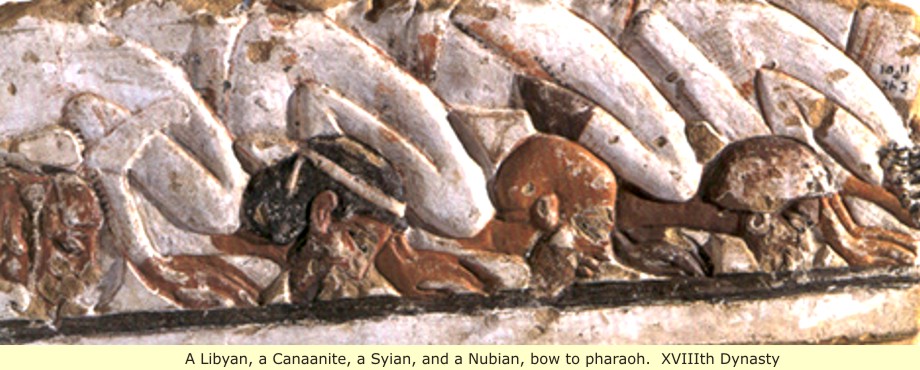
Ancient Man and His First Civilizations
The Real History of White People
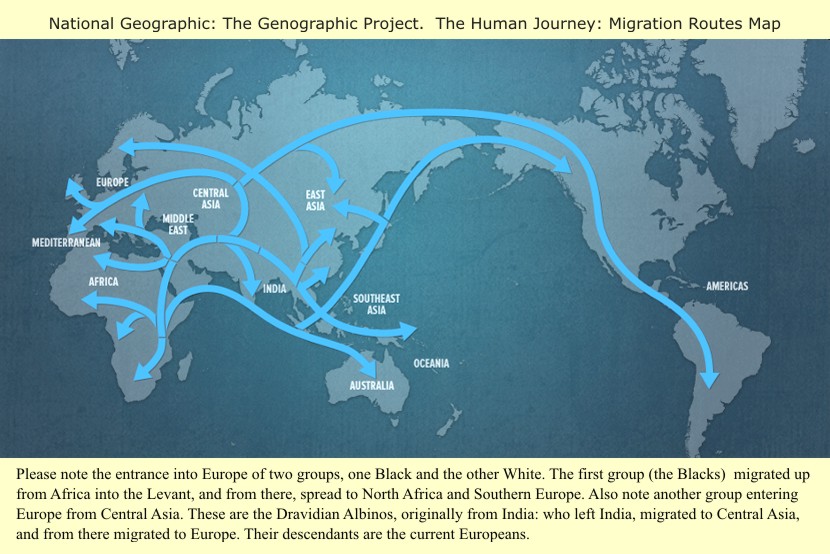
The purpose of this article is to explain who and what White people, such as those in Europe, really are. In order to do that, we will disprove and dispel (by scientific means) all of the White peoples Myths and falsifications. To accomplish this goal two things must be made clear: 1) the number of White people in the world is very small; World Wide there is only about 800 million to 1 Billion Whites (Albinos) actually, that is only about 10 % of the Worlds Human population. This is of course a great surprise to all Blacks who have been called "Minorities" by these Albinos. Blacks (those of Negroid and Caucasoid phenotype), are of course the "Original Humans" and number over 5 billion of the Worlds 8 billion people. The truth of this statement is "Self-evident" by this fact.
 |
Some might wonder exactly WHY European and Asian populations have so little genetic diversity. The answer is quite simple: as fully explained below, European populations derive mainly from just the Black Dravidian people of India, which is just one of the many ethnicities of India.
The lack of diversity among Mongol people is much more complicated though: to begin with, we already know from the Chinese history section that the original (OOA) Out of Africa people who went to china were ordinary Negroid phenotype Africans that we know today as the Xia, Jomon, and Ainu. But also with them were Mongol phenotype Africans like the Himba and San. To "Try" to explain what happened in North-East Asia, we will cite two scientific studies.
 |
DNA Evidence Suggests 300 Million Chinese Men
Are Descended From Just Three Stone Age Grandfathers
More than 40 per cent of the Chinese Han population can trace their
family tree back to three ‘super-grandfathers’ who lived during the Neolithic era The Physics arXiv Blog
This is exactly what Shi and co. have done with over 100 Chinese men in their study. The resulting family tree is complex. It reveals, for example, that the human population split some 54,000 years ago in the migration out of Africa.
But it also points to a more surprising event in China some 5000 years ago in which three populations expanded quickly within 500 years of each other. Each of these populations can be traced to a single man. And yet they now account for more than 40% of today’s Han Chinese population—that’s 300 million living males.
The date is significant too. This period is the late Neolithic age or late Stone Age as it is sometimes called. Although evidence of farming in China dates back about 10,000 years, this new technology spread relatively slowly at first.
But about 5000 years ago, the change to intensive agriculture became more dramatic. “During this period, agriculture became mature and intensive, and the majority of human diet shifted from food collection into production,” they say.
Shi and co’s new evidence suggests that three clans were particularly successful in this. This corresponds to “a remarkable demographic change in the late Neolithic Age,” they say.
|
 |
Discussion
The Han Chinese originated from the Central Plain region, which is substantially smaller than the region the Han Chinese now occupy. According to historical documents, the Han Chinese suffered many conflicts with natives prior to expansion into their lands. The Han migrated northward into regions inhabited by many ancient northern ethnic groups. Based on the advanced agriculture, technology, and culture, the Han Chinese or their ancestors often had a greater demographic advantage over ancient northern ethnic groups. Thus, the Han Chinese or their ancestors might have played a predominant role in the genetic mixture of populations.
|
As is usual with the work of European Albinos and Mongol Asians - NOWHERE is heard a word about the Black man - their Father. The reason for that is of course quite simple: if the Black man is mentioned, then his place must be given and explained. That would leave European Albinos and Asian Mulattoes with the very uncomfortable task of explaining their own place in the hierarchy of Human beings.
In any event, the evidence seems to suggest that the Mongol phenotype Black Africans (such as some San people), produced the most Albinos: and in keeping with Albino behavior in the rest of the world, these Albinos, along with their Mulattoes, killed or "Absorbed" most of the Black East Asians (keeping in mind that the average Chinese is neither Black nor White, but rather a MULATTO!). This is consistent with current population surveys which find that the San of southern Africa have the "lightest" complexion of all Africans.
Examples of these people are found below. |
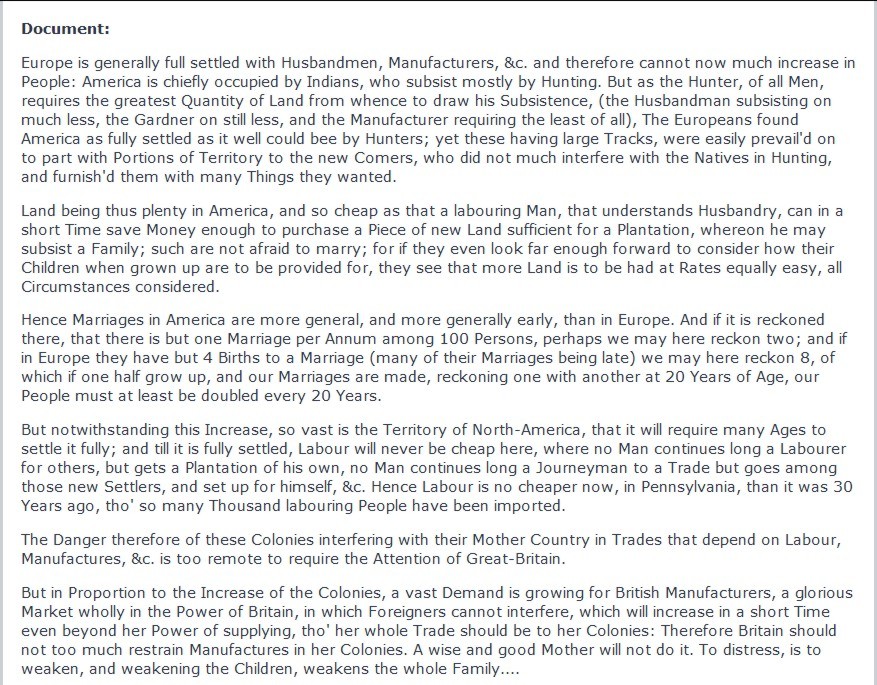
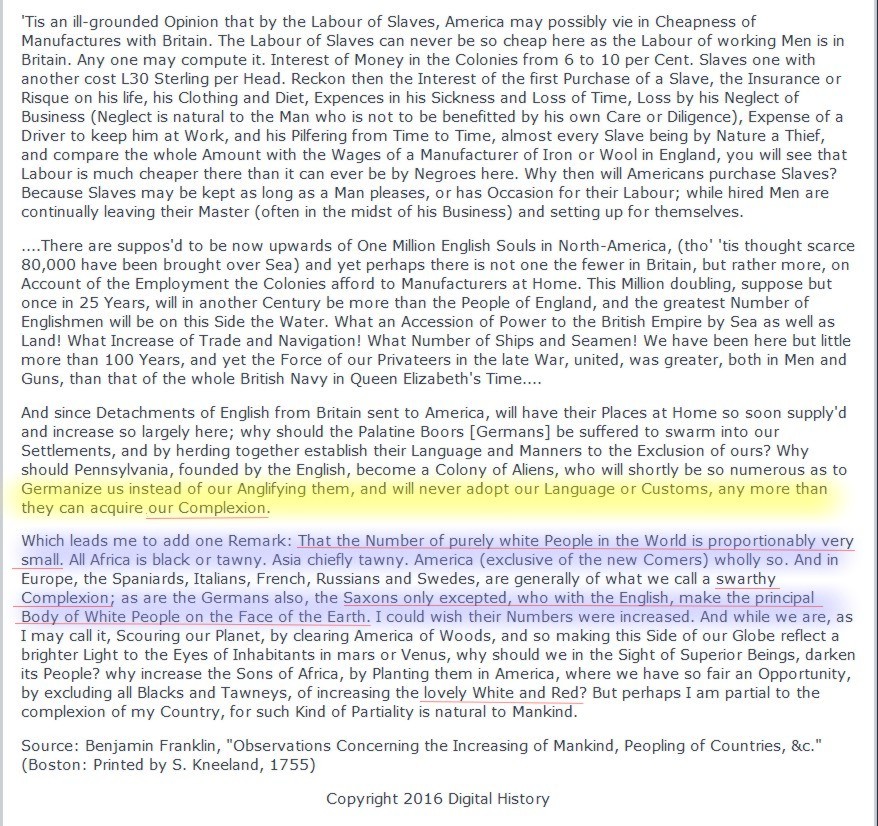
For those who don't believe our claim that European Albinos
are a "Small Minority" of the Human Race,
perhaps the word of that old Racist, Benjamin Franklin, will do.
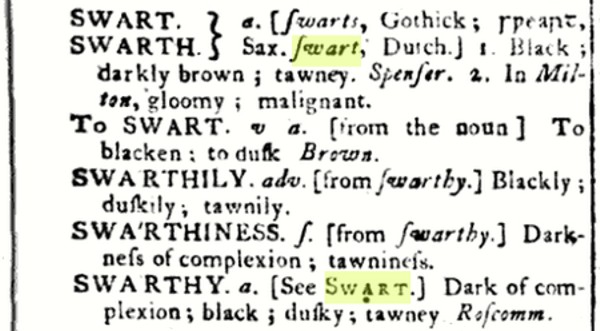
Definition of Terms from above:
 |
The falsity of White history begins and ends with their desire to hide their true nature; that being that they are derived from Albinos. Their efforts to make all peoples of historical significance White, would appear to be their effort to make themselves the "New Normal" i. e. "See everybody important was White, therefore White is good - the best even!" This fabricated concept of themselves, is obviously so satisfying, and so ingrained, that it has become delusional. Even today, there are many Whites who refuse to believe that the ancient Egyptians, and the other original civilizations as well, were Black people! This in spite of the countless evidences to the contrary: Egypt IS in Africa, there are countless statues and paintings which clearly show them to be Black people. Even scientific studies of ancient Egyptian Bones and Mummy tissue, like this one: Mummy tissue study: Click >>>, Does not satisfy them. Whites will still doggedly point to artifacts from the periods of Greek and Roman rule and say: See, these are the "Real Egyptians". Of course, there is absolutely no reason why a reasonably intelligent human being, would ever think that the ancient Egyptians were White people, but then again, reason and intelligent thought, have nothing to do with this: This is about a "Need" to believe. This persistence in thinking, is then clearly not intellectual, put rather purely emotional.
Here then, is White history as developed with "Evidence"
Note: here we do not delve too deeply into the discussion of whether or not Whites are derived from Albinos, or present the many proofs thereof. That discussion is Here: Click >>>
THE ARYAN CONTROVERSY
Europes Albinos, since the time they ursurped Blacks and took power in Europe, have tried mightly to figure out where they came from.
Paul Broca (1824–80), French surgeon and anthropologist had urged that while there may be Aryan languages, there is no such thing as an Aryan race, and that language is only one, and the least important factor in the inquiry, and that while Aryan languages are spoken by races wholly unrelated, there is only one race, the tall, blue-eyed, fair-skinned German race, with abundant beard and dolichocephalic skull, which can claim to be genuine Aryans by blood as well as by language.
Theodor Friedrich Wilhelm Poesche (1825 – 1899) was a German American anthropologist and author, specializing in historical anthropology. In 1878 he published The Aryans: A contribution to historical anthropology. Based on the physical characteristics attributed to Indo-Europeans (fair hair, blue or light eyes, tallness, slim hips, fine lips, a prominent chin). He identified this race with that whose skeletons are found in the Alemannic "row-graves" of Southern Germany, and he contended that it has existed in Europe since the Neolithic period.
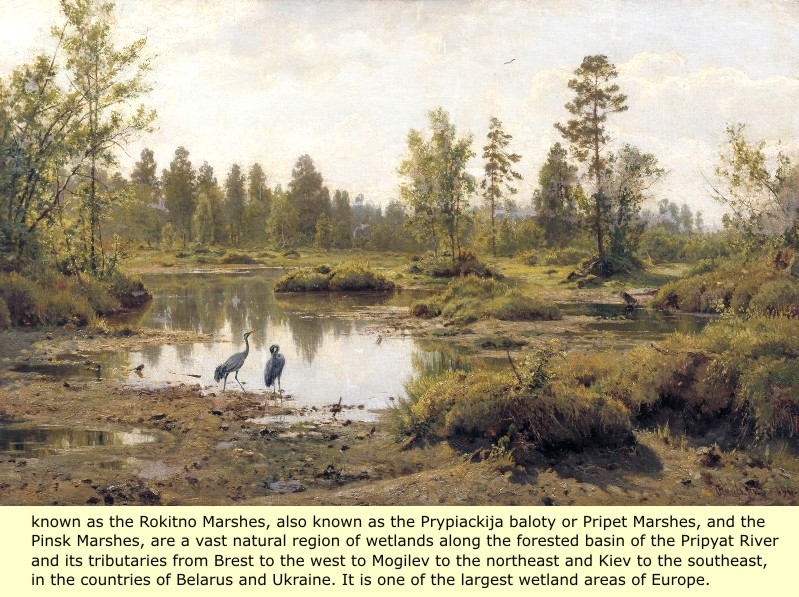
His argument was that the Aryan race originated in the great Rokitno swamp, between the Pripet, the Beresina, and the Dnieper. Here depigmentation or albinism is very prevalent, and here he considers the fair, white race originated. In this swamp, he thinks, lived the pile-dwellers who afterwards extended themselves to the Swiss lakes and the valley of the Po. The archaic character of the neighboring Lithuanian language induced him to believe that the Lithuanians were a surviving relic of this oldest Aryan race.
Comment:
Clearly in earlier times, intelligent Albinos themselves, came to realize that they must be derived from Albinos. But today that openness has evaporated; it seems that when Albinos tell Albinos that they are Albinos, it is acceptable. However, when Blacks tell Albinos that they are Albinos, it seems to illicit ill feelings.
|
The beginning
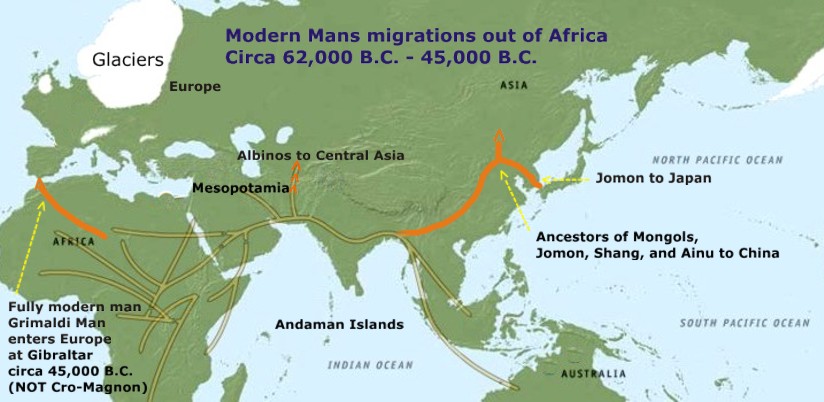
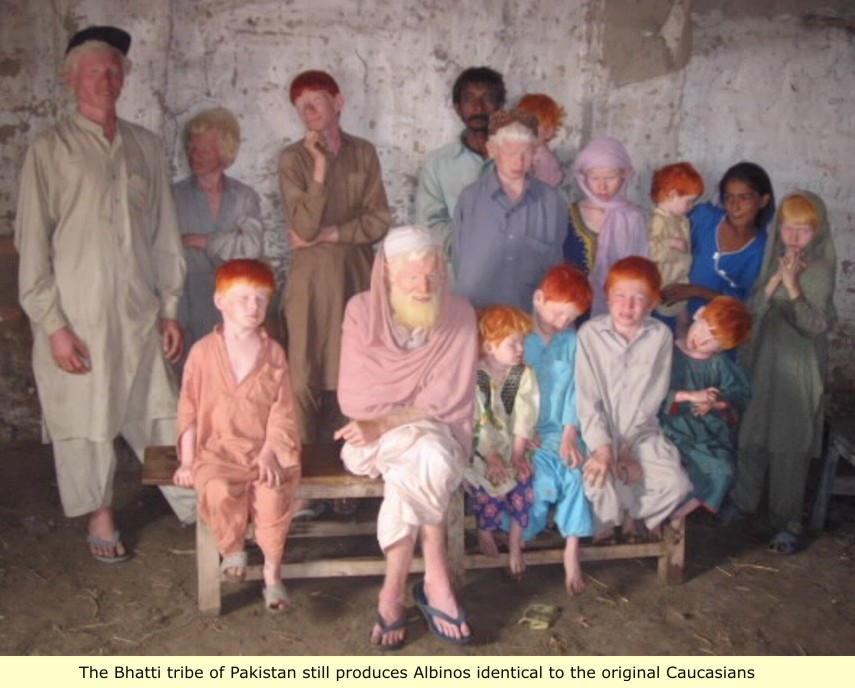
The second Out Of Africa (OOA) migration event (The first being Humans to Australia), saw Blacks from Africa with straight hair and "Mongol features" take an "Inland route" through southern Asia and on up to China, where they settled. Included with this group, were straight haired Blacks "without" Mongol features - now called "Dravidians" who stayed close to Africa, and settled in India and other areas of southern Asia. Also included with this second (OOA) group were Albinos, who were probably motivated by a quest for relief from the heat and burning Sunshine of southern Africa - and relief from the torment heaped upon them by normal Africans. Even today, superstitious Blacks of southern Africa; maim and mutilate Albinos in the ignorant belief that their body parts process magical properties, which they use in rituals.
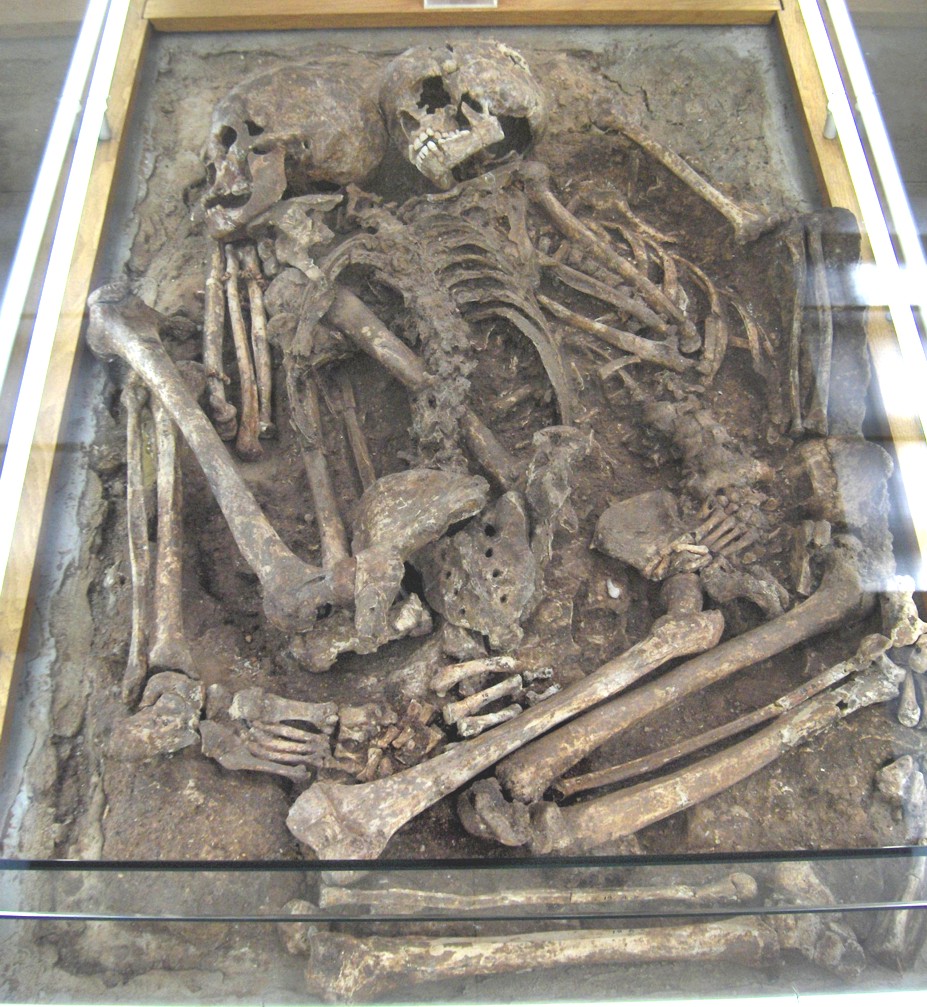
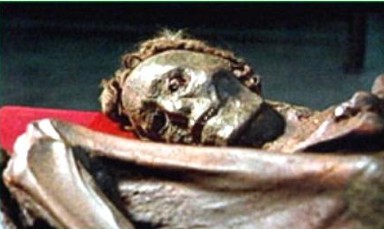
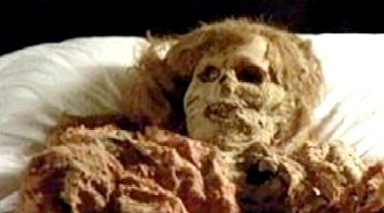
These are the actual first Europeans:
^Grimaldi skeletons as displayed in the Musée d'Anthropologie in Monaco^
(Old Woman and Child)
Analysis of Grimaldi skeletons indicate that they looked like the San of Southern Africa
This is the Genesis of White Europeans:
We know with certainty that they were Albinos because ancient writers described them as such, as they moved towards Europe.
In Book 4 - MELPOMENE: Herodotus describes the Budini people, east of the Ister (Danube) River, thusly:
[4.108] The Budini are a large and powerful nation: they have all deep blue eyes, and bright red hair. There is a city in their territory, called Gelonus, which is surrounded with a lofty wall, thirty furlongs each way, built entirely of wood. All the houses in the place and all the temples are of the same material. Here are temples built in honour of the Grecian gods, and adorned after the Greek fashion with images, altars, and shrines, all in wood. There is even a festival, held every third year in honour of Bacchus, at which the natives fall into the Bacchic fury. For the fact is that the Geloni were anciently Greeks, who, being driven out of the factories along the coast, fled to the Budini and took up their abode with them. They still speak a language half Greek, half Scythian.
[4.109] The Budini, however, do not speak the same language as the Geloni, nor is their mode of life the same. They are the aboriginal people of the country, and are nomads; unlike any of the neighbouring races, they eat lice. The Geloni on the contrary, are tillers of the soil, eat bread, have gardens, and both in shape and complexion are quite different from the Budini. The Greeks notwithstanding call these latter Geloni; but it is a mistake to give them the name.
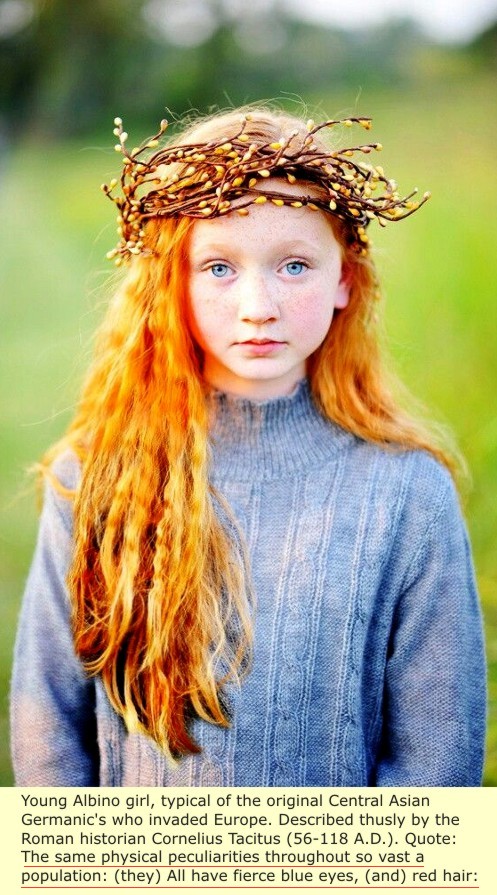
The Roman historian Cornelius Tacitus (56-118 A.D.) said this about the Germanic tribes (Not the same as Germans): All have fierce blue eyes, red hair, huge frames, fit only for a sudden exertion.
The Chinese describe the Yuezhi [Kushans] thusly: The skin of the people there is reddish white.
Oculocutaneous albinism, type 2
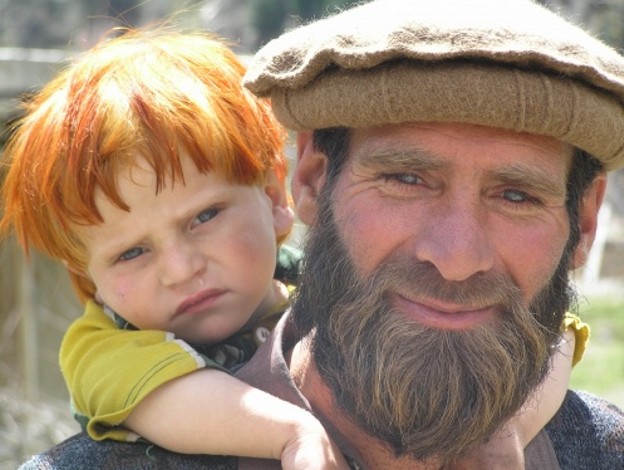
The gene OCA2, when in a variant form, the gene causes the hypopigmentation common in human albinism. Different SNPs within OCA2 are strongly associated with blue and green eyes. Hair color is the pigmentation of hair follicles due to two types of melanin, eumelanin and pheomelanin. Generally, if more melanin is present, the color of the hair is darker; if less melanin is present, the hair is lighter. Blond hair can have almost any proportion of phaeomelanin and eumelanin, but both only in small amounts. More phaeomelanin creates a more golden blond color, and more eumelanin creates an ash blond. Blond hair is common in many European peoples, but rare among peoples of non-European origin. Red hair ranges from vivid strawberry shades to deep auburn and burgundy, and is the rarest fully distinct hair color on earth. It is caused by a variation in the Mc1r gene and believed to be recessive. Red hair has the highest amounts of phaeomelanin and usually low levels of eumelanin, and is the rarest natural human hair color.
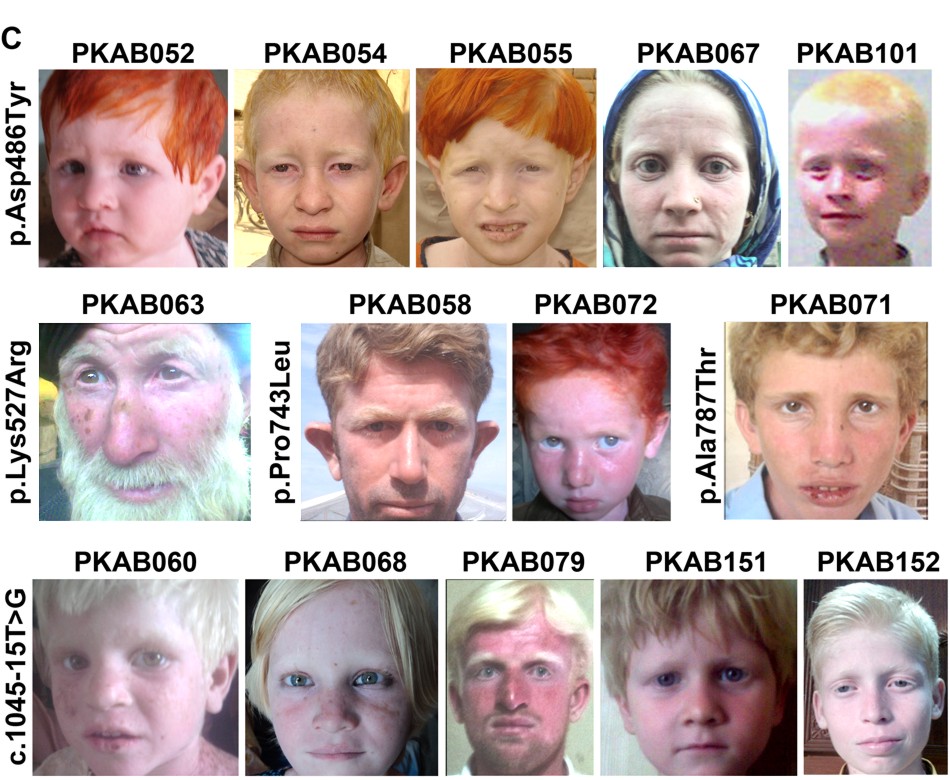
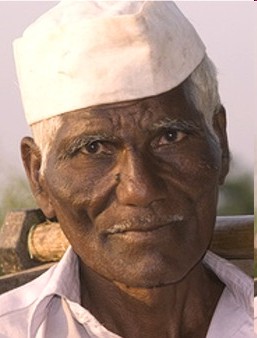
Dravidian |
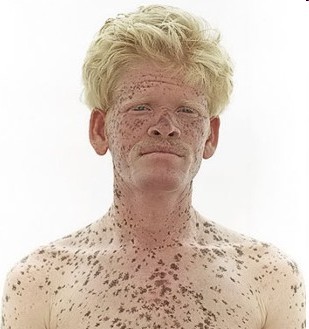
Dravidian Albino |
 |
 |
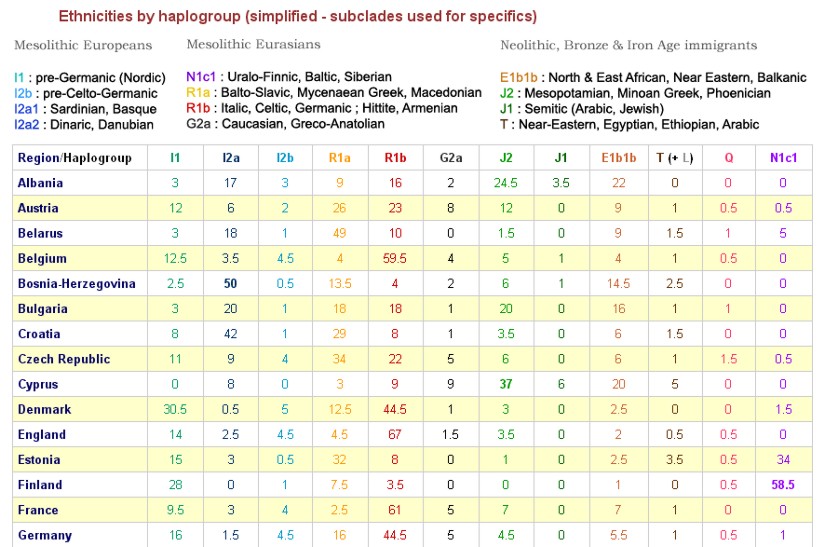
Confirmation that the White (Caucasian) Race is derived from Dravidian Albinos, is documented in the findings from genetic analysis of Y-DNA haplogroup "R".
Haplogroup R (Y-DNA)
In human genetics, Haplogroup R is a Y-chromosome DNA haplogroup, a subgroup of haplogroup P, defined by the M207 mutation.
This haplogroup is believed to have arisen around 26,800 years ago, somewhere in Central Asia or South Asia, where its ancestor Haplogroup P is most often found at polymorphic frequencies. Cambridge University geneticist Kivisild et al. (2003) suggests that southern and western Asia might be the source of this haplogroup:
Given the geographic spread and STR diversities of sister clades R1 and R2, the latter of which is restricted to India, Pakistan, Iran, and southern central Asia, it is possible that southern and western Asia were the source for R1 and R1a differentiation.
The R haplogroup is common throughout Europe and western Asia and the Indian sub-continent, and in those whose ancestry is from within these regions. It also occurs in North and Sub-Saharan Africa. The distribution is markedly different for the two major subclades R1a and R1b.
Haplogroup R1a is typical in populations of Eastern Europe, Indian Subcontinent and parts of Central Asia. R1a has a significant presence in Northern Europe, Central Europe, Altaians and Iran as well as in Siberia. R1a can be found in low frequencies in the Middle East, mostly in Indo-European speakers or their descendants.
Haplogroup R1b predominates in Western Europe. R1b can be found at high frequency in Bashkortostan (Russia). R1b can be found at low frequency in Central Asia, Middle East, South Asia as well as North Africa. There is also R1b in Sub Saharan Africa. In Europe, R1b coincides with areas of Celtic influence. |
Origins of Y-dna Haplogroup "R"
From Wikipedia:
According to the Genographic Project conducted by the National Geographic Society, Haplogroup R2a arose about 25,000 years ago in Central Asia and its members migrated southward as part of the second major wave of human migration into India.
According to Sengupta et al. (2006),
uncertainty neutralizes previous conclusions that the intrusion of HGs R1a1 and R2 [Now R-M124] from the northwest in Dravidian-speaking southern tribes is attributable to a single recent event. Rather, these HGs contain considerable demographic complexity, as implied by their high haplotype diversity. Specifically, they could have actually arrived in southern India from a southwestern Asian source region multiple times, with some episodes considerably earlier than others.
The following is Manoukian's (2006) summary of the findings of the Genographic Project conducted by the National Geographic Society and directed by Spencer Wells (2001):
Haplogroup R, the ancestral clade to R1 and R2, appeared on the Central Asian Steppes around 35,000 to 30,000 years ago.
R1, sister clade to R2, moved to the West (READ EUROPE) from the Central Asian Steppes around 35,000 to 30,000 years ago. R1 pockets were established, from where R1a and R1b emerged.
R2a [R-M124] made its first entry into the Indian sub-continent around 25,000 years ago. The routes taken are not clear, although the Indus and Ganges rivers are possible theories put forward. There could, of course, have been multiple immigrations of this haplogroup into the Indian sub-continent, both in the Paleolithic and the Neolithic |
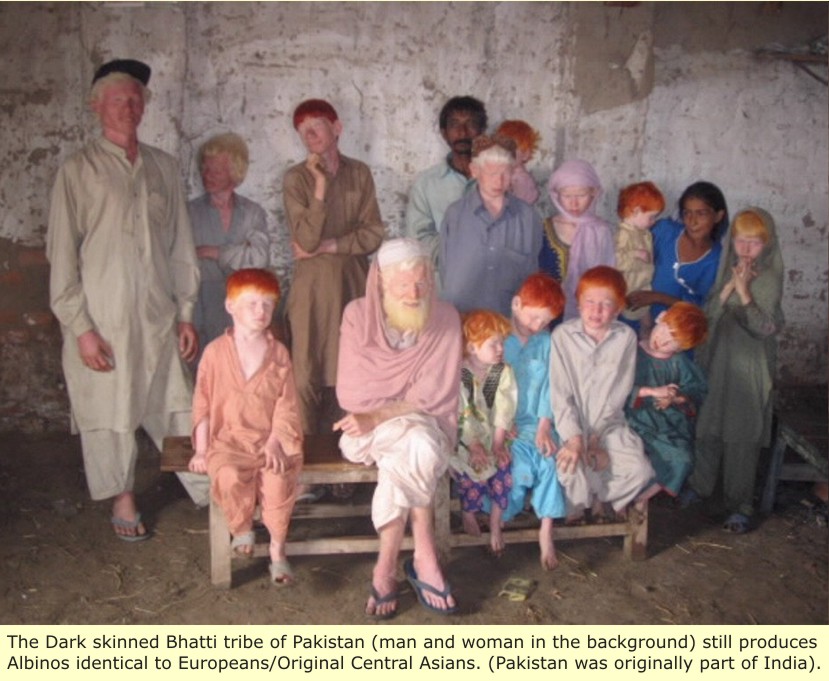
The Albino pictures above, are taken from the study by Andreas Deffner: White, too white A Portrait of Albinism in India.
Link to the study
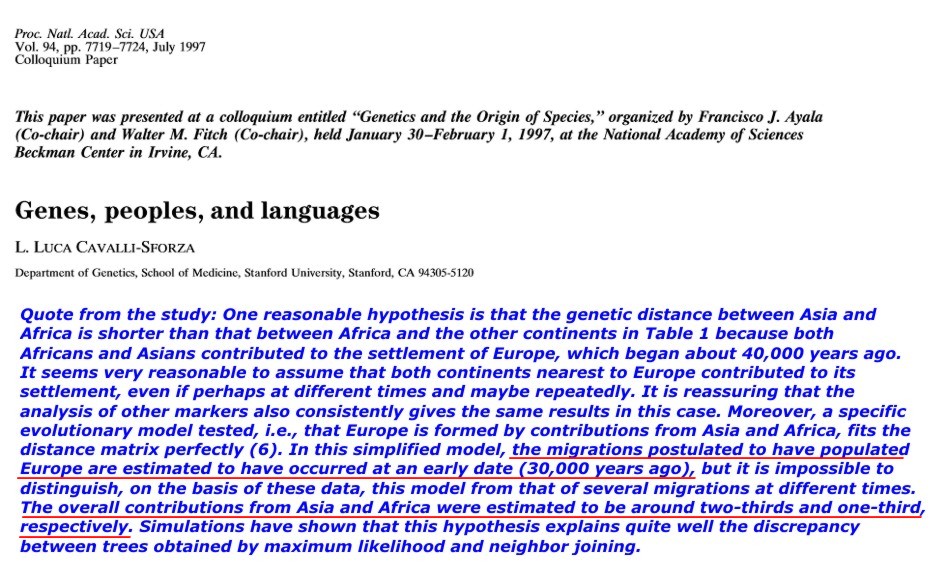
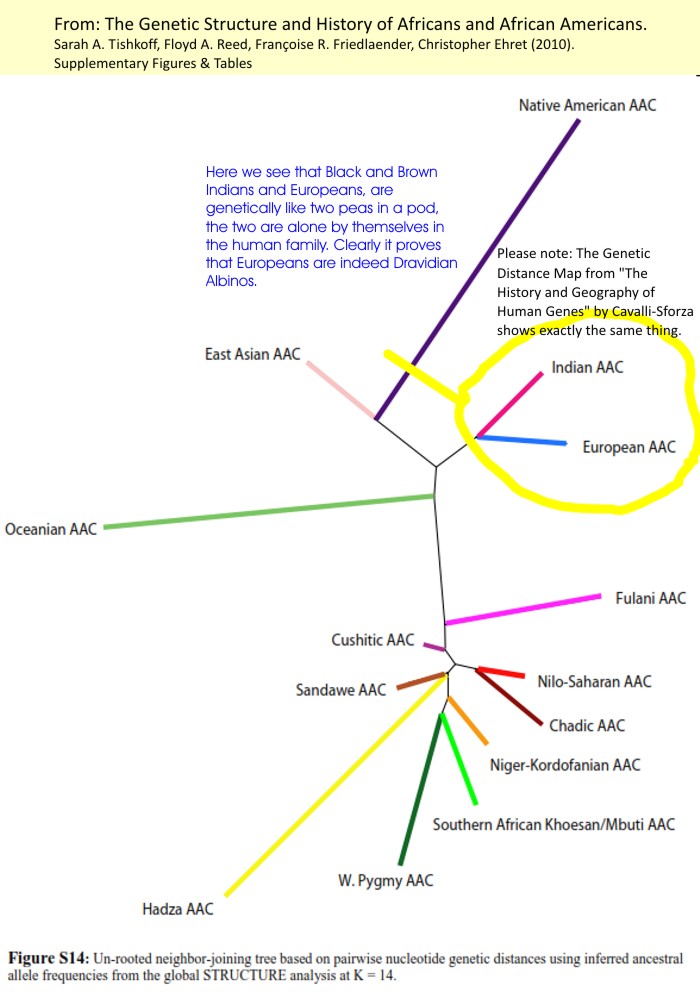
The final proof that Europeans are Albinos derived from Dravidian Indians, is the Genetic Distance Maps created by the studies:
"Genetic Distance Map from The History and Geography of Human Genes" by Cavalli-Sforza.
And "The Genetic Structure and History of Africans and African Americans" by Sarah A. Tishkoff.
Both genetic maps show that Black and Brown Indians, and White Europeans, are alone together, separate from all other humans, like two peas in a pod. The only difference is that one group is pigmented, and the other is not! One group is Albino, the other is not!
|
 |
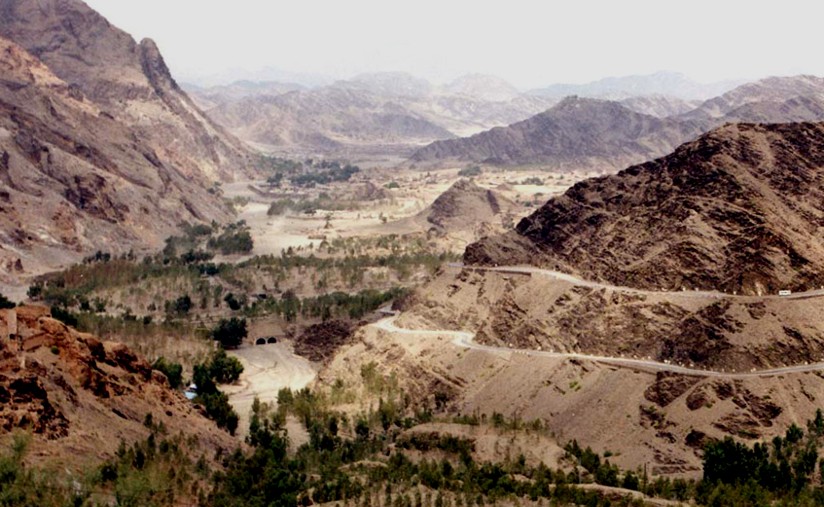
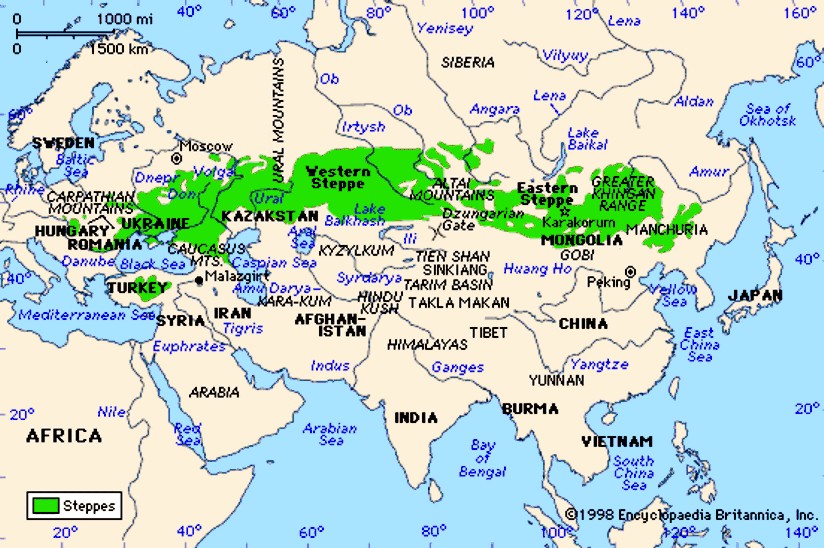
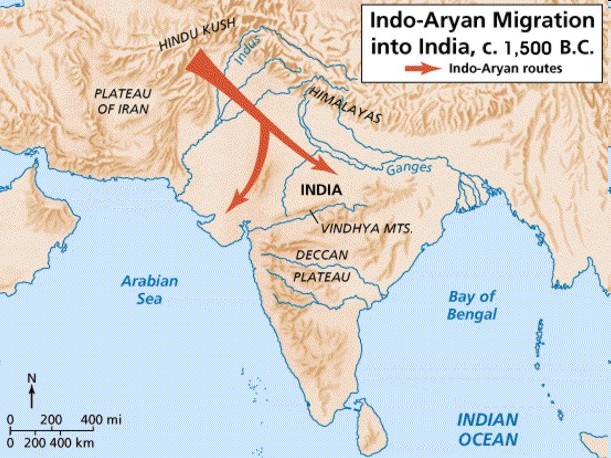
The Albinos finding India not much better than Africa, at some point, decided to head further north. They found a pass through the Hindu Kush mountain range, now called the "The Khyber Pass" they passed through it, and entered the grasslands (Steppes) of Central Asia, where they settled. It seems logical to assume that over the many thousands of years that it took for these migrants to reach northern Asia, and their close proximity there, that there would have been some interbreeding between the Mongols and the Albinos; which probably allowed the Albinos to gain some fixed degree of pigmentation. Proof of this admixture, is in the fact that Whites and Mongols (Chinese), both share the same founding Y-DNA haplogroup "K". Which seems to have evolved during their migration to northern Asia, but while they were still in Southern Asia. Haplogroup "K" is not found in Africa - of course the founding haplogroup of "K" is found in Africa. Also, as we know from everyday life, the product of Black and White mating, often has a slight Yellow hue to the complexion.
The Khyber Pass
The Khyber Pass (altitude: 3,510 ft) is a mountain pass linking Pakistan and Afghanistan. The Pass was an integral part of the ancient Silk Road and throughout history, it has been an important trade route between Central Asia and South Asia. The summit of the Khyber Pass is 5 kilometres (3.1 mi) inside Pakistan at Landi Kotal and it cuts through the northeastern part of the Safed Koh mountains which themselves are a far southeastern extension of the Hindu Kush range.
The Khyber Pass
The Eurasian Steppes
A good understanding of the Albinos life in Central Asia may be gained from "The Cambridge History of Early Inner Asia". But Blacks must be aware that like any works by Albinos, there is a willful attempt to obfuscate Blacks by including them without identifying them. The history of Eastern Europe, and the Apadana pages of this site will serve as good reference.
The Cambridge History of Early Inner Asia is available on-line:
http://www.scribd.com/doc/34133754/31/The-Sabirs
The Kurgan hypothesis
By the mid-fifties, some non-Albino researchers realized that the Albinos European history was totally bogus and impossible to believe. Thus the Kurgan hypothesis was introduced by Marija Gimbutas in 1956; combining kurgan archaeology with linguistics to locate the origins of the Proto-Indo-European (PIE) speaking peoples (White People). The "Kurgan hypothesis" of Proto-Indo-European (PIE) origins assumes gradual expansion of the "Kurgan culture" until it encompasses the entire pontic steppe, Kurgan IV being identified with the Yamna culture of around 3000 B.C. Subsequent expansion beyond the steppes leads to hybrid cultures, such as the globular amphora culture to the west, the immigration of proto-Greeks to the Balkans and the nomadic Indo-Iranian cultures to the east around 2500 B.C. The domestication of the horse, and later the use of early chariots is assumed to have increased the mobility of the Kurgan culture, facilitating the expansion over the entire Yamna region. In the Kurgan hypothesis, the entire pontic steppes are considered the PIE Urheimat, and a variety of late PIE dialects is assumed to have been spoken across the region. The area near the Volga is the location of the earliest known traces of horse-riding, and would correspond to an early PIE or pre-PIE nucleus of the 5th millennium B.C.
The Pontic steppe
The Pontic steppe covers an area of 994,000 square kilometres (384,000 sq mi), extending from eastern Romania across southern Moldova, Ukraine, Russia and northwestern Kazakhstan to the Ural Mountains. The Pontic steppe is bounded by the East European forest steppe to the north, a transitional zone of mixed grasslands and temperate broadleaf and mixed forests.
To the south, the Pontic steppe extends to the Black Sea, excepting the Crimean and western Caucasus mountains' border with the sea, where the Crimean Submediterranean forest complex defines the southern edge of the steppes. The steppe extends to the western shore of the Caspian Sea in the Dagestan region of Russia, but the drier Caspian lowland desert lies between the Pontic steppe and the northwestern and northern shores of the Caspian. The Kazakh Steppe bounds the Pontic steppe on the southeast.
Gimbutas identifies four successive stages of the Kurgan culture and three successive "waves" of expansion.
1) Kurgan I, Dnieper/Volga region, earlier half of the 4th millennium B.C. Apparently evolving from cultures of the Volga basin, subgroups include the Sarama and Seroglasovka cultures.
2) Kurgan II–III, latter half of the 4th millennium B.C. Includes the Srednij-Stog cultures and the Maikop culture of the northern Caucasus. Stone circles, early two-wheeled chariots, anthropomorphic stone stelae of deities.
3) Kurgan IV or Yamna culture, first half of the 3rd millennium B.C, encompassing the entire steppe region from the Ural to Romania.
Wave 1, predating Kurgan I, expansion from the lower Volga to the Dnieper, leading to coexistence of Kurgan I and the Cucuteni culture. Repercussions of the migrations extend as far as the Balkans and along the Danube to the Vinca and Lengyel cultures in Hungary.
Wave 2, mid 4th millennium B.C, originating in the Maikop culture and resulting in advances of "kurganized" hybrid cultures into northern Europe around 3000 B.C. In the view of Gimbutas, this would correspond to the first intrusion of Indo-European languages into western and northern Europe.
Wave 3, 3000–2800 B.C, expansion of the Yamna culture beyond the steppes, with the appearance of the characteristic pit graves as far as the areas of modern Romania, Bulgaria and eastern Hungary.
Secondary Urheimat
The "kurganized" globular amphora culture in Europe is proposed as a "secondary Urheimat", separating into the bell beaker and corded ware cultures around 2300 B.C. and ultimately resulting in the European branches of Italic, Celtic and Germanic languages, and other, partly extinct, language groups of the Balkans and central Europe, possibly including the proto-Mycenaean invasion of Greece.
Gimbutas viewed the expansions of the Kurgan culture as a series of essentially hostile, military invasions where a new warrior culture imposed itself on the peaceful, matriarchal Black cultures of "Old Europe", replacing it with a patriarchal warrior society, a process visible in the appearance of fortified settlements and hillforts and the graves of warrior-chieftains:
The Process of Indo-Europeanization was a cultural, not a physical transformation. It must be understood as a military victory in terms of imposing a new administrative system, language and religion upon the indigenous groups.
In her later life, Gimbutas increasingly emphasized the violent nature of this transition from the Mediterranean cult of the Mother Goddess to a patriarchal society and the worship of the warlike Thunderer (Zeus, Dyaus), to a point of essentially formulating feminist archaeology. Many scholars who accept the general scenario of Indo-European migrations proposed, maintain that the transition may well have been much more peaceful and gradual than suggested by Gimbutas. The migrations were certainly not a sudden, concerted military operation, but the expansion of disconnected tribes and cultures, spanning many generations. But to what degree the indigenous cultures were peacefully amalgamated or violently displaced remains a matter of controversy among supporters of the Kurgan hypothesis. Note; our analysis indicates that the invasion of Greece took place later than the time suggested by Gimbutas. Though Gimbutas's hypothesis was way-off in timeframe, the concept was correct.
Central Asia
Though most Dravidian Albinos left Central Asia for Europe from ancient times: due to Mongol pressure and/or a desire for better lands. Some Dravidian Albinos remained in Central Asia, their descendants are clearly visible there today.
Note: we do understand that the average person - after a lifetime of the Albino lie that they (Albinos) are native to the Black Mans Ancient Home of Europe - finds this material hard to believe. So, under the heading of: "Strange Bedfellows" We have this quote from the "Race Experts" at "STORMFRONT:"
Quote: Today's Central Asians are extensively mixed-race with both White and East Asian blood and the White element is older since the Whites were there first and are the indigenous people of Central Asia. |
 |
|
 |
 |
 |
Update 2014:
Eureka! The Albinos have finally admitted where they come from!

As you ponder what this admission means, you might also consider what nonsense like this means:
If you Google "Where do White people come From" the second result that you will get is this Livescience article; (the first result is Stormfront - go ahead and read it for a laugh).
Why Did People Become White?
Heather Whipps, September 01, 2009
QUOTE: Vitamin D plays an important role in bone growth and the body's natural protection against certain diseases, and the inability to absorb enough in areas of less-powerful sunlight would have decreased life expectancies in our African ancestors. The further north they trekked, the more vitamin D they needed and the lighter they got over the generations, due to natural selection.
Also: While people of all skin types have the ability to produce the same amount of vitamin D in their systems, “highly pigmented (Black) people will need to stay in the sun around 6 times longer than light people in order to synthesize the same amount of vitamin D,” Juzeniene said, and a lack of the vitamin — something occurring among many American children right now, partly because they don't get out much — can make humans more susceptible to everything from heart disease to internal cancers.
That is of course "Pure" lie:
In the last century, cases of Rickets (often caused by lack of Vitamin D) was epidemic in Europe and North America. So much so, that they had to start adding Vitamin D in the manufacture of their Milk, Cereals, Cheeses, and such. This was NOT done for Blacks - who don't need it, it was done for Albino people, who desperately needed it.
THE REASON FOR SUCH RIDICULOUS STATEMENTS AND LIES IS THIS:
If Africans went into Europe circa 45,000 B.C. and STAYED Black.
Then modern Europeans MUST have ALWAYS been WHITE!
i.e. ALBINOS!
See: the section "Indus Valley-2" and other pages for the history of Europeans.
|
Aside from all the Common sense and scientific
debunkings of that Silly concept - There is THIS!
_________________________________________________________________________________________
HOWEVER! Just as one group of Albino people had decided to admit that they came from Central Asia, and had ALWAYS been White, and thus derived from Dravidian Albinos. Other groups were pressing ahead with new lies to buttress European claims of being Black Africans who turned White because of Vitamin D deficiency. But these new claims have a twist, one would suppose to keep up with the times.
The "Supposed" New research is reported by YahooNews.com from LiveScience. Link to the on-line Newsstory
And the Daily Mail U.K. online. Link to the on-line Newsstory
Nature - International weekly Journal of science (no comment) also carried the story. Link to on-line Newsstory
The LiveScience Headline says: 7,000-Year-Old Human Bones Suggest New Date for Light-Skin Gene
And the Daily Mail U.K. Headline says: Light skin in Europeans stems from ONE 10,000-year-old ancestor who lived between India and the Middle East, claims study
The reason for these nonsensical proclamations is THIS, as summed up by LiveScience:
An ancient European hunter-gatherer man had dark skin and blue eyes, a new genetic analysis has revealed. The analysis of the man, who lived in modern-day Spain only about 7,000 years ago, shows light-skin genes in Europeans evolved much more recently than previously thought.
Lets take those points individually
. Hunter-gatherers, some of them blue-eyed, who came from Africa more than 40,000 years ago
They would have looked like THIS:
. Middle Eastern farmers who migrated west much more recently
They would have looked like THIS:
. A mysterious population whose range may have spanned northern Europe and Siberia
We have no idea who that could be, unless they are talking about "Modern" Europeans AFTER they had migrated from Central Asia.
Actual White History
Ever since their ascension to power in Europe some two hundred years ago, the European Albinos have dedicated all of their time and energies towards substantiating their bogus European and African history, with falsified artifacts and vicarious texts, rather than collecting data and artifacts from their own actual Asian history. This behavior is new and strange, and so cannot be understood by the non-Albino mind. For though in times past, it was common for rulers who came from humble beginnings and had usurped power, to manufacture a grandiose past for themselves, in order to legitimize their new-found status. It is unheard of for an entire race to do it, or rather try. Thus articles like the following on the Yuezhi, is likely filled with error, but because of the Albinos neglect of their own true history, it is the state of knowledge at this time.
Hephthalites
After crossing Hindu Kush mountain range and entering Central Asia, the Dravidian Albinos then spread eastward. The most eastern Albino tribe that we yet know of is the Hoa or Hoadun, known in the west as Hephthalites, White Huns or Hunas. Encyclopedia Britannica says this about them:
Hephthalite, also spelled Ephthalite, member of a people important in the history of India and Persia during the 5th and 6th centuries A.D. According to Chinese chronicles, they were originally a tribe living to the north of the Great Wall and were known as Hoa or Hoadun. Elsewhere they were called White Huns or Hunas. They had no cities or system of writing, lived in felt tents, and practiced polyandry. In the 5th and 6th centuries the Hephthalites repeatedly invaded Persia and India. In the mid-6th century, under the attacks of the Turks, they ceased to exist as a separate people and were probably absorbed into the surrounding population. Nothing is known of their language.
It must be noted that the Hephthalites were no relation to the Black Huns, they merely called themselves Huns in order to terrify their enemies.
The Yuezhi
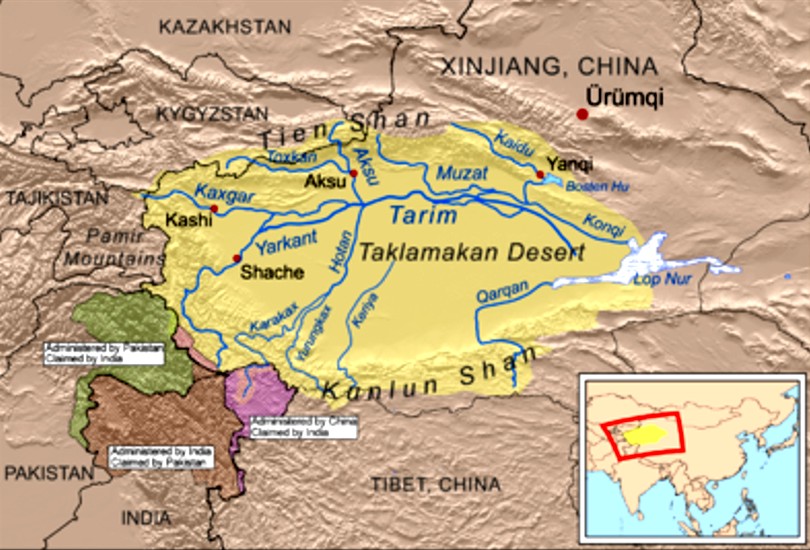
The Yuezhi, or Rouzhi were another ancient Central Asian people. They are believed by most scholars to have been an Indo-European people and may have been the same as or closely related to the Tocharians of Classical sources (this is disputed). They were originally settled in the arid grasslands of the eastern Tarim Basin area, in what is today Xinjiang and western Gansu, in China, before they migrated to Transoxiana, Bactria and then northern South Asia, where they may have had a part in forming the Kushan Empire.
There are numerous theories about the derivation of the name Yuezhi, and none has yet found general acceptance. According to Zhang Guang-da, the name Yuezhi is a transliteration of their own name for themselves, the Visha ("the tribes"), being called the Vijaya in Tibetan.
Origins
The first known references to the Yuezhi are contained in the Yizhoushu, Guanzi Essays: 73: 78: 80: 81) and Tale of King Mu, Son of Heaven. The dates of the most common version of this book are disputed, however, and it may date to as late as the 1st century B.C. The book described the Yuzhi, or Niuzhi, as a people from the northwest who supplied jade to the Chinese. The supply of jade from the Tarim Basin from ancient times is indeed well documented archaeologically: "It is well known that ancient Chinese rulers had a strong attachment to jade. All of the jade items excavated from the tomb of Fuhao of the Shang dynasty, more than 750 pieces, were from Khotan in modern Xinjiang. As early as the mid-first millennium B.C. the Yuezhi engaged in the jade trade, of which the major consumers were the rulers of agricultural China." (Liu (2001), pp. 267–268). The suffix Di or Zhi was generally used to describe the Di people, called "Western barbarians", in Han Dynasty-era Chinese annals.
 |
According to former USSR scholar Zuev, there was a queen among the large Yuezhi confederation who added to her possessions the lands of the Tochar (Pinyin: Daxia) on the headwaters of the Huanghe c. 3rd century BCE. According to Zuev, the Chinese chronicles began referring to the queen's tribe as the Great Yuezhi (Da Yuezhi) and to the Tochars as the Lesser Yuezhi (Pinyin: Xiao Yuezhi). Together, they were simply called Yuezhi. In the 5th century CE, scholar, translator and monk Kumarajiva, while translating texts into Chinese, used the name Yuezhi to translate Tochar. In the middle of the 2nd century B.C. the Yuezhi conquered Bactria, and the Ancient Greek authors inform us that the conquerors of Bactria were the Asii and Tochari tribes. In the Chinese chronicles Bactria then began to be called the country of Daxia, i.e., Tocharistan, and the language of Bactria/Tocharistan began to be called Tocharian.
The Yuezhi are also documented in detail in Chinese historical accounts, in particular the 2nd-1st century BCE Records of the Great Historian, or Shiji, by Sima Qian. According to these accounts:
Quote: "The Yuezhi originally lived in the area between the Qilian or Heavenly Mountains (Tian Shan) and Dunhuang, but after they were defeated by the Xiongnu they moved far away to the west, beyond Dayuan, where they attacked and conquered the people of Daxia and set up the court of their king on the northern bank of the Gui [= Oxus] River. A small number of their people who were unable to make the journey west sought refuge among the Qiang barbarians in the Southern Mountains, where they are known as the Lesser Yuezhi."
The Qilian and Dunhuang original homeland of the Yuezhi has recently been argued not to refer to the current locations in Gansu, but to the Tian Shan range and the Turpan region, 1,000 km to the west, Dunhuang being identified with a mountain named Dunhong listed in the Shanhaijing. The Yuezhi were a Caucasoid people, as indicated by the portraits of their kings on the coins they struck following their exodus to Transoxiana (2nd-1st century B.C.), some old place names in Gansu explainable in Tocharian languages, and especially the coins they struck in India as Kushans (1st-3rd century A.D.).
 |
Ancient Chinese sources do describe the existence of "white people with long hair" (the Bai people of the Shan Hai Jing) beyond their northwestern border. Very well-preserved Tarim mummies with Caucasian features, today displayed at the Ürümqi Museum and dated to the 3rd century B.C. were found at the ancient oasis on the Silk Road, Niya. It should be noted that though the attribution of reddish can be because of Bog chemicals, Embalming chemicals, or the use of Henna to color the hair: (for example, even African mummies also have so-called reddish hair but are clearly not White or European). But the Reddish or blond hair of these mummies must be natural, as no chemicals were present in Tarim graves. Additionally, genetic testing and skull examples have shown conclusively that Caucasian genetic material is present in this area. Blond hair among the Tocharian mummies is also common.
According to one theory, the Yuezhi were probably part of the large migration of Indo-European-speaking peoples who were settled in eastern Central Asia at that time. The nomadic people of the Ordos culture, who lived in northern China, east of the Yuezhi, are another example. Also, the Caucasian mummies of Pazyryk, which were probably Scythian in origin, were found around 1,500 kilometers northwest of the Yuezhi and date to around the 3rd century B.C.
According to Han Dynasty accounts, the Yuezhi "were flourishing" during the time of the first great Chinese Qin emperor, but were regularly in conflict with the neighboring tribe of the Xiongnu to the Northeast."
The Yuezhi exodus
The Yuezhi sometimes practiced the exchange of hostages with the Xiongnu, and at one time, were hosts to Modu Shanyu, son of the Xiongnu leader. Modu stole a horse and escaped when the Yuezhi tried to kill him in retaliation for an attack by his father. Modu subsequently became ruler of the Xiongnu after killing his father.
Shortly before 174 B.C. led by one of Modu's tribal chiefs, the Xiongnu invaded Yuezhi territory in the Gansu region and achieved a crushing victory. Modu boasted in a letter (174 B.C.) to the Han emperor that due to "the excellence of his fighting men, and the strength of his horses, he has succeeded in wiping out the Yuezhi, slaughtering or forcing to submission every number of the tribe." The son of Modu, Laoshang Chanyu, subsequently killed the king of the Yuezhi and, in accordance with nomadic traditions, "made a drinking cup out of his skull." (Shiji 123. Watson 1961:231).
Following Chinese sources, a large part of the Yuezhi people therefore fell under the domination of the Xiongnu, and these may have been the ancestors of the Tocharian speakers attested in the 6th century A.D. A very small group of Yuezhi fled south to the territory of the Proto-Tibetan Qiang and came to be known to the Chinese as the "Small Yuezhi". According to the Hanshu, they only numbered around 150 families.
Finally, a large group of the Yuezhi fled from the Tarim Basin towards the Northwest, first settling in the Ili valley, immediately north of the Tian Shan mountains, where they confronted and defeated the Sai (Sakas or Scythians): "The Yuezhi attacked the king of the Sai who moved a considerable distance to the south and the Yuezhi then occupied his lands" (Han Shu 61 4B). The Sai undertook their own migration, which was to lead them as far as Kashmir, after travelling through a "Suspended Crossing" (probably the Khunjerab Pass between present-day Xinjiang and northern Pakistan). The Sakas ultimately established an Indo-Scythian kingdom in northern India.
 |
 |
After 155 B.C. the Wusun, in alliance with the Xiongnu and out of revenge from an earlier conflict, managed to dislodge the Yuezhi, forcing them to move south. The Yuezhi crossed the neighbouring urban civilization of the Dayuan in Ferghana and settled on the northern bank of the Oxus, in the region of Transoxiana, in modern-day Tajikistan and Uzbekistan, just north of the Hellenistic Greco-Bactrian kingdom. The Greek city of Alexandria on the Oxus was apparently burnt to the ground by the Yuezhi around 145 B.C.
Settlement in Transoxiana
Chinese Emperor Wu-di Han sent a Chinese mission to the Yuezhi, led by Zhang Qian in 126 B.C. they were seeking an offensive alliance with the Yuezhi to counter the Xiongnu threat to the north. Although the request for an alliance was denied by the son of the slain Yuezhi king, who preferred to maintain peace in Transoxiana rather than to seek revenge, Zhang Qian made a detailed account, reported in the Shiji, that gives considerable insight into the situation in Central Asia at that time.
Zhang Qian, who spent a year with the Yuezhi in Bactria, relates that "the Great Yuezhi live 2,000 or 3,000 li (832-1,247 kilometers) west of Dayuan (Ferghana), north of the Gui (Oxus) river. They are bordered on the south by Daxia (Bactria), on the west by Anxi (Parthia), and on the north by Kangju (beyond the middle Jaxartes). They are a nation of nomads, moving from place to place with their herds, and their customs are like those of the Xiongnu. They have some 100,000 or 200,000 archer warriors."
Although they remained north of the Oxus for a while, they apparently obtained the submission of the Greco-Bactrian kingdom to the south of the Oxus. The Yuezhi were organized into five major tribes, each led by a yabgu, or tribal chief, and known to the Chinese as Xiūmì in Western Wakhān and Zibak, Guishuang in Badakhshan and the adjoining territories north of the Oxus, Shuangmi in the region of Shughnan, Xidun in the region of Balkh, and Dūmì in the region of Termez.
A description of the Greco-Bactrian kingdom was made by Zhang Qian after the conquest by Yuezhi:
Quote: "Daxia (Greco-Bactria) is located over 2,000 li southwest of Dayuan, south of the Gui (Oxus) river. Its people cultivate the land and have cities and houses. Their customs are like those of Ta-Yuan. It has no great ruler but only a number of petty chiefs ruling the various cities. The people are poor in the use of arms and afraid of battle, but they are clever at commerce. After the Great Yuezhi moved west and attacked the lands, the entire country came under their sway. The population of the country is large, numbering some 1,000,000 or more persons. The capital is called the city of Lanshi (Bactra) (modern Balkh) and has a market where all sorts of goods are bought and sold."
In 126 B.C. Zhang Qian reports that "although the states from Dayuan west to Anxi (Parthia), speak rather different languages, their customs are generally similar and their languages mutually intelligible. The men have deep-set eyes and profuse beards and whiskers. They are skilful at commerce and will haggle over a fraction of a cent. Women are held in great respect, and the men make decisions on the advice of their women."
(Tacitus makes the same observation, much later, after the Albinos have settled into western Europe).
Quote: The Roman historian Cornelius Tacitus (56-118 A.D.) said this about them: For my own part, I agree with those who think that the tribes of Germany are free from all taint of intermarriages with foreign nations, and that they appear as a distinct, unmixed race, like none but themselves. Hence, too, the same physical peculiarities throughout so vast a population. All have fierce blue eyes, red hair, huge frames, fit only for a sudden exertion. They are less able to bear laborious work. Heat and thirst they cannot in the least endure; to cold and hunger their climate and their soil inure them.
Germany Book 1
(On the Germans going into Battle)
7. They also carry with them into battle certain figures and images taken from their sacred groves. And what most stimulates their courage is, that their squadrons or battalions, instead of being formed by chance or by a fortuitous gathering, are composed of families and clans. Close by them, too, are those dearest to them, so that they hear the shrieks of women, the cries of infants. They are to every man the most sacred witnesses of his bravery--they are his most generous applauders. The soldier brings his wounds to mother and wife, who shrink not from counting or even demanding them and who administer both food and encouragement to the combatants.
8. Tradition says that armies already wavering and giving way have been rallied by women who, with earnest entreaties and bosoms laid bare, have vividly represented the horrors of captivity, which the Germans fear with such extreme dread on behalf of their women, that the strongest tie by which a state can be bound is the being required to give, among the number of hostages, maidens of noble birth. They even believe that the sex has a certain sanctity and prescience, and they do not despise their counsels, or make light of their answers.
Invasion of Bactria
In 124 B.C. the Yuezhi were apparently involved in a war against the Parthians, in which the Parthian king Artabanus I of Parthia was wounded and died:
Quote: "During the war against the Tokharians, he (Artabanus) was wounded in the arm and died immediately" (Justin, Epitomes, XLII,2,2: "Bello Tochariis inlato, in bracchio vulneratus statim decedit").
Some time after 124 B.C. possibly disturbed by further incursions of rivals from the north and apparently vanquished by the Parthian king Mithridates II, successor to Artabanus, the Yuezhi moved south to Bactria. Bactria had been conquered by the Greeks under Alexander the Great in 330 B.C. and since settled by the Hellenistic civilization of the Seleucids and the Greco-Bactrians for two centuries. This event is recorded in Classical Greek sources, when Strabo presented them as a Scythian tribe and explained that the Tokharians—together with the Assianis, Passianis and Sakaraulis—took part in the destruction of the Greco-Bactrian kingdom in the second half of the 2nd century B.C.
"Most of the Scythians, beginning from the Caspian Sea, are called Dahae Scythae, and those situated more towards the east Massagetae and Sacae; the rest have the common appellation of Scythians, but each separate tribe has its peculiar name. All, or the greatest part of them, are nomads. The best known tribes are those who deprived the Greeks of Bactriana, the Asii, Pasiani, Tochari, and Sacarauli, who came from the country on the other side of the Jaxartes, opposite the Sacae and Sogdiani." (Strabo, 11-8-1)
The last Greco-Bactrian king, Heliocles I, retreated and moved his capital to the Kabul Valley. The eastern part of Bactria was occupied by Pashtun people. As they settled in Bactria from around 125 B.C. the Yuezhi became Hellenized to some degree, as suggested by their adoption of the Greek alphabet and by some remaining coins, minted in the style of the Greco-Bactrian kings, with the text in Greek. The area of Bactria they settled came to be known as Tokharistan, since the Yuezhi were called "Tocharians" by the Greeks.
Commercial relations with China also flourished, as many Chinese missions were sent throughout the 1st century B.C. "The largest of these embassies to foreign states numbered several hundred persons, while even the smaller parties included over 100 members. In the course of one year anywhere from five to six to over ten parties would be sent out." (Shiji, trans. Burton Watson). The Hou Hanshu also records the visit of Yuezhi envoys to the Chinese capital in 2 B.C. who gave oral teachings on Buddhist sutras to a student, suggesting that some Yuezhi already followed the Buddhist faith during the 1st century B.C. (Baldev Kumar (1973)).
A later Chinese annotation in Shiji made by Zhang Shoujie during the early 8th century, quoting Wan Zhen's s Strange Things from the Southern Region (Nanzhouzhi, a now-lost third century text of from the Wu kingdom), describes the Kushans as living in the same general area north of India, in cities of Greco-Roman style, and with sophisticated handicraft. The quotes are dubious, as Wan Zhen probably never visited the Yuezhi kingdom through the Silk Road, though he might have gathered his information from the trading ports in the coastal south. The Chinese never adopted the term Guishuang and continued to call them Yuezhi:
"The Great Yuezhi [Kushans] is located about seven thousand li (about 3000 km) north of India. Their land is at a high altitude; the climate is dry; the region is remote. The king of the state calls himself "son of heaven". There are so many riding horses in that country that the number often reaches several hundred thousand. City layouts and palaces are quite similar to those of Daqin (the Roman empire). The skin of the people there is reddish white. People are skilful at horse archery. Local products, rarities, treasures, clothing, and upholstery are very good, and even India cannot compare with it."
Expansion into the Hindu-Kush
The area of the Hindu-Kush (Paropamisade) was ruled by the western Indo-Greek king until the reign of Hermaeus (reigned c. 90 BCE–70 BCE). After that date, no Indo-Greek kings are known in the area, which was probably overtaken by the neighbouring Yuezhi, who had been in relation with the Greeks for a long time. According to Bopearachchi, no trace of Indo-Scythian occupation (nor coins of major Indo-Scythian rulers such as Maues or Azes I) have been found in the Paropamisade and western Gandhara.
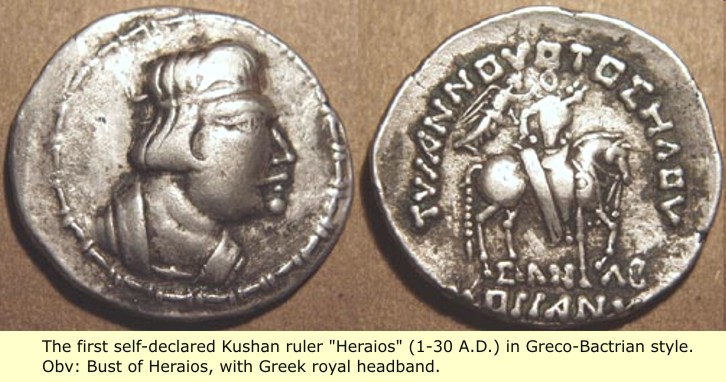
As they had done in Bactria with their copying of Greco-Bactrian coinage, the Yuezhi copied the coinage of Hermeaus on a vast scale, up to around 40 A.D. when the design blends into the coinage of the Kushan king Kujula Kadphises. The first presumed, and documented, Yuezhi prince is Sapadbizes (probably a yabgu's prince of Yuezhi confederation), who ruled around 20 BCE and minted in Greek and in the same style as the western Indo-Greek kings.
Foundation of the Kushan empire
By the end of the 1st century B.C. one of the five tribes of the Yuezhi, the Guishuang, origin of name Kushan adopted in the West), managed to take control of the Yuezhi confederation. From that point, the Yuezhi extended their control over the northwestern area of the Indian subcontinent, founding the Kushan Empire, which was to rule the region for several centuries. The Yuezhi came to be known as Kushan among Western civilizations; however, the Chinese kept calling them Yuezhi throughout their historical records over a period of several centuries. The Yuezhi/Kushans expanded to the east during the 1st century A.D. to found the Kushan Empire. The first Kushan emperor, Kujula Kadphises, ostensibly associated himself with Hermaeus on his coins, suggesting that he may have been one of his descendants by alliance, or at least wanted to claim his legacy.
The unification of the Yuezhi tribes and the rise of the Kushan are documented in the Chinese Historical chronicle, the Hou Hanshu:
Quote: "More than a hundred years later, the xihou "Allied Prince") of Guishuang (Badakhshan and the adjoining territories north of the Oxus), named Qiujiu Que, Kujula Kadphises) attacked and exterminated the four other xihou ("Allied Princes"). He set himself up as king of a kingdom called Guishuang (Kushan). He invaded Anxi (Parthia) and took the Gaofu (Kabul) region. He also defeated the whole of the kingdoms of Puda (Ch: and Jibin (Ch: Kapiśa-Gandhāra). Qiujiu Que (Kujula Kadphises) was more than eighty years old when he died. His son, Yan Gaozhen (Vima Takto), became king in his place. He returned and defeated Tianzhu (Northwestern India) and installed a General to supervise and lead it. The Yuezhi then became extremely rich. All the kingdoms call [their king] the Guishuang (Kushan) king, but the Han call them by their original name, Da Yuezhi." (Hou Hanshu, trans. John Hill.
 |
The Yuezhi/Kushan integrated Buddhism into a pantheon of many deities and became great promoters of Mahayana Buddhism, and their interactions with Greek civilization helped the Gandharan culture and Greco-Buddhism flourish. During the 1st and 2nd century, the Kushan Empire expanded militarily to the north and occupied parts of the Tarim Basin, their original grounds, putting them at the center of the lucrative Central Asian commerce with the Roman Empire.
In recognition of their support to the Chinese, the Kushans requested, but were denied, a Han princess, even after they had sent presents to the Chinese court. In retaliation, they marched on Ban Chao in 86 A.D. with a force of 70,000 but, exhausted by the expedition, were finally defeated by the smaller Chinese force. The Kushans retreated and paid tribute to the Chinese Empire during the reign of the Chinese emperor Han He (89-106).
About 120 A.D. Kushan troops installed Chenpan—a prince who had been sent as a hostage to them and had become a favorite of the Kushan Emperor—on the throne of Kashgar, thus expanding their power and influence in the Tarim Basin, and introduced the Brahmi script, the Indian Prakrit language for administration, and Greco-Buddhist art, which developed into Serindian art.
Benefiting from this territorial expansion, the Yuezhi/Kushans were among the first to introduce Buddhism to northern and northeastern Asia, by direct missionary efforts and the translation of Buddhist scriptures into Chinese. Major Yuezhi missionaries and translators included Lokaksema and Dharmaraksa, who went to China and established translation bureaus, thereby being at the center of the Silk Road transmission of Buddhism.
The Chinese kept referring to the Kushans as Da Yuezhi throughout the centuries. In the Sanguozhi it is recorded that in 229 CE, "The king of the Da Yuezhi, Bodiao (Vasudeva I), sent his envoy to present tribute, and His Majesty (Emperor Cao Rui) granted him the title of King of the Da Yuezhi Intimate with the Wei (Ch: Qīn Wèi Dà Yuèzhī Wáng)."
Fall of Kushan
The Sassanid Persians extended their dominion into Bactria during the reign of Ardashir I around 230 A.D.
The Albinos in Central Asia
In Central Asia, the Albinos found a climate which is temperate and semi-arid to semi-humid. Temperature: warm to hot season (often with a cold to freezing season in winter).
Soil: fertile with rich nutrients and minerals.
Plants: grass; trees or shrubs in savanna and shrubland.
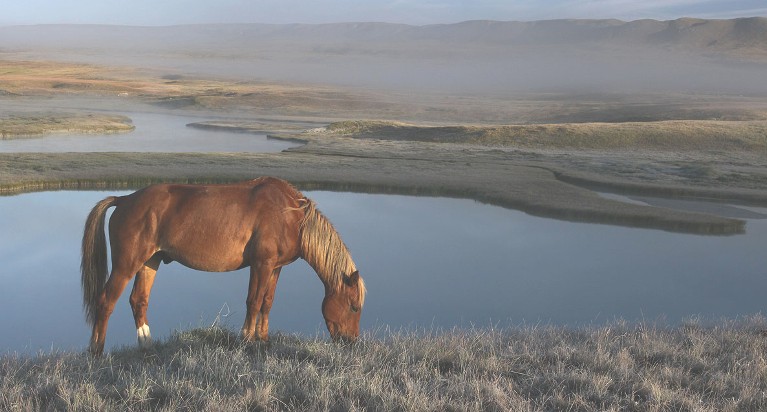
Animals: large, grazing mammals and birds. But most importantly, they found the Horse! Which they undoubtedly at first hunted, but then learned to domesticate.
The Altai region
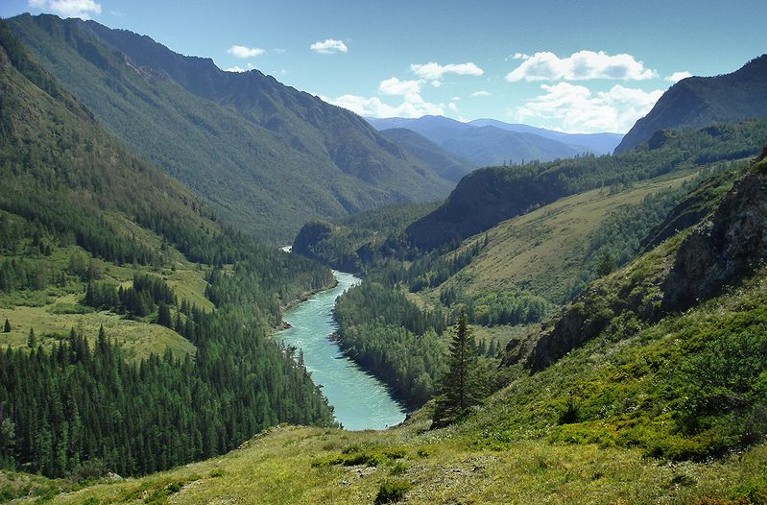
Located in the heart of southwestern Siberia, the Altai region of Russia boasts incredible environmental riches—rolling foothills and grasslands, blue lakes and rivers, and dramatic alpine landscapes that are home to numerous threatened and endangered species. Local residents, especially the native peoples indigenous to the area, rely on Altai’s rich agricultural lands for survival—raising livestock, farming, growing homeopathic herbs, and gathering other non-agricultural forest products. Often called “the cradle of Mongolian and Turkic civilizations,” Altai is home to ancient rock art, or petroglyphs. These sites and artifacts are considered sacred to local indigenous peoples and have important historical and scientific value.
Katun River
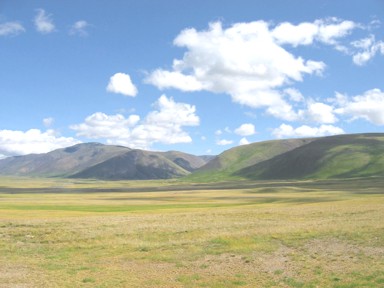
The Ukok Plateau
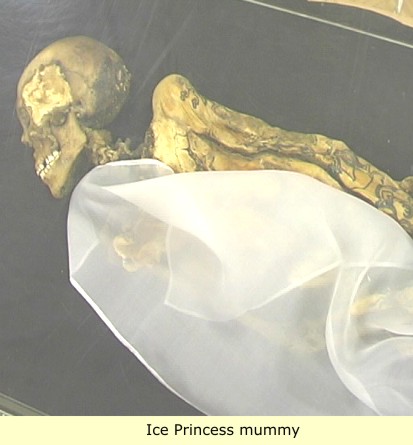
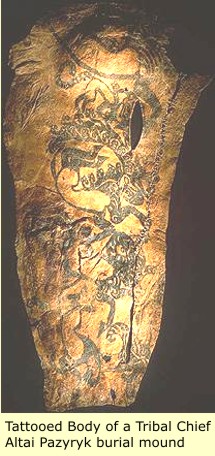
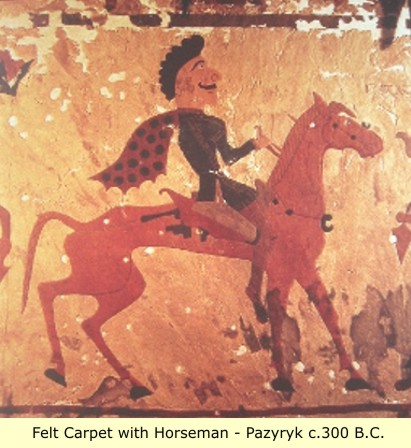
Ukok Plateau is a remote and pristine grasslands area located in the heart of southwestern Siberia, the Altai Mountains region of Russia near the borders with China, Kazakhstan and Mongolia. The Pazyryk is the name of an ancient people who lived in the Altai Mountains on this plateau who are associated with some spectacular archeological findings, including mummies found frozen in the permafrost. Many ancient Bronze Age tomb mounds have been found in the area and have been associated with the Pazyryk culture which closely resembled that of the legendary Scythian people to the west. The term kurgan is in general usage to describe such log-barrow burials. Excavations of this site have continued to yield fascinating archaeological findings. One famous finding is known as the "Ice Princess" excavated by Russian archaeologist, Natalia Polosmak. Three tattooed mummies (c. 300 BC) were extracted from the permafrost of the Ukok Plateau in the second half of the 20th century
Early Nomads
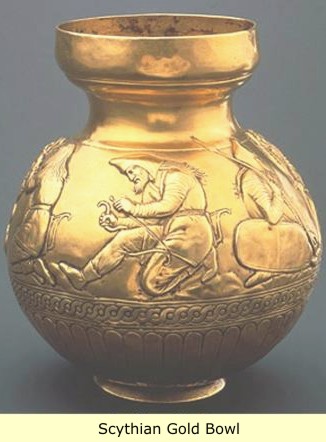
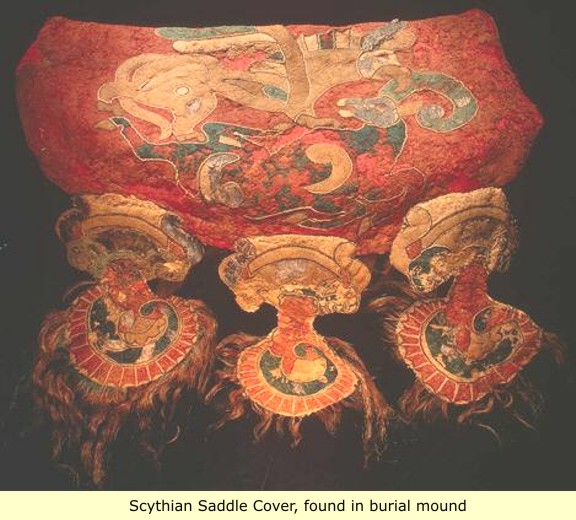
This rich and fascinating collection from the Altai mountains dates to the Scythian-Sakae period (6th–4th centuries BC) and embraces over 5,000 items. At its heart lie the unique articles found during excavation of the burial mounds of Pazyryk in the Eastern part of the High Altai, at a height of 1,600 metres above sea level.
Large Altaic burial mounds were intended for those who occupied high positions in early nomadic society, such as chiefs, elders and priests. According to custom, the chief's wife or concubines was also buried with him and all the dead bodies were embalmed. Deep graves were hollowed out for the burial, and many objects considered both precious and necessary were interred along with the bodies. Of great interest is the body of the chief from Burial Mound No. 2 at Pazyryk. His body was almost completely covered with tattoos, the main motifs being fabulous animals - for these people were hunters. Horses with lavish harness were also usual features in such tumuli.
The Pontic-Caspian steppe is the vast steppeland stretching from the north of the Black Sea (called Pontus Euxinus in antiquity) as far as the east of the Caspian Sea, from western Ukraine across the Southern Federal District and the Volga Federal District of Russia to western Kazakhstan, forming part of the larger Eurasian steppe, adjacent to the Kazakh steppe to the east. The area corresponds to Scythia and Sarmatia of Classical antiquity. Across several millennia the steppe was used by numerous tribes of nomadic horsemen, many of which went on to conquer lands in the settled regions of Europe and in western and southern Asia. It was finally brought under the control of a sedentary people by the Russian Empire in the 16th to 18th centuries.
Pontic-Caspian steppe
The Kurgan
Kurgan is the Russian word (of Turkic origin) for a tumulus, a type of burial mound or barrow, heaped over a burial chamber, often made of wood. The distribution of such tumuli in Eastern Europe corresponds closely to the area of the Pit Grave or Kurgan culture in South-Eastern Europe.
Kurgans were built in the Eneolithic, Bronze, Iron, Antiquity and Middle Ages, with old traditions still existing in Southern Siberia and Central Asia. Kurgan Cultures are divided, archeologically, into different sub-cultures, such as Timber Grave, Pit Grave, Scythian, Sarmatian, Hunnish and Kuman-Kipchak. Burial mounds are complex structures with internal chambers. Within the burial chamber at the heart of the kurgan, elite individuals were buried with grave goods and sacrificial offerings, sometimes including horses and chariots. Kurgans were first used in the Russian Steppes, but spread into eastern, central, and northern Europe, beginning in the third millennium B.C.
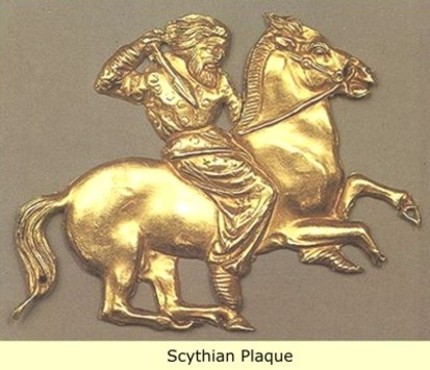 |
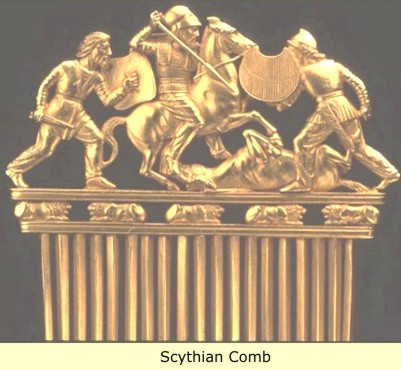 |
The monuments of these cultures coincide with Scythian-Saka-Siberian monuments. Scythian-Saka-Siberian monuments have common features, and sometimes common genetic roots. Also associated with these spectacular burial mounds are the Pazyryk, an ancient people who lived in the Altai Mountains, which lay in Siberian Russia, on the Ukok Plateau, near the borders with China, Kazakhstan and Mongolia.
Scythian-Saka-Siberian classification includes monuments from the 800 B.C. to 300 B.C. This period is called Early or Ancient Nomads epoch. "Hunnic" monuments date from the 300 B.C. to 600 A.D, and other Turkic ones from the 6th century A.D, to the 13th century A.D, leading up to the Mongolian epoch. In all periods, the development of the kurgan structure tradition in the various ethnocultural zones can be distinguished by common components or typical features in the construction of the monuments.
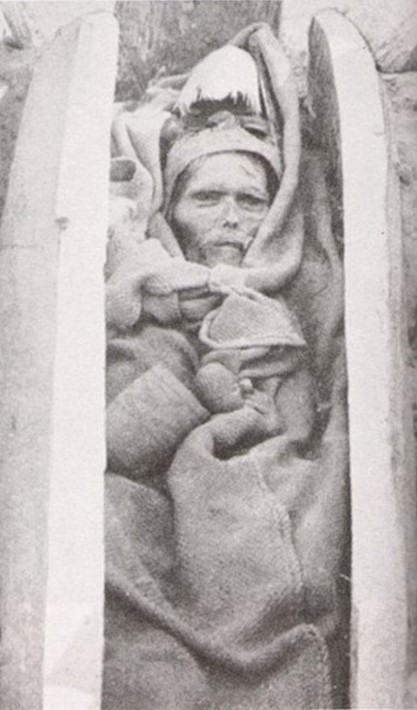
Above we alluded to Albino and Mongol admixture. Further proof of White and Black Mongol admixture is demonstrated with the "Tarim mummies" which are a series of mummies (dating from 1,800 B.C.) discovered in the Tarim Basin in present-day Xinjiang, which is on the border with Central Asia, in northwest China. The oldest mummies are White people, but later, at about 1,100 B.C, they become "mixed-race". See below.
The Mummies of Xinjiang
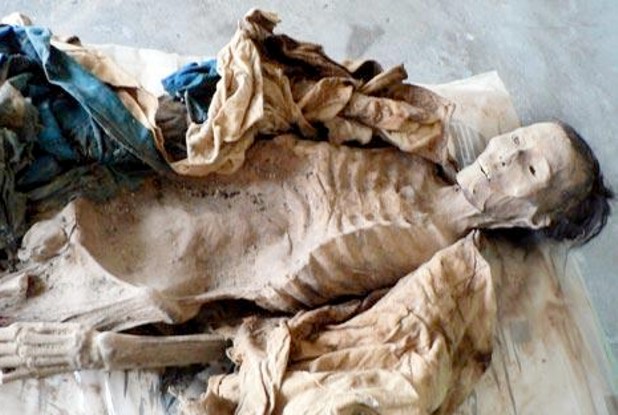
The Tarim mummies are a series of mummies discovered in the Tarim Basin in present-day Xinjiang, China, which date from 1800 B.C. to 200 A.D. Some of the mummies are frequently associated with the presence of the Indo-European Tocharian languages in the Tarim Basin although the evidence is not totally conclusive.
The Archeological record
At the beginning of the 20th century European explorers such as Sven Hedin, Albert von Le Coq and Sir Aurel Stein all recounted their discoveries of desiccated bodies in their search for antiquities in Central Asia. Since then, many other mummies have been found and analysed, most of them now displayed in the museums of Xinjiang. Most of these mummies were found on the eastern (around the area of Lopnur, Subeshi near Turpan, Kroran, Kumul) and southern (Khotan, Niya, Qiemo) edge of the Tarim Basin.
The earliest Tarim mummies, found at Qäwrighul and dated to 1800 B.C, are of a Caucasoid physical type whose closest affiliation is to the Bronze Age populations of southern Siberia, Kazakhstan, Central Asia, and the Lower Volga. The cemetery at Yanbulaq contained 29 mummies which date from 1100–500 B.C, of which 21 are Mongoloid — the earliest Mongoloid mummies found in the Tarim Basin — and 8 of which are of the same Caucasoid physical type found at Qäwrighul.
Notable mummies are the tall, red-haired "Chärchän man" or the "Ur-David" (1000 B.C.); his son, a small 1-year-old baby with blond hair protruding from under a red and blue felt cap, and blue stones in place of the eyes; the "Hami Mummy" (c. 1400–800 B.C.), a "red-headed beauty" found in Qizilchoqa; and the "Witches of Subeshi" (4th or 3rd century B.C.), who wore two foot long black felt conical hats with a flat brim. Also found at Subeshi was a man with traces of a surgical operation on his neck; the incision is sewn up with sutures made of horsehair.
The Loulan Beauty
 |
Wiki:
A 2008 study by Jilin University showed that the Yuansha population has relatively close relationships with the modern populations of South Central Asia and Indus Valley, as well as with the ancient population of Chawuhu.
In 2007 the Chinese government allowed a National Geographic Society team headed by Spencer Wells to examine the mummies' DNA. Wells was able to extract undegraded DNA from the internal tissues. The scientists extracted enough material to suggest the Tarim Basin was continually inhabited from 2000 BCE to 300 BCE and preliminary results indicate the people, rather than having a single origin, originated from Europe, Mesopotamia, Indus Valley and other regions yet to be determined.[citation needed]
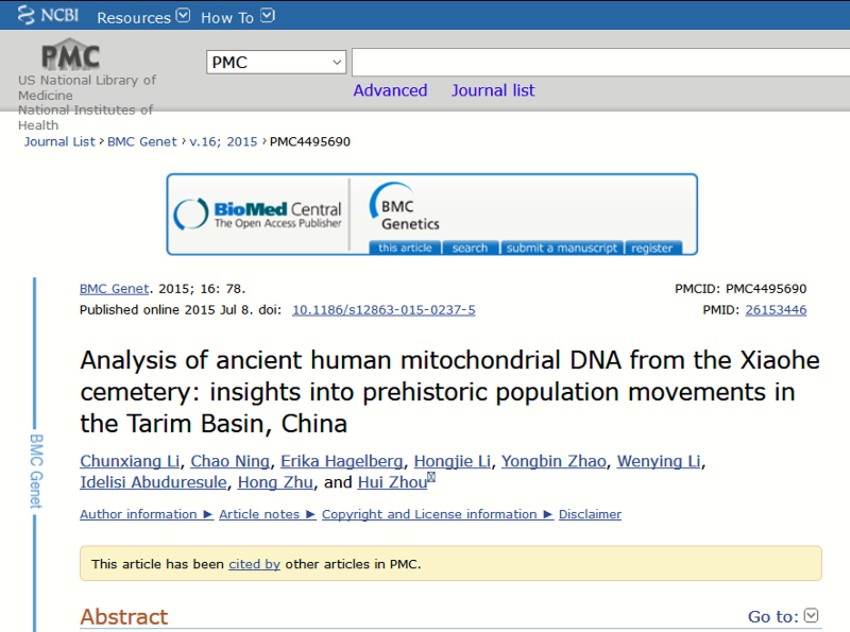
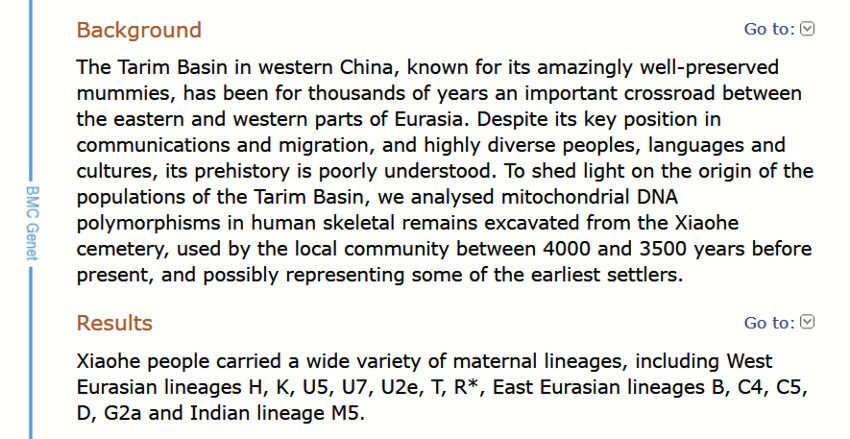
In years 2009-2015, the remains of in total 92 individuals found at the Xiaohe Tomb complex were analyzed for Y-DNA and mtDNA markers.
Genetic analyses of the mummies showed that the Xiaohe people were an admixture from populations originating from both the West and the East. The maternal lineages of the Xiaohe people originated from both East Asia and West Eurasia, whereas the paternal lineages all originated from West Eurasia.
Mitochondrial DNA analysis showed that maternal lineages carried by the people at Xiaohe included mtDNA haplogroups H, K, U5, U7, U2e, T and R*, which are now most common in West Eurasia. Also found were haplogroups common in modern populations from East Asia: B5, D and G2a. Haplogroups now common in Central Asian or Siberian populations included: C4 and C5. Haplogroups later regarded as typically South Asian includedM5 and M*.
The paternal lines of male remains surveyed nearly all – 11 out of 12, or around 92% – belonged to Y-DNA haplogroup R1a1, which are now most common in West Eurasia; the other belonged to the exceptionally rare paragroup K* (M9).
The geographic location of this admixing is unknown, although south Siberia is likely.
According to a comment posted on 18 July 2014 by one of study co-authors - prof. Hui Zhou - Xiaohe R1a1 lineages does not belong to R-Z93 branch and the study supports the "steppe hypothesis".
It has been asserted that the textiles found with the mummies are of an early European textile type based on close similarities to fragmentary textiles found in salt mines in Austria, dating from the second millennium BCE. Anthropologist Irene Good, a specialist in early Eurasian textiles, noted the woven diagonal twill pattern indicated the use of a rather sophisticated loom and said that the textile is "the easternmost known example of this kind of weaving technique."
Mair claims that "the earliest mummies in the Tarim Basin were exclusively Caucasoid, or Europoid" with east Asian migrants arriving in the eastern portions of the Tarim Basin around 3,000 years ago while the Uyghur peoples arrived around the year 842. In trying to trace the origins of these populations, Victor Mair's team suggested that they may have arrived in the region by way of the Pamir Mountains about 5,000 years ago.
Mair has claimed that:
The new finds are also forcing a reexamination of old Chinese books that describe historical or legendary figures of great height, with deep-set blue or green eyes, long noses, full beards, and red or blond hair. Scholars have traditionally scoffed at these accounts, but it now seems that they may be accurate.
Chinese historian Ji Xianlin says China "supported and admired" research by foreign experts into the mummies. "However, within China a small group of ethnic separatists have taken advantage of this opportunity to stir up trouble and are acting like buffoons. Some of them have even styled themselves the descendants of these ancient 'white people' with the aim of dividing the motherland. But these perverse acts will not succeed". Barber addresses these claims by noting that "[The Loulan Beauty] is scarcely closer to 'Turkic' in her anthropological type than she is to Han Chinese. The body and facial forms associated with Turks and Mongols began to appear in the Tarim cemeteries only in the first millennium BCE, fifteen hundred years after this woman lived. Due to the "fear of fuelling separatist currents", the Xinjiang museum, regardless of dating, displays all their mummies, both Tarim and Han, together. |
Tarim mummies
Many of the mummies have been found in very good condition, owing to the dryness of the desert and the desiccation it produced in the corpses. The mummies share many typical Caucasoid body features (elongated bodies, angular faces, recessed eyes), and many of them have their hair physically intact, ranging in color from blond to red to deep brown, and generally long, curly and braided. It is not known whether their hair has been bleached by internment in salt. Their costumes, and especially textiles, may indicate a common origin with Indo-European neolithic clothing techniques or a common low-level textile technology. Chärchän man wore a red twill tunic and tartan leggings.
Genetic links
DNA sequence data shows that the mummies had a Haplogroup R1a (Y-DNA) characteristic of western Eurasia in the area of East-Central Europe, Central Asia and Indus Valley.
A team of Chinese and American researchers working in Sweden tested DNA from 52 separate mummies, including the mummy denoted "Beauty of Loulan." By genetically mapping the mummies' origins, the researchers confirmed the theory that these mummies were of West Eurasian descent. Victor Mair, a University of Pennsylvania professor and project leader for the team that did the genetic mapping, commented that these studies were: extremely important because they link up eastern and western Eurasia (NOT Europe) at a formative stage of civilization (Bronze Age and early Iron Age) in a much closer way than has ever been done before. An earlier study by Jilin University had found an mtDNA haplotype characteristic of Western Eurasian populations with Europoid genes.
Note; still at this late date, we have White scientists trying to find a way to suggest that these people CAME from Europe, as opposed to their kind GOING to Europe. They have been unsuccessful in this, because it didn't happen, and the evidence that it DIDN'T happen is overwhelming! But since when has the truth ever stopped the White man from telling a good lie.
Mair states that "the earliest mummies in the Tarim Basin were exclusively Caucasoid, with east Asian (Chinese) migrants arriving in the eastern portions of the Tarim Basin around 3,000 years ago, while the Uyghur peoples arrived around the year 842. In trying to trace the origins of these populations, Victor Mair's team suggested that they may have arrived in the region by way of the Pamir Mountains about 5,000 years ago. This evidence remains controversial. It refutes the contemporary nationalist claims of the present-day Uyghur peoples who claim that they are the indigenous people of Xinjiang, rather than the Han Chinese. In comparing the DNA of the mummies to that of modern day Uyghur peoples, Mair's team found some genetic similarities with the mummies, but "no direct links". It should be noted that the Chinese are in a bind politically, if they acknowledge that the Uyghur peoples are indigenous to Xinjiang, which they probably are: the 842 timeframe being probably a political tactic, then the Chinese have no right to the land.
We here at Realhistoryww have for many years, asserted and offered copious proofs,
that European White people are really just the Albinos of Indian Dravidians
(Mostly) and Africans. Now we offer just more of the same.
 |
 |
Genetics and archaeogenetics of South Asia -
From Wikipedia, the free encyclopedia
Overview
All the mtDNA and Y-chromosome lineages outside Africa descend from three founder lineages:
M, N and R haplogroups for mtDNA: .....continued below. As we always say, the Albino boys at Wiki often make it up as they go!
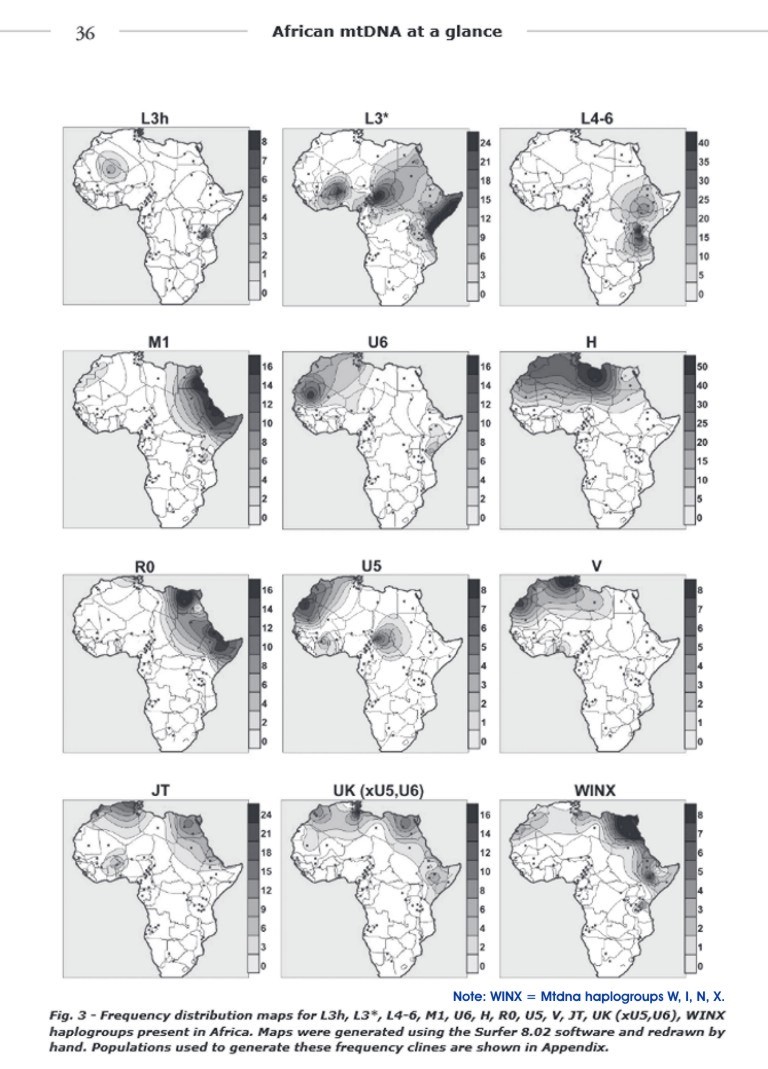
Mtdna haplogroups of Africa = L, M, U, H, R, V, JT, UK, WINX, and counting. Note also that WINX - is shorthand for haplogroups W,I,N,X.
Africa is the birthplace of ALL Humans, when are our Albinos going to accept that?
......continued from above: C, D and F haplogroups for the Y-chromosome.
All these six founder haplogroups can be found in the present day populations of South Asia. Moreover, the mtDNA haplogroup M and the Y-chromosome haplogroups C and D are restricted to the area east of South Asia. All the West Eurasian populations derive from the N and R haplogroups of mtDNA and the F haplogroup of the Y-chromosome.
Endicott et al. state that these facts are consistent with the hypothesis of a single exodus from East Africa 65,000 years ago via a southern coastal route, with the West Eurasian lineages separating from the South Asian lineages somewhere between East/Northeast Africa and South Asia.
The most frequent mtDNA haplogroups in South Asia are M, R and U (where U is a descendant of R).
Arguing for the longer term "rival Y-Chromosome model", Stephen Oppenheimer believes that it is highly suggestive that India is the origin of the Eurasian mtDNA haplogroups which he calls the "Eurasian Eves". According to Oppenheimer it is highly probable that nearly all human maternal lineages in Central Asia, the Middle East and Europe descended from only four mtDNA lines that originated in South Asia 50,000-100,000 years ago.
Y chromosome
Y-DNA haplogroups in populations of South Asia
The major South Asian Y-chromosome DNA haplogroups are H, J2, L, R1a1 and R2.
|
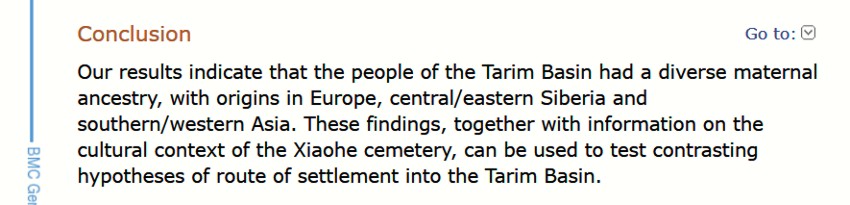 |
We note with humor that these Mongol Albinos or Mulattoes who did this study: fail to mention that the DNA of the Xiaohe people is really African. Europeans have trained them well, then again, perhaps not much training was necessary.
|
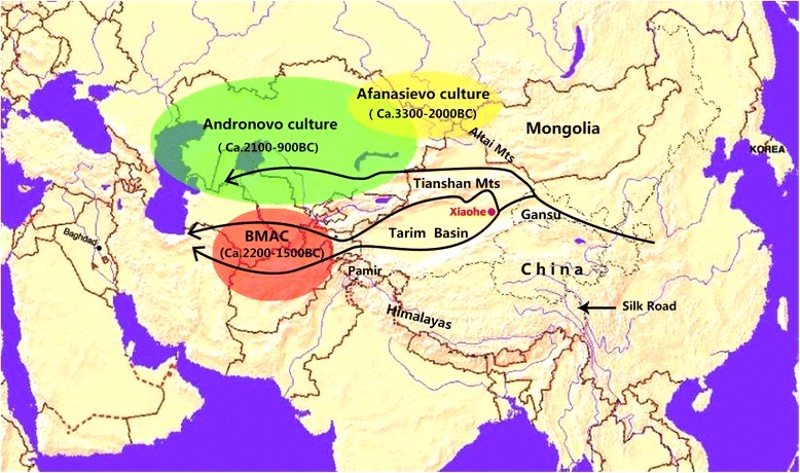 |
| Map of Eurasia showing the location of the Xiaohe cemetery, the Tarim Basin, the ancient Silk Road routes and the areas occupied by cultures associated with the settlement of the Tarim Basin. This figure is drawn according to literatures |
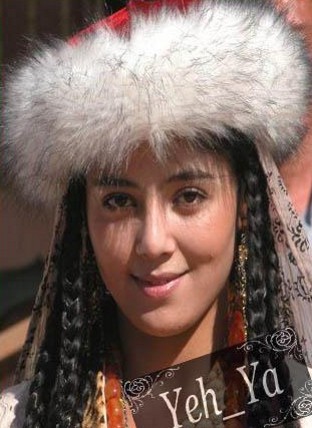
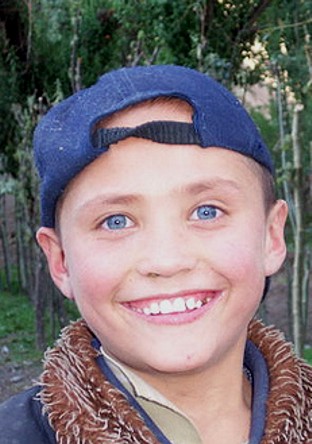
Modern Uyghur People
The new finds are also forcing a reexamination of old Chinese books that describe historical or legendary figures of great height, with deep-set blue or green eyes, long noses, full beards, and red or blond hair. Scholars have traditionally scoffed at these accounts, but it now seems that they may be accurate. Chinese scientists were initially hesitant to provide access to DNA samples because they were sensitive about the claims of the nationalist Uyghur who claim the Loulan Beauty as their symbol, and to prevent a pillaging of national monuments by foreigners.
Chinese historian Ji Xianlin says China "supported and admired" research by foreign experts into the mummies. However, within China a small group of ethnic separatists have styled themselves the descendants of these ancient people". Due to the "fear of fueling separatist currents" the Xinjiang museum, regardless of dating, displays all their mummies both Tarim and Han, together.
Comment:
The discovery of the mummies put the Chinese in a bind on all fronts; for years the Chinese had been teaching their people the they evolved from "Peking Man" (Homo erectus). They completely ignored their ancient writings attesting to the Black creators or their civilization, and the subsequent invasion and takeover by Whites in China. This position was maintained until a group of researchers from all over the world, did a genetic study of the Chinese, which proved that they were "Exclusively" of African origin. As with Whites, common sense would have told them the same story (how else to explain the great variety in skin color and phenotype found in the Chinese if not by the melding of Black and White?). Obviously, the Chinese didn't just take a lack of melanin from the White man, they also took his proclivity for lies and hubris.
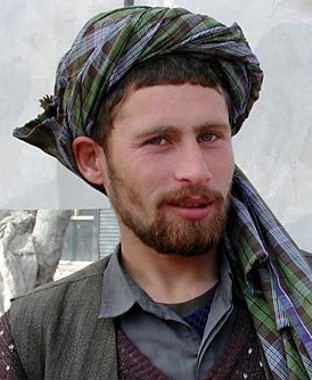
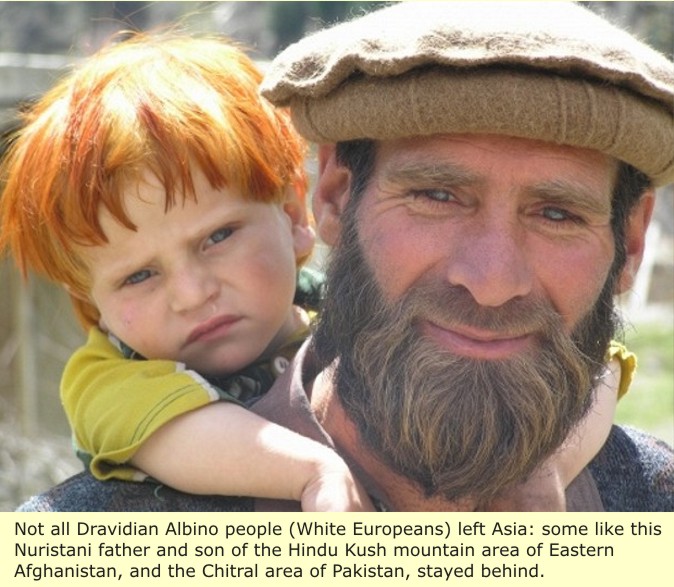
Another Dravidian Albino people who stayed in Asia, as all the others migrated west into Europe, is the Nuristani people.
The Nuristani people
The Nuristani are an original people of the Hindu Kush mountain area of Eastern Afghanistan and the Chitral area of Pakistan. Their territory, formerly called Kāfiristān, “Land of the Infidels,” was renamed Nūristān, “Land of Light” or “Enlightenment,” when the populace was forcibly converted to Islam from the local polytheistic religion by the Afghan emir ʿAbd al-Raḥmān at the turn of the 20th century. The territory now forms part of the Afghan province of Nūristān. In the early 21st century, the total Nūristāni population was estimated to be more than 100,000, with the vast majority living in Afghanistan; just a few thousand lived in Pakistan.
The Nūristāni languages belong to the Indo-Aryan subgroup of the Indo-Iranian branch of the Indo-European language family. The Nūristāni are nominally Sunni Muslims but continue many of their traditional ways dating from before their conquest by the Afghans in 1895–96. Their earlier record was one of brigandage and plundering; they were, and still are, intensely loyal to their own people and strongly cherish their independence. They have a clan organization with village government and are now settled agriculturists. The region as a whole has a most distinctive culture, and although it is possible to establish certain cultural differences between the three main valleys, the Nūristāni share a culture which gives them a unique position within Afghanistan.
The houses in the highest northern regions are built of stone or clay, but in the forested regions they are mainly of wood, often (to save space) with multiple stories and arranged in steplike terraces on the mountain slopes. The small enclosed fields (often no bigger than an ordinary floor space), mostly lying in steep, narrow mountain valleys, are cultivated by the women, while the men hunt or tend livestock. The main crop is wheat, supplemented by barley, corn (maize), millet, and peas. Grapes and mulberries are grown in the lower areas. Livestock consists mainly of goats, with some cattle and a few sheep in the upper, wider valleys. There are no horses.
Modern Nuristani People
A word on Human development:
Albinos often say, and those that don't say it, think it: "If Blacks could have created all of those great original civilizations all over the world, and had been the most advanced humans on Earth, then why are Africans so backwards?"
Recalling David Attenborough famously saying as he introduced a documentary on ancient Egypt: "Many find it hard to believe that the mumbling superstitious people to the south could have built such a great civilization.
Well Africans are backwards for the very same reasons that the Uyghurs, and the Nuristani, and all other tribal European type Albinos who stayed in their original homelands in Asia are backwards. The ENVIRONMENTAL stresses, and new points of view, and new methods, and other things that spur advancement and development, are absent from their lives and environment - and perhaps most importantly, they do not need to change in order to survive.
What role did sexual selection play in the evolution of the White/Albino Race?
Return of the Albinos
No one knows why the first Albinos left Central Asia; perhaps it was some natural disaster, or perhaps they had overpopulated the sparse land, and now found it difficult to acquire enough food there. Perhaps they rightly thought themselves powerful, and were bent on conquest. Passages in the Rig Veda suggests this, it also betrays a deep dislike for Blacks. But then again, it was written some 600 years after the initial invasion, so intervening events may have contributed to that: (like the Hellenes in Greece, it took the Aryans many hundreds of years to master written language). But one can't help but wonder, if their hatred of Blacks, was the result of ancient memories of past abuse, somehow kept alive for thousands of years, through stories and song. Or perhaps, they were simply preyed upon by their Black neighbors in Northern Asia - this would certainly be the reason for later Albino movements out of Asia. Whatever the initial cause or reason, within 2,000 years (1,500 B.C. to 500 A.D.) ALL the millions of Albino (Caucasian) peoples, would abandon Central Asia and move to India and Europe - later Turkey and the middle East. Today the Uyghurs, a Turkic ethnic group, who live primarily in the Xinjiang Uyghur Autonomous Region, in the People's Republic of China, are the only Caucasians still living in Eastern and Central Asia. (Many are actually now mixed-race).
It is also not known why the Aryans/Arians would hazard a return to lands that they originally found inhospitable because of the intense Sunshine. Perhaps over the tens-of-thousands of years that they spent in Central Asia, they were able to acquire a "Fixed" degree of Melanination through crossbreeding with the Blacks in China and Eastern Europe who surrounded them (see the Eastern Europe and China pages).
Unlike their normally pigmented brethren who stayed behind in India, they had not evolved into a civilized people. They had not developed a written language, technology or cities. They returned to India as an illiterate, pastoral people now called Aryans/Arians. They migrated from the steppe lands of Central Asia through what is now Afghanistan, down through the Khyber Pass and onto the now sparsely populated Indus Plain.
The Aryans/Arian's invasion of India, and the subsequent cross-breeding between the Aryans/Arian Albinos and Normal Dravidians resulted in the ethnic group that we now call Hindus.
|
At about the same time that the Aryans/Arian's went south into India, another group, comprised of the people we now call Hellenes (Greeks) and Latin's (Romans) headed West into Europe, circa 1,200 B. C. There they also cross-bred with the local Blacks (the original Europeans), and also produced a Mulatto ethnicity.
The National Geographic "Genographic Project" is an ambitious attempt to answer fundamental questions about where we originated and how we came to populate the Earth. The Genographic Project is a multiyear research initiative led by National Geographic Explorer-in-Residence Dr. Spencer Wells. Dr. Wells and a team of renowned international scientists are using cutting-edge genetic and computational technologies to analyze historical patterns in DNA from participants around the world to better understand our human genetic roots.
These first Albino people who entered Europe as illiterate Horse Nomads were of course NOT Hellenes: that is part of the Albinos "Fantasy" history.
In Book 1 - CLIO: Herodotus say this about the Hellenes:
[1.58] The Hellenic race has never, since its first origin, changed its speech. This at least seems evident to me. It was a branch of the Pelasgic, which separated from the main body, and at first was scanty in numbers and of little power; but it gradually spread and increased to a multitude of nations, chiefly by the voluntary entrance into its ranks of numerous tribes of barbarians.
The lineage of the Ancient Greeks is always a source of controversy. In the Histories of Herodotus, he clearly identifies the lineage of each major Greek tribe. These books are considered one of the seminal works of history in Western literature. Written from the 450s to the 420s B.C, in the Ionic dialect of classical Greek. Here we have excerpted quotes from Herodotus Histories to clearly ethnically define each tribe of the ancient Greeks. Click here >>>
The earliest Black European writing, that we know about, is the Linear A script which first appeared in Crete (the Middle Minoan period (1700 - 1550 BC). After the Whites invaded (circa 1,200 B.C.), all writing STOPPED! This period is commonly called "The Greek Dark Ages" it was obviously a time of Great Wars and social upheaval; the biggest upheaval being the Exodus of the Sea people. Click here for more on the Sea Peoples flight: Click >>>
When writing reappeared, at about 750 B.C, Greeks had adopted an alphabet that came from a Phoenician script. Phoinikeia was the name for the letters. The Greeks modified some of the letters for the vowels. There were many local alphabets but in 403 B.C. Athens adopted the Ionic or Milesian alphabet which eventually became common in all of Greece and is still used today.
The first actual writings were by Aesculus 525-456 B.C. These were tragedies including the Orestia Trilogy.
* Agamemnon
* Choephoroe
* Eumenides
Note: It seems the lies of Whites are never-ending: Homers Iliad is dated to 800 B.C. which is of course a fantasy. But much more importantly, the Iliad and the Orestia Trilogy read like MODERN works, they are NOT primitive in style! When compared to Herodotus's histories, which are NEWER, circa 440 B.C: But IS primitive in style. It becomes clear that we are dealing with just another White mans lie: the point of which is still unclear.
Link to the Orestia Trilogy Link to the Iliad Link to the Histories of Herodotus
Note: some translations of ancient works by degenerate lying Whites, attribute Blonde hair and Blue eyes to Greek gods and demigods. That is of course false. |
Modern Greek Sculpture
(These are fakes created mostly in the last two hundred years)
Just making the point that the ancient Greeks were not as taught, and quite different from the modern people. This modern image of ancient Greece, is merely part of the Albinos falsification of History. |
The "People of Lerna" is an analysis of ancient skeletons from the necropolis of the ancient town of Lerna in Greece.
The skeletons of Lerna clearly show that throughout ancient times, Greeks were, and remained Black!
REAL GREEKS!
REAL ROMANS!
Thus by the time that the dark ages were over, almost 500 years had passed. Anyone who has ever researched family genealogy will tell you that oral history, as passed down from generation to generation is very undependable. After only a generation or two, it becomes so corrupted with exaggeration and myth that it becomes useless.
This then is what the Greeks were faced with, without written documents, all memories of their early beginnings in Europe were in the form of oral history, passed down from generation to generation. Thus Greeks recorded their previous history as a series of founding myths, with god-like ancestors as the founders of their line. Over time, they came to explain everything that they didn't know or understand with these myths. However, it should be noted that unlike the pathetic racists of today, the ancient Greeks were always careful to give proper respect and credit, especially to the Egyptians and Persians: they understood who and what they were, and how they got what they got. Illustrative of this, is the Myth of Danaus:
Danaus, or Danaos ("sleeper"): In Greek mythology he was the twin brother of Aegyptus and son of Achiroe and Belus, (mythical king and Queen of Egypt). The myth of Danaus is a foundation legend of Argos, one of the foremost Mycenaean cities of the Peloponnesus. (Mycenae had been earlier built at about 1,500 B.C, by Cretens and Egypt). Thus this myth serves as a good example of how the early Greeks used myth to explain their current circumstance.
The Myth
The Egyptian Prince Danaus had fifty daughters, the Danaides, twelve of whom were born to Polyxo and rest to Pieria and other women, and his twin brother, Aegyptus, had fifty sons. Aegyptus commanded that his sons marry the Danaides. But Danaus elected to flee Egypt instead, and to that purpose, he built a ship, the first ship that ever was.
In it, he fled to Argos, to which he was connected by his descent from Io, the maiden wooed by Zeus and turned into a heifer and pursued by Hera until she found asylum in Egypt. Argos at the time was ruled by King Pelasgus, the eponym of all the Black inhabitants who had lived in Greece since the beginning of time, also called Gelanor (he who laughs). The Danaides asked Pelasgus for protection when they arrived, (the event is portrayed in The Suppliants by Aeschylus). Protection was granted after a vote by the Argives.
____________________________________________________________________________
The writer Pausanias was a native of Lydia in Anatolia. He was a traveller and geographer of the 2nd century A.D, who lived in the times of Hadrian, Antoninus Pius and Marcus Aurelius. He is famous for his Description of Greece, a lengthy work that describes ancient Greece from firsthand observations, and is a crucial link between classical literature and modern archaeology. As a Greek writing under the auspices of the Roman empire, he found himself in an awkward cultural space, between the glories of the Greek past he was so keen to describe and the realities of a Greece beholden to Rome as a dominating imperial force. His work bears the marks of his attempt to navigate that space and establish an identity for Roman Greece.
____________________________________________________________________________
When Pausanias visited Argos in the 2nd century A.D, he related their version of the succession of Danaus to the throne thusly: "judged by the Argives (Argos citizens), who "from the earliest times... have loved freedom and self-government, and they limited to the utmost the authority of their kings:"
"On coming to Argos Danaus claimed the kingdom against Gelanor, the son of Sthenelas. Many plausible arguments were brought forward by both parties, and those of Sthenelas were considered as fair as those of his opponent; so the people, who were sitting in judgment, put off, they say, the decision to the following day. At dawn a wolf fell upon a herd of oxen that was pasturing before the wall, and attacked and fought with the bull that was the leader of the herd. It occurred to the Argives that Gelanor was like the bull and Danaus like the wolf, for as the wolf will not live with men, so Danaus up to that time had not lived with them. It was because the wolf overcame the bull that Danaus won the kingdom. Accordingly, believing that Apollo had brought the wolf on the herd, he founded a sanctuary of Apollo Lycius."
When Aegyptus and his fifty sons arrived to take the Danaides, Danaus gave them, to spare the Argives the pain of a battle. However, he instructed his daughters to kill their husbands on their wedding night. Forty-nine followed through: "they buried the heads of their bridegrooms in Lerna; but one, Hypermnestra (or Amymone, the "blameless" Danaid) refused because her husband, Lynceus, honored her wish to remain a virgin. Danaus was angry with his disobedient daughter and threw her to the Argive courts. Aphrodite intervened and saved her. Lynceus and Hypermnestra then began a dynasty of Argive kings (the Danaan Dynasty).
The remaining forty-nine Danaides had their grooms chosen by a common mythic competition: a foot-race was held and the order in which the potential Argive grooms finished decided their brides (compare the myth of Atalanta).
In some versions, Lynceus later killed Danaus as revenge for the death of his brothers.
Also in some versions, the Danaides were punished in Tartarus (Tartarus is both a deity and a place in the underworld even lower than Hades), by being forced to carry water in a jug to fill a bath and thereby wash off their sins, but the jugs were actually sieves, so the water always leaked out (see below).
Even a cautious reading of the subtext as a vehicle for legendary history suggests that a Pelasgian kingship in archaic Argos was overcome, not without violence, by seafarers out of Egypt (compare the Sea Peoples who "left" Europe), whose leaders then intermarried with the local dynasty. The descendants of Danaus' "blameless" daughter Hypermnestra, through Danaë, led to Perseus, founder of Mycenae, thus suggesting that Argos had a claim to be the "mother city" of Mycenae.
In Homer's Iliad, "Danaans" ("tribe of Danaus") and "Argives" commonly designate the Greek forces opposed to the Trojans. (Troy was the Greek name for the Hattie city of Wilusa, on the northern coast of Anatolia).
You will note that the ancient Greeks; attributed no part of the building of the Mycenaean civilization to themselves; but rather, truthfully and correctly to Egyptians and Pelasgusians, (Please try to find a White textbook that does the same). How different Whites are in modern times: Now they are so "full of themselves" that the lie comes easily and unabashedly. Note the depiction of the Tartarus version of the myth by John William Waterhouse (1903); in his painting "Danaides". To people like him, if they were Great, they MUST have been White! If not, he will MAKE them White.
|
To really appreciate the absurdity of John Waterhouse's painting, please note this passage from Aeschylus play, "The Suppliants".
The Suppliants
By Aeschylus
Written ca. 463 B.C.E
Translated by E. D. A. Morshead
From the classics@MIT
Scene
A sacred precinct near the shore in Argos. Several statues of the gods can be seen, as well as a large altar. As the play opens, DANAUS, and his fifty daughters, the maidens who compose the CHORUS, enter. Their costumes have an oriental richness about them not characteristic of the strictly Greek. They carry also the wands of suppliants. The CHORUS is singing.
strophe 8
Yet if this may not be,
We, the dark race sun-smitten, we
Will speed with suppliant wands
To Zeus who rules below, with hospitable hands
Who welcomes all the dead from all the lands:
Yea, by our own hands strangled, we will go,
Spurned by Olympian gods, unto the gods below!
|
Click here for more on how modern Whites use their power over media: Paintings, Books, Movies, television, to propagate their false version of History. Click >>>
In "Classical" Greek times, after the Greeks had became competent, and were feeling "full of themselves" They always had the Egyptians to put them in their place.
| Illustrative of this, is an account from Herodotus (II, 143); of a visit by Hecataeus to an Egyptian temple at Thebes. It recounts how the priests showed Hecataeus a series of statues in the temple's inner sanctum, each one set up by the high priest of each generation: After mentioning that he (Hecataeus) traced his descent through sixteen generations - from a god. The Egyptians compared his genealogy to their own - as recorded by the statues. Since the generations of their high priests had numbered three hundred and forty-five, all entirely mortal, they refused to believe his claim of descent from a mythological figure. This encounter with the antiquity of Egypt, has been identified as a crucial influence on Hecataeus's skepticism: The mythologized past of the Hellenes shrank into insignificant fancy next to the history of a civilization so ancient. |
In modern times, the reason that Whites falsely claim that they originated in Europe is likely embarrassment. They did not discover definitive evidence of their Asian origins until the early 1900s. (Even though the Archeological finds of the previous century should have given them a clue: all the ancient skeletons found in Europe were of Black people - To date, absolutely NO ancient White skeletons have ever been found in Europe - (pre 1,200 B.C.). Whereas skeletons of ancient Africans - Not Neanderthals, Not Cro-Magnons - but "Modern Man" Africans (Homo-sapiens) are found all over the place in Europe, Some from as early as 45,000 B.C. Bog Mummies have also been found in Europe, the oldest being about 10,000 years old; But the oldest White Bog mummies are only from the iron age.
We say embarrassment, because for the previous several centuries, Whites had been building a tale of White superiority and Black inferiority; and had even created the institution of Racism. How then were they to admit that just the opposite was true. Not only were they a people of humble beginnings, but derived from "Defective" Humans (Albinos) too. And all that they had, and had achieved, was derived from that which they had taken from the Black man.
Map of Hellenic expansion |
Though Greeks and Romans were able to establish settlements in North Africa, they did not make serious inroads into Egypt and the Middle East, until Alexander the Greats conquest of the decadent and faltering Achaemenid Persian Empire (331 B.C.). With his victory, their Empire became His Empire! Alexander's victory set in motion over 2,000 years of European rule and White migration to those lands. Broken only by the period of the Sassanian Persian Empire (224 - 651 A.D.) And the Arab Conquests (632 A.D. to the resignation - at the insistence of Turkish king Toghril Beg - of the last Arab caliph "al-Qa'im" reigned 1031–75 A.D.) And collimating in the Turkish Ottoman Empire (1299 - 1922 A.D.) Over those 2,000 plus years, the indigenous Black populations of those lands became, in varying degrees - Mulattoes. (The Fatimid Caliphate 909 to 1171 A.D. is thought of more as a Berber Caliphate).
 |
However, modern White Europeans are NOT related to those early Whites of Greece and Rome. Modern White Europeans are the descendants of the "Second" Albino invasion of Europe: that of the Germanics, Slavs, and Alan's. As described by ancient Greek and Roman historians, these invading "barbarians" were fundamentally "Pure Albinos".
The Roman historian Cornelius Tacitus (56-118 A.D.) from his book: Germany Book 1: Describes them thusly; They All have fierce blue eyes, red hair, huge frames, fit only for a sudden exertion. They are less able to bear laborious work. Heat and thirst they cannot in the least endure; to cold and hunger their climate and their soil inure them. Herodotus (ca. 400 B.C.): describes them thusly; "they have all deep blue eyes, and bright red hair".
Most historians do not attribute their entry into Europe as an invasion or a normal migration, rather, they were chased into Europe by the murading Black Huns of Mongolia.
The Huns
The Huns were a nomadic pastoral people from Eastern Asia, they invaded Europe in about 370 A.D. and created an enormous empire; which reached as far west as Germany. They were possibly the descendants of the Xiongnu who had been northern neighbors of China three hundred years before. Note: the so-called "White Huns" had no direct connection with the European Huns of Attila, these White tribes deliberately called themselves Huns, in order to frighten their enemies.
The Huns may have stimulated the Great Migration, a contributing factor in the collapse of the Roman Empire. They formed a unified empire, with its capital in what is now central Germany, under Attila the Hun, who died in 453 A.D; their empire broke up the next year.
The historian Priscus was a Greek-speaking Roman citizen who routinely referred to Huns, Germans, Goths and people of other tribes as "barbarians." He often meant with Attila, and described Attila’s personal features: a short, square body with a large head; deep-seated eyes; a swarthy complexion with little facial hair. He wore plain, not luxurious, clothing.
Jordanes - The Roman historian, wrote a book on the history of the Goths called "Getica" (circa 551 A.D). In his book, he describes the Huns as: They made their foes flee in horror because their swarthy (black skinned) aspect was fearful, and they had, if I may call it so, a sort of hideous lump, not a head, with pinholes rather than eyes. For they cut the cheeks of the males with a sword, so that before they receive the nourishment of milk they must learn to endure wounds. Hence they grow old beardless and their young men are without comeliness, because a face furrowed by the sword spoils by its scars the mature beauty of a beard. It is also said that another common custom of the Huns was to strap their children's noses flat from an early age, in order to widen their faces, as to increase the terror their looks instilled upon their enemies.
These pictures from a silk scroll depicting a hunting expedition of Kublai Khan (yellow Mongolian), painted by the court artist Liu Guandao, circa 1280 A.D. Shows what are probably Black Huns (who were also Mongolians). |
The Alans
The Alans were a group of Sarmatian tribes, also known over the course of their history by another group of related names including the variations Asi, As, and Os (Bulgarian Uzi, Hungarian Jász, Russian Jasy, Georgian Osi). It is this name that is the root of the modern Ossetian.
Migratory path of the Alan's |
Early Alans
The first mentions of names that historians link with the "Alani" appear at almost the same time in Greco-Roman geography and in the Chinese dynastic chronicles.
The Geography (XXIII, 11) of Strabo (63/64 BC–ca. 24 AD), who was born in Pontus on the Black Sea, but was also working with Persian sources, to judge from the forms he gives to tribal names, mentions Aorsi that he links with Siraces and claims that a Spadines, king of the Aorsi, could assemble two hundred thousand mounted archers in the mid-1st century BC. But the "upper Aorsi" from whom they had split as fugitives, could send many more, for they dominated the coastal region of the Caspian Sea: "and consequently they could import on camels the Indian and Babylonian merchandise, receiving it in their turn from the Armenians and the Medes, and also, owing to their wealth, could wear golden ornaments. Now the Aorsi live along the Tanaïs, but the Siraces live along the Achardeüs, which flows from the Caucasus and empties into Lake Maeotis."
Chapter 123 of the Shiji (whose author, Sima Qian, died circa 90 BC) reports:
The mouth of the Syr Darya or Jaxartes River, which emptied into the Aral Sea was approximately 850 km northwest of the oasis of Tashkent which was an important centre of the Kangju confederacy. This provides remarkable confirmation of the account in the Shiji. The Later Han Dynasty Chinese chronicle, the Hou Hanshu, (covering the period 25–220 and completed in the 5th century), mentioned a report that the steppe land Yancai was now known as Alanliao:
The 3rd century Weilüe states:
By the beginning of the 1st century, the Alans had occupied lands in the northeast Azov Sea area, along the Don and by the 2nd century had amalgamated or joined with the Yancai of the early Chinese records to extend their control all the way along the trade routes from the Black Sea to the north of the Caspian and Aral seas. The written sources suggest that from the end of the 1st century to the second half of the 4th century the Alans had supremacy over the tribal union and created a powerful confederation of Sarmatian tribes.
From a Western point-of-view the Alans presented a serious problem for the Roman Empire, with incursions into both the Danubian and the Caucasian provinces in the 2nd and 3rd centuries.
Ammianus Marcellinus considered the Alans to be the former Massagetae: "the Alani, who were formerly called the Massagetae" and stated "Nearly all the Alani are men of great stature and beauty; their hair is somewhat yellow, their eyes are terribly fierce"..
In Cathay and the Way Thither, 1866, Henry Yule writes:
The Alans were known to the Chinese by that name, in the ages immediately preceding and following the Christian era, as dwelling near the Aral, in which original position they are believed to have been closely akin to, if not identical with, the famous Massagetæ. Hereabouts also Ptolemy (vi, 14) appears to place the Alani-Scythæ, and Alanæan Mountains. From about 40 B.C. the emigrations of the Alans seem to have been directed westward to the Lower Don; here they are placed in the first century by Josephus and by the Armenian writers; and hence they are found issuing in the third century to ravage the rich provinces of Asia Minor. In 376 the deluge of the Huns on its westward course came upon the Alans and overwhelmed them. Great numbers of Alans are found to have joined the conquerors on their further progress, and large bodies of Alans afterwards swelled the waves of Goths, Vandals, and Sueves, that rolled across the Western Empire. A portion of the Alans, however, after the Hun invasion retired into the plains adjoining Caucasus, and into the lower valleys of that region, where they maintained the name and nationality which the others speedily lost. Little is heard of these Caucasian Alans for many centuries, except occasionally as mercenary soldiers of the Byzantine emperors or the Persian kings. In the thirteenth century they made a stout resistance to the Mongol conquerors, and though driven into the mountains they long continued their forays on the tracts subjected to the Tartar dynasty that settled on the Wolga, so that the Mongols had to maintain posts with strong garrisons to keep them in check. They were long redoutable both as warriors and as armourers, but by the end of the fourteenth century they seem to have come thoroughly under the Tartar rule; for they fought on the side of Toctamish Khan of Sarai against the great Timur.
Migration to Gaul
Around 370, the Alans were overwhelmed by the Huns. They were divided into several groups, some of whom fled westward. A portion of these western Alans joined the Vandals and the Sueves in their invasion of Roman Gaul. Gregory of Tours mentions in his Liber historiae Francorum ("Book of Frankish History") that the Alan king Respendial saved the day for the Vandals in an armed encounter with the Franks at the crossing of the Rhine on December 31, 406). According to Gregory, another group of Alans, led by Goar, crossed the Rhine at the same time, but immediately joined the Romans and settled in Gaul.
In Gaul, the Alans originally led by Goar were settled by Aetius in several areas, notably around Orléans and Valentia. Under Goar, they allied with the Burgundians led by Gundaharius, with whom they installed the usurping Emperor Jovinus. Under Goar's successor Sangiban, the Alans of Orléans played a critical role in repelling the invasion of Attila the Hun at the Battle of Châlons. After the 5th century, however, the Alans of Gaul were subsumed in the territorial struggles between the Franks and the Visigoths, and ceased to have an independent existence. Flavius Aëtius settled large numbers of Alans in and around Armorica in order to quell unrest. The Breton language name Alan (rather than the French Alain) and several towns with names related to 'Alan', such as Allainville, Yvelines, Alainville-en Beauce, Loiret, Allaines and Allainville, Eure-et-Loir, and Les Allains, Eure, are taken as evidence that a contingent settled in Armorica, Brittany, which retained a reputation for outstanding horsemanship with Gregory of Tours and into the Middle Ages, preferring to remain mounted to fight in contrast with all their neighbors, who dismounted in battle.
Hispania and Africa
Following the fortunes of the Vandals and Suevi into the Iberian peninsula (Hispania, comprising modern Portugal and Spain) in 409, the Alans led by Respendial settled in the provinces of Lusitania and Carthaginiensis: "Alani Lusitaniam et Carthaginiensem provincias, et Wandali cognomine Silingi Baeticam sortiuntur" (Hydatius). The Siling Vandals settled in Baetica, the Suevi in coastal Gallaecia, and the Asding Vandals in the rest of Gallaecia.
In 418 (or 426 according to some authors, cf. e.g. Castritius, 2007), the Alan king, Attaces, was killed in battle against the Visigoths, and this branch of the Alans subsequently appealed to the Asding Vandal king Gunderic to accept the Alan crown. The separate ethnic identity of Respendial's Alans dissolved. Although some of these Alans are thought to have remained in Iberia, most went to North Africa with the Vandals in 429. Later Vandal kings in North Africa styled themselves Rex Wandalorum et Alanorum ("King of the Vandals and Alans").
There are some vestiges of the Alans in Portugal, namely in Alenquer (whose name may be Germanic for the Temple of the Alans, from "Alen Ker", and whose castle may have been established by them; the Alaunt is still represented in that city's coat of arms), in the construction of the castles of Torres Vedras and Almourol, and in the city walls of Lisbon, where vestigies of their presence may be found under the foundations of the Church of Santa Luzia.
In the Iberian peninsula the Alans settled in Lusitania (cf. Alentejo) and the Cartaginense provinces. They became known in retrospect for their massive hunting and fighting dog of Molosser type, the Alaunt, which they apparently introduced to Europe. The breed is extinct, but its name is carried by a Spanish breed of dog still called Alano, traditionally used in boar hunting and cattle herding. The Alano name, however, has historically been used for a number of dog breeds in a few European countries thought to descend from the original dog of the Alans, such as the German mastiff (Great Dane) and the French Dogue du Bordeaux, among others.
Alans and Slavs
Third-century inscriptions from the Greek colony of Tanais at the mouth of the Don River mention a nearby Alan tribe called the Choroatos or Chorouatos. The historian Ptolemy identifies the Serboi as a tribe who lived north of the Caucasus, and other sources identify the Serboi as an Alan tribe in the Volga-Don steppe in the 3rd century. Some historians argue that the arrival of the Huns on the European steppe forced a portion of Alans previously living there to move northwest into the land of Venedes, possibly merging with Western Balts there to become the precursors of historic Slav nations.) It's believed that some Alans resettled to the North (Barsils), merging with Volga Bulgars and Burtas, eventually transforming to Volga Tatars
Medieval Alania
Some of the other Alans remained under the rule of the Huns. Those of the eastern division, though dispersed about the steppes until late medieval times, were forced by the Mongols into the Caucasus, where they remain as the Ossetians. Between the 9th and 12th centuries, they formed a network of tribal alliances that gradually evolved into the Christian kingdom of Alania. Most Alans submitted to the Mongol Empire in 1239–1277. They participated in Mongol invasions of Europe and the Song Dynasty in Southern China, and the Battle of Kulikovo under Mamai of the Golden Horde.
In 1253, the Franciscan monk William of Rubruck reported numerous Europeans in Central Asia. It is also known that 30,000 Alans formed the royal guard (Asud) of the Yuan court in Dadu (Beijing). Marco Polo later reported their role in the Yuan Dynasty in his book Il Milione. It's said that those Alans contributed to a modern Mongol clan, Asud. John of Montecorvino, archbishop of Dadu (Khanbaliq), reportedly converted many Alans to Roman Catholic Christianity.
The linguistic descendants of the Alans, who live in the autonomous republics of Russia and Georgia, speak the Ossetic language which belongs to the Northeastern Iranian language group and is the only remnant of the Scytho-Sarmatian dialect continuum and which once stretched over much of the Pontic steppe and Central Asia. Modern Ossetic has two major dialects: Digor, spoken in the western part of North Ossetia; and Iron, spoken in the rest of Ossetia. A third branch of Ossetic, Jassic (Jász), was formerly spoken in Hungary. The literary language, based on the Iron dialect, was fixed by the national poet, Kosta Xetagurov (1859–1906).
The Germanics
Migratory path of the Visagoths (Germanics) |
The Visigoths
In 376, the Goths, long-standing traders with and mercenaries for the Roman Empire, who were settled in large numbers on the north bank of the Danube, came under aggressive attack from the Huns. Their leader came to an agreement with the Emperor Valens that they would be given lands and allowed to settle on the Mediterranean side of the Danube; however, there was a famine, the emperor reneged on his promise and the Goths attacked, killing the emperor at the Battle of Adrianople in 378 and decimating the Roman field army. The Goths were inside the empire to stay, soon becoming known as the Visigoths (originally a tribal name, which became identified as meaning 'Western Goths').
From then on, they alternately made peace with various Roman emperors and generals and were double-crossed by them. Eventually they sacked Rome under Alaric in 410 (the incident that led Augustine to write his City of God). They were asked by Honorius to help drive the Vandals out of Spain, and settled in the Aquitaine in 418, the nucleus of what would become, by 475, an independent Visigothic kingdom covering most of the Iberian peninsula.
The Ostrogoths
The Ostrogoths were a second wave of Goths from the around the Crimean, who had been a subject part of Attila's kingdom, but rebelled in the early 450s. They settled within the Roman Empire, on the Dalmatian coast, and were sent by the Byzantine emperor Zeno to take back Italy from Odoacer, who had deposed the last nominal Roman emperor of the West, Romulus Augustulus, in 476. Theodoric, the great Ostrogothic general, did so, inviting Odoacer to a banquet in 493 and killing him at the table. Theodoric ruled from Ravenna, where his mausoleum survives, together with several churches he had decorated with beautiful mosaics.
Germanic countries - Great Britain, Netherlands, Germany, Austria, Switzerland, Belgium, France, Spain, portugal, Scandinavians (Denmark, Sweden, Finland, Norway, Iceland, Faroe Islanders, not Sami).
The Franks
The Franks were a loose group of Black tribes who inhabited the Upper Rhine, a number of whom were living within the bounds of the empire from the mid-fourth century. They were further displaced in the early fifth century, partly by skirmishes with the Vandals, Sueves and Alans, as the latter made their way down the Rhine to escape from the Huns, and partly by the Huns themselves. They spread into Northern Gaul, following and continuing to skirmish with the other tribes. Two successful leaders, Childeric (who reigned c.457 – 481) and his son Clovis (who reigned 481-511), established Frankish dominance more securely there, ruling most of France north of the Loire. Clovis' decision to convert to the Nicene version of Christianity in 496 may have been decisive for its re-establishment in Western Europe, as the Frankish kingdom continued to prosper.
Angles, Saxons and Jutes
The Angles came from Schleswig-Holstein, the Saxons from Lower Saxony, and the Jutes from Jutland. They arrived in south-east England from the 440s on, and gradually extended across to the North and West over the next two centuries. They may have been invited initially by the Britons to help protect them from the raids of the Picts and Scots. These appear to have been Black and Albino people.
The Slavs
According to the "Eastern Homeland theory" prior to becoming known to the Roman world, Slavic speaking tribes were part of the many multi-ethnic confederacies of Eurasia - such as the Sarmatian, Hun and Gothic empires. The Slavs emerged from obscurity when the westward movement of Germans in the 5th and 6th centuries A.D. (thought to be in conjunction with the movement of peoples from Siberia and Eastern Europe: Huns, and later Avars and Bulgars): started the great migration of the Slavs, who settled the lands abandoned by Germanic tribes fleeing the Huns and their allies. They moved westward into the country between the Oder and the Elbe-Saale line; southward into Bohemia, Moravia, much of present day Austria, the Pannonian plain and the Balkans; and northward along the upper Dnieper river. Perhaps some Slavs migrated with the movement of the Vandals to Iberia and north Africa.
Around the 6th century, Slavs appeared on Byzantine borders in great numbers. The Byzantine records note that grass wouldn't regrow in places where the Slavs had marched through, so great were their numbers. After military movements, even the Peloponnese and Asia Minor (Turkey) were reported to have Slavic settlements. By the end of the 6th century A.D, Slavs had settled the Eastern Alps region.
Slavic peoples are classified geographically and linguistically into West Slavic (including Czechs, Kashubians, Moravians, Poles, Silesians, Slovaks and Sorbs), East Slavic (including Belarusians, Russians, Rusyns and Ukrainians), and South Slavic (including Bosniaks, Bulgarians, Croats, Macedonians, Montenegrins, Serbs and Slovenes).
Slavic countries - Russia, Ukraine, Poland, Greece, Hungary, Macedonia, Albania, Azerbaijan, Belarus, Bosnia and Herzegovina, Bulgaria, Croatia, Czech Republic, Hungary, Georgia, Kosovo, Moldova, Montenegro, Romania, Serbia, Slovakia, Slovenia, Estonia, Latvia, Lithuania.
Italy - mixed Slav/Germanic
Greece - Mixed, mostly Slav
Armenia - mixed Slav/Turk
Algeria - mixed Berber/Germanic
Tunisia - mixed Germanic/Berber
The Turks
The last remaining Whites in Asia, the Turks (before admixture with indigenous Black Anatolians, they were originally Albinos too), were chased out of Asia by the yellow Mongols. Little is known about the origins of the Turkic peoples, and much of their history even up to the time of the Mongol conquests in the 10th–13th A.D. is shrouded in obscurity. Chinese documents of the 6th century A.D. refer to the empire of the T'u-chüeh as consisting of two parts, the northern and western Turks. This empire submitted to the nominal suzerainty of the Chinese T'ang dynasty in the 7th century, but the northern Turks regained their independence in 682 and retained it until 744 A.D. The Orhon inscriptions, the oldest known Turkic records (8th century A.D.), refer to this empire and particularly to the confederation of Turkic tribes known as the Oguz; to the Uighur, who lived along the Selenga River (in present-day Mongolia); and to the Kyrgyz, who lived along the Yenisey River (in north-central Russia).
When able to escape the domination of the T'ang dynasty, these northern Turkic groups fought each other for control of Mongolia from the 8th to the 11th century, when the Oguz migrated westward into Persia and Afghanistan. In Persia the family of Oguz tribes known as Seljuqs created an empire that by the late 11th century stretched from the Amu Darya south to the Persian Gulf and from the Indus River west to the Mediterranean Sea.
Turkic peoples - Göktürks, Seljuks, Khazars (Jews), Mughals, Azerbaijani, Bashkir, Chuvash, Kazakh, Kyrgyz, Tatar, Uighur, Uzbek, and Sakha, Hephthalites.
Turkic Countries - Turkey, Azerbaijan, Kazakhstan, Kyrgyzstan, Turkmenistan, Uzbekistan, Northern Cyprus (Turkish Republic of Northern Cyprus).
Countries with large populations of ethnic Turks and Turkic culture:
Egypt, Iran, Libya, Iraq, Jordan, Kuwait, Lebanon, Oman, Qatar, Saudi Arabia, Syria, United Arab Emirates, Yemen, Bahrain.
(Note: Just as modern Christian culture is far removed from ancient Hebrew culture - it is now European culture. So too is modern Arab culture far removed from original Arab culture - it is now Turkish culture. During the time of the Turkish Ottoman Empire (1299 - 1922), Islam was not known as the Arab religion, it was known as the Turkish religion).
The Thawb (Arab Robes) Emblematic of Arab culture, is not Arab at all. The original Arabs, like the Egyptians, Berbers, Mesopotamian's, Elamites/Persians: had Black skin, they did not need the Head to Toe protection from the Sun, that the Thawb affords. It is not known who invented the Thawb, but it is known that even though the Turks once ruled from Baghdad, they hated to go there because of the hot climate and burning Sunshine. Being that the original Turks were a very pale skinned people who needed protection from the Sun, it is likely that they invented the Thawb.
Modern man of Turkic ethnicity in a Thawb |
Ancient Arab |
Ancient Berber |
Ancient Egyptian |
 |
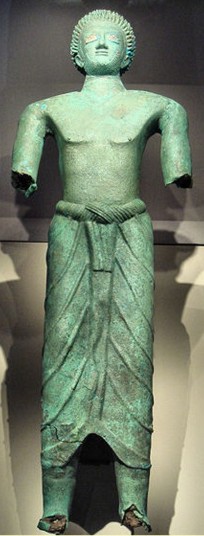 |
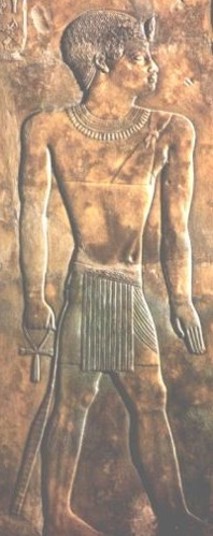 |
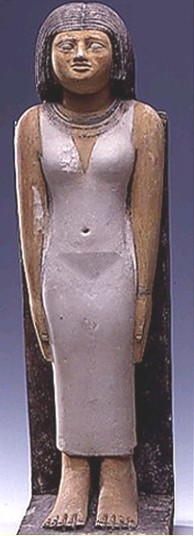 |
Ancient Hebrew |
Ancient Persian |
Ancient Sumerian |
Ancient Assyrian |
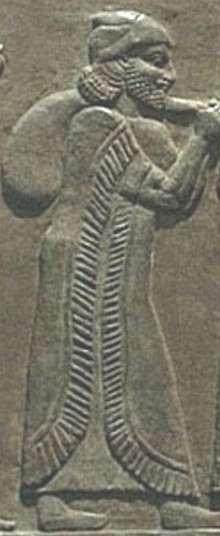 |
 |
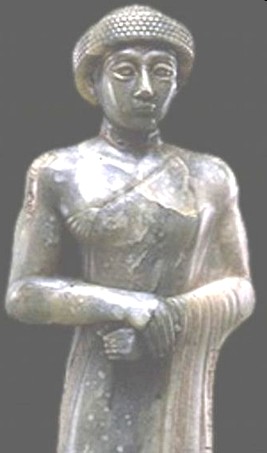 |
 |
Former territories of the Turks |
The very albinoish Turkish prince of the Turkish Qajar dynasty of Iran (1796–1925) |
Modern Turks
Thus when these millions of "New" Albino Asians Invaded the Europe of Black and Mixed-race people, it of course, over time, changed the appearance of all future Europeans. As attested to by the observations of Herodotus and Tacitus: Today's Europeans are just slightly different from the original second-wave Albinos into Europe - but still changing. Whereas before, they ALL had Red hair and Blue Eyes: today Red hair is the Rarest hair color. Likewise, Blue Eyes are slowly being "Bred-out" by admixture with Normal people:
"Since the turn of the century, people born with blue eyes in the United States have dramatically decreased, with only about 10 percent having blue eyes today. According to Mark Grant, an epidemiologist from Loyola University in Chicago. During the turn of the last century, the percentage of people with blue eyes stood at 57.4% for those born between 1899 through 1905; and 33.8% for those born between 1936 through 1951. According to Grant, in a study titled "Cohort effects in a genetically determined trait: eye color among US whites." This decrease in the occurrence of blue eyes is due to many factors, with the majority pointing to the increase in brown-eyed immigrants, mainly Hispanics and Asians, as well as heightened interracial relationships: as the other determinant. Blue eyes, next to green, are the rarest eye color in the world, as people of counties in Asia and Africa possess brown eyes."
The reason why modern Europeans are still so close to the "Pure Albinism" of the original Germanics, Slavs and Turks; as opposed to the admixture readily apparent in Asians, Middle-Easterners etc, is that the population of Blacks in Europe was not nearly as large as the Black population in those other places. That was compounded by the flight of Blacks from Europe, when hostilities between Blacks and the first incoming Albinos began: (See the Sea Peoples Exodus circa 1,100 B.C.). Keeping in mind that the "Entire" Dravidian type Albino population was driven out of Asia by the Mongols. This represented untold millions of people: here again, note what Tacitus said concerning just the Germans. Quote: hence too, the same physical peculiarities throughout so "vast" a population. All have fierce blue eyes, red hair, huge frames.
Clearly then, just the Germans by themselves, represented an overwhelming influx of people. However, a student of genetics might ask: since Europeans are about evenly divided between the Dravidian Y-dna haplogroup "R" and the Y-dna haplogroup "I" of the indigenous Black Europeans, shouldn't Europeans be Mulattoes - half Black/half White? Once again, Tacitus provides an explanation:
Germany Book 1
(On the Germans going into Battle)
7. They also carry with them into battle certain figures and images taken from their sacred groves. And what most stimulates their courage is, that their squadrons or battalions, instead of being formed by chance or by a fortuitous gathering, are composed of families and clans. Close by them, too, are those dearest to them, so that they hear the shrieks of women, the cries of infants. They are to every man the most sacred witnesses of his bravery--they are his most generous applauders. The soldier brings his wounds to mother and wife, who shrink not from counting or even demanding them and who administer both food and encouragement to the combatants.
8. Tradition says that armies already wavering and giving way have been rallied by women who, with earnest entreaties and bosoms laid bare, have vividly represented the horrors of captivity, which the Germans fear with such extreme dread on behalf of their women, that the strongest tie by which a state can be bound is the being required to give, among the number of hostages, maidens of noble birth. They even believe that the sex has a certain sanctity and prescience, and they do not despise their counsels, or make light of their answers.
Clearly the indigenous Black Europeans, were killing German Males, and taking their Females as spoils of War. Thus the offspring gained the ability to produce "Some" Melanin in their skin, and the Males gained a strengthening measure of genetic diversity. But most importantly, the German females were not taken as wives, they were simply "despoiled" and allowed to return to their tribes. Y-dna does not change, it is passed from father to son, regardless of whether the father is Black or White. Thus their "Mulatto" Male offspring would retain the Y-dna haplogroup "I" of their despoiler father. When these mulatto males bred with their tribal White females, their resultant male offspring would be Quadroons (1/4) Black, but still with the Y-dna haplogroup "I" of their despoiler grandfather. When these Quadroon males bred with their tribal White females, their resultant male offspring would be Octoroons (1/8) Black, but still with the Y-dna haplogroup "I" of their despoiler great grandfather - and so on. Of course the opposite is also true on the maternal Mtdna side, a Mulatto female breeding with an Albino Y-dna haplogroup "R" male, would produce Quadroon male offspring with the Y-dna haplogroup "R" of their Albino father.
 |
However, one can easily see the results of a more evenly balanced admixture - 1:1 Mulatto| 1:4 Quadroon etc - within the demographics of China, Turkey, the Middle East, and North Africa.
Modern Chinese skin colors and phenotypes
Closing thoughts:
Let us end with a rather sad observation: As we have seen, the Albino peoples history is a totally made-up contrivance, devoid of much truth at all. Likewise is their definition of themselves: they steadfastly refuse to believe/acknowledge that they are Albinos, yet every honest study that they have ever done for themselves, clearly shows that they are indeed either Albinos, or the much more numerous and darker ones, those who are "derived" from Albinos, (through admixture with Black Europeans).
By way of example, let us look at a 1997 study done by Luigi Luca Cavalli-Sforza, who is an Italian population geneticist born in Genoa, who has been a professor at Stanford University since 1970 (now emeritus).
Clearly the data told Luigi Luca Cavalli-Sforza that White Europeans like himself were hybrids, but he steadfastly refused to acknowledge what that meant. Instead he tried to obfuscate by saying that modern Europeans were two-thirds Asian and one-third African. But what does that mean????
Lets do a test:
All of these people are Asians, the first three are Chinese, the last is a Dravidian Indian.
Do you think that Luigi Luca Cavalli-Sforza meant "These" people when he said that modern Europeans were two-thirds Asian???
Or, do you think that he meant "These" Central Asian Albinos?
Or these: Uyghur People, currently of Xinjiang China: which is in extreme western China/Central Asia.
Click here for link to the full Study
This is a gene haplogroup table for all Europeans.
(Except "R" which is dealt with above)
Haplogroup I
Haplogroup I is a branch of the mega-haplogroup F and its subsequent mega-haplogroup IJ. I originated approximately 25,000 years ago among the people of Eastern Africa and Southern Europe. As the ice receded after the last glacial maximum, it spread into Northern Europe.
Haplogroup G
Haplogroup G is a branch of the mega-haplogroup F. G originated approximately 25,000 years ago in Eastern Africa. Its branches have spread into Eurasia. Some branches moved across Southern Asia and from there to India. Others moved across the Mediterranean and into Europe.
Haplogroup J
Haplogroup J is a branch of the mega-haplogroup F and its subsequent mega-haplogroup IJ. J originated approximately 25,000 years ago in the Eastern Africa Levant. It has two main branches, J1 and J2. Both are found in Eastern African populations. It has also spread into Europe and the Indian subcontinent during the Bronze Age. J1 is the parent haplogroup of the Cohen Model Haplotype, CMH. (J2: Originated in the northern portion of the Fertile Crescent where it later spread throughout central Asia, the Mediterranean, and south into India. As with other populations with Mediterranean ancestry this lineage is found within Jewish populations.
Research note: Many people new to Genetic Genealogy think the J2 haplogroup is synonymous with having male Jewish ancestry. One should note that having a J2 haplogroup assignment does not necessarily indicate Jewish ancestry. The J2 haplogroup is far more ancient than the Jewish religion and is found in many lines with Mediterranean region ancient ancestry. Another relatively more recent mode for J2's entry into some parts of Europe from the Mediterranean areas could have been the Roman Legions and Roman settlements)
Haplogroup E
Haplogroup E is one of the two branches of the mega-haplogroup DE. It originated approximately 50,000 years ago. Scientists believe that it ether arose in Africa or represents a back migration.
Haplogroup T
Haplogroup T is a fairly rare lineage in Europe. It makes up only 1% of the population on most of the continent, except in Greece, Macedonia and Italy where it exceeds 4%, and in Iberia where it reaches 2.5%, peaking at 10% in Cadiz and over 15% in Ibiza. The maximal worldwide frequency for haplogroup T is observed in East Africa (Eritrea, Ethiopia, Somalia, Kenya, Tanzania) and in the Middle East (especially the South Caucasus, southern Iraq, south-west Iran, Oman and southern Egypt), where it accounts for approximately 5 to 15% of the male lineages. Besides these regions and Europe, T is found in isolated pockets as far as Central Asia, India, Cameroon, Zambia and South Africa. Its highest density is actually found among the Fulani people of Cameroon (18% of the population).
Haplogroup Q
Haplogroup Q is one of two branches of the mega-haplogroup P. Q originated approximately 20,000 years ago in Central Asia. Its branches have migrated into both Europe and East Asia. Some of its branches took part in the settlement of the Americas. These branches make up the majority of pre-Columbian Amerindian populations. (Q3: The only lineage strictly associated with Native American populations. This haplogroup is defined by the presence of the M3 mutation (also known as SY103). This mutation occurred on the Q lineage 8-12 thousand years ago as the migration into the Americas was underway. There is some debate about which side of the Bering Strait this mutation occurred on, but it definitely happened in the ancestors of the Native American peoples)
Haplogroup N
Haplogroup N is a branch of the mega-haplogroup K. N originated approximately 10,000 years ago in Asia. Its branches have spread into East Asia and across Northern Europe.
http://www.worldfamilies.net/yhaplogroups
Please note that Every European haplogroup is accounted for, and they all come from someplace else.
Proving that the story of Indigenous White Europeans is a lie.
Please also note that these haplogroups all come from Black people in Asia or Africa!
There is no doubt many who still refuse to believe that Europeans are merely the Albinos of Dravidians.
For those we offer this bit of additional proof: (those with OCA1 and OCA2 are identical to Europeans)
European Reference Networks - Orphanet Journal of Rare Diseases
Research Study:
Molecular genetic studies and delineation of the oculocutaneous albinism phenotype in the Pakistani population.
Oculocutaneous Albinism Type 1 (OCA1)
Novel TYR mutations and resulting OCA1 phenotypes. A. Electropherograms of amplimers from genomic DNA templates illustrating homozygosity for the substitution mutations found in the affected individuals of the families. Arrows indicate the site of the mutations. All of the mutations described here are numbered from the ATG start codon (GenBank NM_000372). B. Clustal W alignment of tyrosinase proteins from various species that shows the conservation of residues at positions 21, 35 and 411 among ten species. The conserved amino acids are shown with a dark gray background, and the nonconserved amino acids are shown with a white background. C. Photographs of ten OCA1 probands. The family number and the mutation identified in the TYR gene are given for each proband; some of the probands have used hair dyes.
Jaworek et al. Orphanet Journal of Rare Diseases 2012 7:44 doi:10.1186/1750-1172-7-44
Oculocutaneous Albinism Type 2 (OCA2)
Novel OCA2 mutations and resulting OCA2 phenotypes. A.Electropherograms of amplimers from genomic DNA templates illustrating homozygosity for the substitution mutations found in the affected individuals of the families. Arrows indicate the site of the mutations. All mutations described here are numbered from the ATG start codon (GenBank NM_000275). B. Clustal W alignment of OCA2 proteins from various species shows conservation of the residues at positions 318, 486 and 527 among twelve species. The conserved amino acids are shown with a dark gray background, and the nonconserved amino acids are shown with a white background. C. Photographs of fourteen OCA2 probands. The family number and the mutation identified in the OCA2 gene are given for each proband; a number of the probands shown have used hair dyes.
Jaworek et al. Orphanet Journal of Rare Diseases 2012 7:44 doi:10.1186/1750-1172-7-44
Click here for link to the Study
Journal of Investigative Dermatology
Genetic Studies of TYRP1 and SLC45A2 in Pakistani Patients with Nonsyndromic Oculocutaneous Albinism.
Mutant alleles of TYRP1and SLC45A2 segregating in four Pakistani families. Pedigrees of four multigenerational Pakistani families cosegregating recessive nonsyndromic oculocutaneous albinism (OCA) and mutant alleles of TYRP1 or SLC45A2. The filled and clear symbols represent affected and unaffected individuals, respectively. The double lines indicate consanguineous marriages. TYRP1 or SLC45A2 mutations segregating in these families are also indicated. Photographs of multiple affected individuals from each family are also shown. The numbers on the family pedigrees indicate individuals shown. All the individuals have given written consent to show their images. For several of the affected individuals, multiple photographs taken at different ages revealed no significant changes in the pigmentation of the hair, iris, or skin. Some of the affected individuals have used hair dyes.
Oculocutaneous Albinism Type 3 (OCA3)
Click here for Link to the Study
More Scientific Data
Further proof of irrational thinking regarding the issue of Albinism is their (the common European mans) rejection of simple logic.
i.e. As demonstrated in the following scientific article: White scientists look for the presence of the mutated Albino genes SLC45A2 and SLC24A5 to tell whether or not a particular ancient human was White like modern Europeans.
These are the currently known Albinism types caused by the indicated gene mutation:
OCA = Oculocutaneous Albinism
TYR = OCA1
"P" gene mutations causes Oculocutaneous Albinism type 2, (OCA2).
TYRP1 = OCA3
SLC45A2 = OCA4
4Q24 = OCA5
SLC24A5 = OCA6
C10ORF11 = OCA7
Strangely, there are currently seven known mutations which causes Oculocutaneous Albinism in humans. Why these White scientists chose to key-in on only two types is unknown, but experience tells us that they are hiding something.
See the following example sources.
Example Source 1:
2015 American Association for the Advancement of Science.
How Europeans evolved white skin
Quote: When it comes to skin color, the team found a patchwork of evolution in different places, and three separate genes that produce light skin, telling a complex story for how European’s skin evolved to be much lighter during the past 8000 years. The modern humans who came out of Africa to originally settle Europe about 40,000 years ago are presumed to have had dark skin, which is advantageous in sunny latitudes. And the new data confirm that about 8500 years ago, early hunter-gatherers in Spain, Luxembourg, and Hungary also had darker skin: They lacked versions of two genes—SLC24A5 and SLC45A2—that lead to depigmentation and, therefore, pale skin in Europeans today.
http://news.sciencemag.org/archaeology/2015/04/how-europeans-evolved-white-skin
Yet here, the mutated SLC24A5 gene is identified as an Albinism gene.
Scientific study:
Exome sequencing identifies SLC24A5 as a candidate gene for nonsyndromic oculocutaneous albinism.
Abstract
Oculocutaneous albinism (OCA) is a heterogeneous and autosomal recessive disorder with hypopigmentation in the eye, hair, and skin color. Four genes, TYR, OCA2, TYRP1, and SLC45A2, have been identified as causative genes for nonsyndromic OCA1-4, respectively. The genetic identity of OCA5 locus on 4q24 is unknown. Additional unknown OCA genes may exist as at least 5% of OCA patients have not been characterized during mutational screening in several populations. We used exome sequencing with a family-based recessive mutation model to determine that SLC24A5 is a previously unreported candidate gene for nonsyndromic OCA, which we designate as OCA6. Two deleterious mutations in this patient, c.591G>A and c.1361insT, were identified. We found apparent increase of immature melanosomes and less mature melanosomes in the patient's skin melanocytes. However, no defects in the platelet dense granules were observed, excluding typical Hermansky-Pudlak syndrome (HPS), a well-known syndromic OCA. Moreover, the SLC24A5 protein was reduced in steady-state levels in mouse HPS mutants with deficiencies in BLOC-1 and BLOC-2. Our results suggest that SLC24A5 is a previously unreported nonsyndromic OCA candidate gene and that the SLC24A5 transporter is transported into mature melanosomes by HPS protein complexes.
http://www.ncbi.nlm.nih.gov/pubmed/23364476
DEFINITION OF SLC24A5:
From Wikipedia, the free encyclopedia
Solute carrier family 24 (sodium/potassium/calcium exchanger), member 5
Sodium/potassium/calcium exchanger 5 (NCKX5), also known as solute carrier family 24 member 5 (SLC24A5), is a protein that in humans is encoded by the SLC24A5 gene that has a major influence on natural skin color variation. The NCKX5 protein is a member of the potassium-dependent sodium/calcium exchanger family. Sequence variation (read mutation) in the SLC24A5 gene, particularly a non-synonymous SNP changing the amino acid at position 111 in NCKX5 from alanine to threonine, has been associated with differences in skin pigmentation.
And here, the mutated SLC45A2 gene is identified as an Albino gene.
Scientific study:
How are changes in the SLC45A2 gene related to health conditions?
Oculocutaneous albinism - caused by mutations in the SLC45A2 gene
More than 20 mutations in the SLC45A2 gene are responsible for oculocutaneous albinism type 4. The most common SLC45A2 mutation in the Japanese population switches a single protein building block (amino acid) in the SLC45A2 protein. Specifically, this mutation replaces the amino acid aspartic acid with the amino acid asparagine at protein position 157 (written as Asp157Asn or D157N). Other mutations, including changes in single amino acids and deletions or insertions of genetic material in the SLC45A2 gene, have also been reported in several populations worldwide. Mutations in this gene reduce or eliminate the function of the SLC45A2 protein in melanin production. Because this protein is important for normal pigmentation, its loss leads to changes in skin, hair, and eye coloration and problems with vision that are characteristic of oculocutaneous albinism type 4.
http://ghr.nlm.nih.gov/gene/SLC45A2
DEFINITION OF SLC45A2
From Wikipedia, the free encyclopedia
Membrane-associated transporter protein (MATP) also known as solute carrier family 45 member 2 (SLC45A2) or melanoma antigen AIM1 is a protein that in humans is encoded by the SLC45A2 gene.
SLC45A2 is a transporter protein that mediates melanin synthesis. SLC45A2 is also a melanocyte differentiation antigen that is expressed in a high percentage of melanoma cell lines. A similar sequence gene in medaka, 'B,' encodes a transporter that mediates melanin synthesis. Mutations in this gene are a cause of oculocutaneous albinism type 4. SLC45A2 has been found to play a role in pigmentation in several species. In humans, it has been identified as a factor in the light skin of Europeans
The Central Asian/European Albino, and Skin Cancer.
Since the Albinos usurpation of Black rule in Europe several hundred years ago: and their subsequent "Arms Race" against, and conquest of, the non-Albino people of the world. The Albinos have invaded and settled every part of the World. But Nature has methods for dealing with Humans who try to corrupt the "Natural Order". The problem is that the Central Asian/European Albinos want to ignore their DEFECT: but they can't, their defect is that they can't make sufficient melanin, thus - THEY ARE ALBINOS! And the Sun BURNS ALBINOS!
All of those Places of ORIGINAL CIVILIZATION were in SUNNY PLACES!
Black Phoenicians and Hebrews were in Canaan - now called Israel. In modern times it was populated mostly by the mulattoes of the original invading Albinos. They wore garments that covered their ENTIRE bodies, to protect themselves from the Sun. Since the 1940s, new Albino invaders have arrived, but they don't want to be covered up!
Eleanor Ainge Roy in Dunedin - Thursday 31 March 2016
New Zealand now has the highest rate of melanoma skin cancer in the world – eclipsing Australia as the most dangerous place to be exposed to the sun.
New research published in the Journal of Investigative Dermatology has found New Zealand has 50 cases of melanoma per 100,000 people, compared with Australia’s 48. While Australia’s incidence of melanoma has begun declining, New Zealand’s continues to rise, the report found.
Professor David Whiteman, who led the study, said the New Zealand government had failed to invest in adequate prevention, instead leaving the bulk of the work to charities like Melanoma New Zealand. “New Zealand’s approach has been fragmented, piecemeal and with limited or no government support,” Whiteman said. “The health minister needs to step up and show leadership on this issue because New Zealand is really lagging behind, and that costs lives.”
Whiteman said many New Zealanders’ Anglo-Celtic ancestry and outdoor lifestyles made them particularly vulnerable to sun damage, with UV levels “similar [to] or higher” than Australia’s. Australia had taken bold government and state action on skin cancer prevention, which was particularly evident in school policies such as “no hat, no play” , and policies enforcing hats, sunscreen and protective clothing for outdoor workers, Whiteman said.
New Zealand health minister Jonathan Coleman said he was not surprised by the research. “We knew we had a high melanoma rate anyway and we’ve got to continue pushing those messages around prevention, covering up, making sure people are wearing sunscreen and hats,” he said.
Linda Flay, CEO of Melanoma New Zealand, said that while skin cancer prevention had improved in the last five to 10 years, it was “deeply concerning” how many New Zealand schools were allowing children to be exposed to the sun without protection. Flay said she was approached “constantly” by concerned parents whose children’s schools had no sun-safe policy of any kind.
Newly released research by the University of Otago found only 3% of secondary school children wore sun-protective hats at 10 school sports days in the south island city of Dunedin, and only 25% of supervising adults. It found sunscreen was available at half the school events, but shade was “not generally available”. The researchers said this confirmed a national study that found only 50% of schools reported having a sun protection policy. “Sadly, those findings didn’t surprise me at all,” said Flay. “New Zealand also still has sunbeds and Australia has banned them. We really have a lot of catching up to do.”
_____________________________________________________________________________________________________
The sad fact is that the UV in Jerusalem and Sidney Australia/New Zealand is actually pretty mild for Black people, But still, it kills Europeans from Central Asia.
This is the "Risk" chart for Albinos.
COMPARE the UV levels which kill Albinos,
to the UV levels normal Humans have evolved to deal with in complete safety.
|
Clearly then, White scientists us the presence of Albinism genes in ancient humans to tell if they were White like modern European's. All the while denying that modern Europeans are Albinos, or rather, derived from the original Central Asian Albinos who invaded Europe. To be clear, most modern Europeans are not pure Albinos. Rather, they are various levels of mulatto, derived from the original Germanic, Slav, and Turk Albinos who invaded Europe, and the Black Europeans they encountered, as they entered Europe.
We ran across this MSN (Microsoft Network)
video about Blue eyes, and thought it very informative - (in how Albino people lie about the issue).
Click here to run the video: >>> http://www.msn.com/en-us/video/tunedin/why-do-you-have-blue-eyes/vi-AAfknvc?ocid=spartandhp
a) In the video they keep saying that Blue Eyes are due to a mutated OCA2 gene. But they never say what OCA2 stands for.
OCA2 means "Oculocutaneous Albinism II" (type 2).
b) It also says that all Blue-eyed people descend from a common (White) European ancestor 10k-20k ago.
What a silly lie - note the Black children below.