Ancient Egypt |
Nubia |
Assyrian Empire |
Persian Empire |
Middle East |
Alexanders Empire |
Ottoman Empire |
When last we left Egypt, king Ramesses III had stopped the Sea People, but by the end of the 20th dynasty, Egypt had once more descended into a period of chaos.
After Hrihor and Smendes had split-up Egypt, it was now governed from two separate capitals, Thebes in the south and Tanis in the north; this begins the third intermediate period. For a time, relations between the two halves of the country were amicable and cooperative. However before long, Smendes (Nesbanebded), asserted his claim to the throne, thus begins the Twenty-first Dynasty, which appears to be in truth, a theocratic dynasty of priests, some of whom were even pious.
|
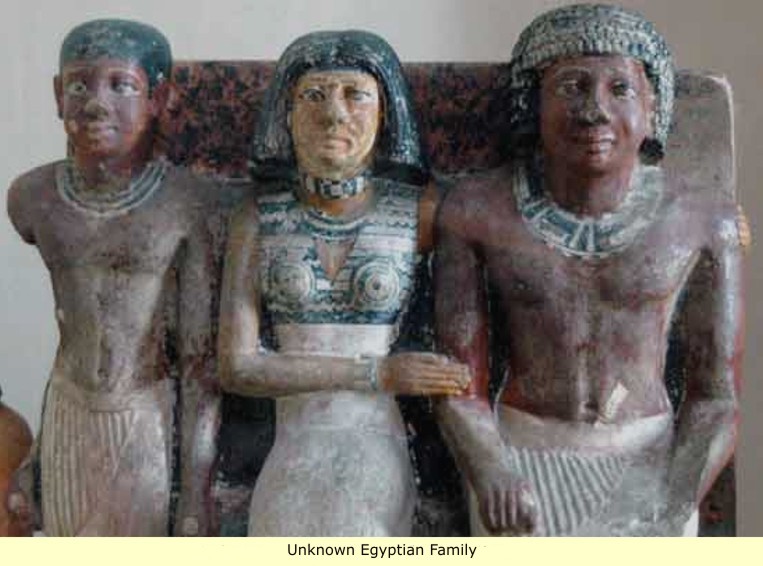
Smendes of his own accord could have no legitimate claim to the throne, so it is curious as to why the royals in Thebes accepted the suzerainty of Tanis so submissively. The answer seems to lie in the person of Tentamun - Smendes's wife, who appears to have been a member of the royal family. She may have been a daughter of another woman named Tentamun, who may have been the wife of Ramesses XI or possibly some other Ramesside king. She was also related to the royal house in Thebes. In fact, some of the later kings of the 21st. dynasty appear to have been from the Theban royal family. However, rule was never truly centralized during this entire intermediate period.
 |
 |
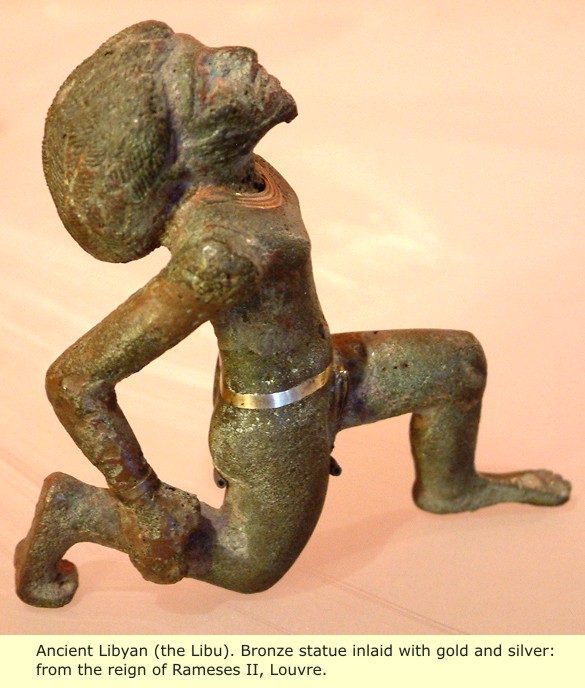
(The country west of Egypt)
 From
earlier times, Libyans and other Mediterranean peoples, who settled
mostly in the delta (northern Egypt), had constituted a substantial
part of the Egyptian army as mercenaries. They were most likely the
descendants of captured prisoners or even settlers like the Sherden,
{who were probably Sardinians }, who had been granted land of their own on the condition of their military service.
From
earlier times, Libyans and other Mediterranean peoples, who settled
mostly in the delta (northern Egypt), had constituted a substantial
part of the Egyptian army as mercenaries. They were most likely the
descendants of captured prisoners or even settlers like the Sherden,
{who were probably Sardinians }, who had been granted land of their own on the condition of their military service.
Greeks too, were part of this foreign population, as large numbers of Greek merchants and mercenaries also settled in the Delta. The Greeks however, were deterred from becoming too powerful by confining them to the city of Naucratis. Here the population was exclusively Greek. In Naucratis Greeks built great temples and Naucratis became the forerunner of Alexandria in terms of Greek influence in Egypt.
The Libyans, the Lebu/Libu and the Meshwesh - titled chiefs of the Meshwesh, Lords of Bubastis, (usually though to be Libyan in origin, however sometimes though to be of Elamite origin), had already, several generations before the time of Ramesses III, immigrated into the Egyptian Delta. They apparently had a sort of local autonomy, and their own hereditary chiefs.
 |
 |
 |
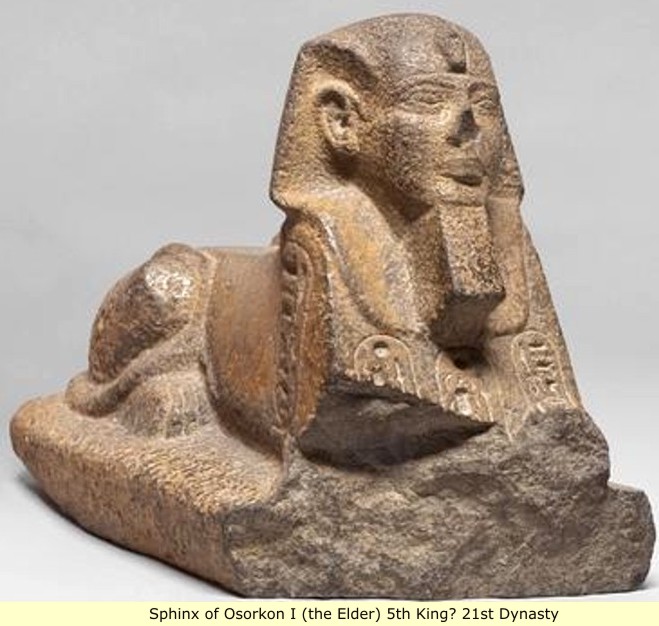
Over time, the Libyans power had grown such that soon after the death of Pharaoh Ramesses III, some of his successors were apparently compelled to share power with a Libyan general named Sheshong, who apparently was Lord of Bubastis and also titled Great Chief of Meshwesh. He seems to have been related by marriage to the Ramesside dynasty (either his grandmother was also mother of a king, or his aunt had married a king).
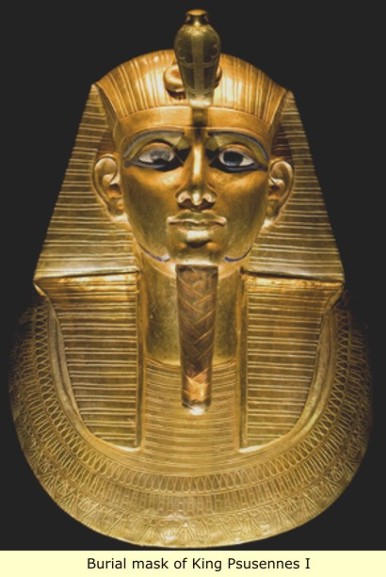
Libyan power continued to grow, so that even before the death of the last 21st. dynasty king, Psusennes II. Tanis had already been ruled for some time, by King Usimare Osorkon Si-Bast, Lord of Bubastis and third descendant of the Libyan Hedj-kheper-re Sheshong.
 |
After the death of the last King Psusennes (there were two), his family was more or less extinct. This opened the door for the reign of Libyan kings, they constitute the 22, 23 and 24th. dynasties. The capital cities of these Libyan kings were Bubastis, Tanis, Hermopolis, Herakleopolis, Leonthopolis, Thebes, Sais.
Sheshong I - 22nd dynasty. Also spelled Shosheng, (the Biblical Shishak in kings).
During his reign, political infighting and religious and family factionalism posed such a threat, that in 945 B.C, Pharaoh Sheshong I formed the world's first known secret police. This internal police force was so brutal and so thorough, that some historians have drawn parallels between it and the Nazi Gestapo and the Soviet KGB.

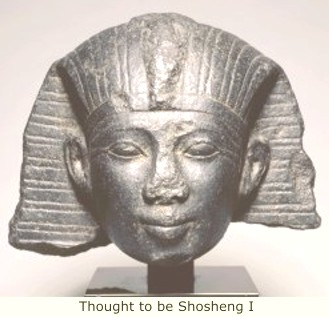
However Sheshong's greatest impact on history came about because of his greed. With the death of Solomon in 930 B.C, the Hebrew states fell into a period of civil war. Sheshong (who is referred to in the Bible as Shishak), used this period of turmoil to invade the Hebrew states. In 925 B.C, he smashed the Judean army of Rehoboam (Solomon's son) and defeated the forces of Jeroboam I (Rehoboam's chief rival). Then marched through to the other Hebrew state of Israel, plundering and looting as he had in Judah. With the Hebrew states thus depleted, Sheshong unwittingly sealed Egypt's doom, for he had weakened the buffer between Egypt, and what would become Egypt's eventual conqueror, Assyria.
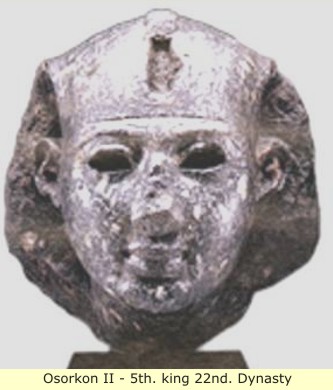
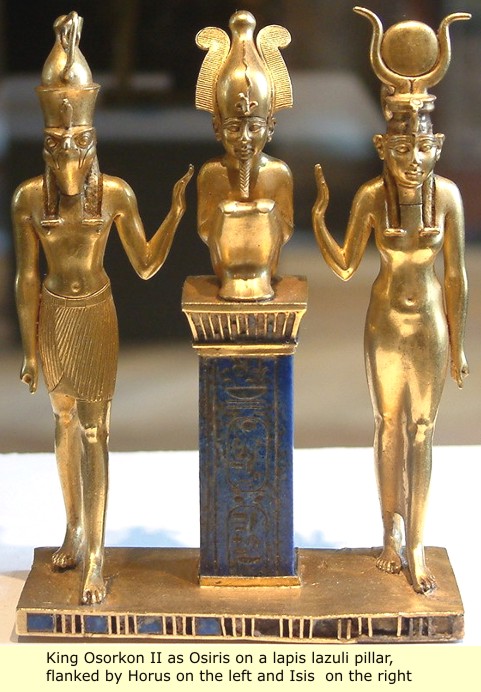 |
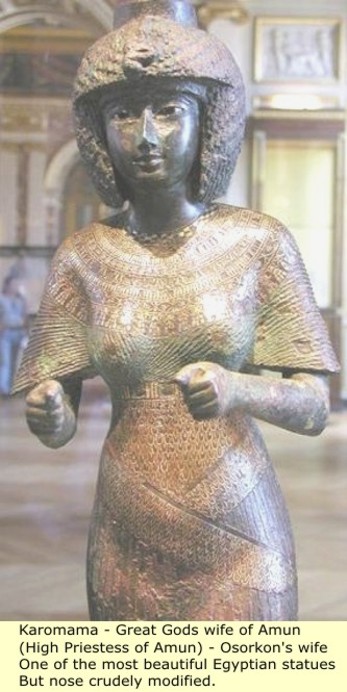 |
Sheshong IV was the ninth king of the 22nd Dynasty. In the year 732 B.C, toward the end of his reign, the Assyrian king Tiglath-pileser III, took Damascus and killed its king Rezin. He then captured many cities of northern Israel and took the people to Assyria. Egyptian troops had earlier joined forces with Damascus, Israel and some other states to resist a previous Assyrian king, Shalmaneser III. This time Sheshong IV made no attempt to help his former allies.
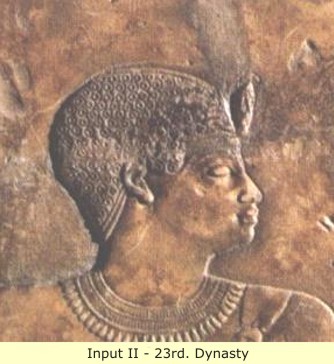
Osorkon IV- (735-712 B.C.). Osorkon IV was the tenth and final ruler of the Twenty-second Dynasty. During his reign, Hoshea, the king of Israel, sent messengers to Osorkon, requesting help against Assyrian king Shalmaneser V. No help was sent, the city of Samaria was captured and the Israelites were taken away to Assyria. Later, there were also threats from Sargon II, the next Assyrian king. To try to avoid an attack, Osorkon IV sent him rich gifts and it apparently worked. The Assyrian king came no further. Nothing worthy of note is known of the kings of the 23rd and 24th dynasties.
The MoorsThis
however was not the end of the Libyans: In 711 A.D. A Berber army led
by general Tariq ibn Ziyad, invaded Iberia (Spain) and overthrew the
Visigoths (Western Goths): Who were one of two main branches of the
Goths, an east Germanic tribe, who over the period of only one hundred
years, had migrated from eastern Europe, thru Greece, thru Italy, and
finally down into the Iberian peninsula. In Iberia (Spain), the Berbers, now known as Moors,
created a highly advanced civilization and culture, famous for it’s
art, architecture, and centers of learning. While having rule over
Spain: The Berbers, who themselves fifty years earlier had been forced
to accept Islam, now forced the inhabitants of Iberia to do the same.
Though the number of "Moors" remained small, (moors 400,000 – Arabs
(Turks) 40,000), they forced large numbers of Iberians to convert to
Islam. According to Ronald Segal, author of Islam's Black Slaves, some
5.6 million of Iberia's 7 million inhabitants were Muslim by 1200 AD,
virtually all of them native inhabitants (Blacks). Beginning
in about 900 A.D. A small Christian enclave of Visigoths in
northwestern Spain, named Asturias; initiated conflicts between
Christians and Muslims. Soon after, Christian states based in the north
and west slowly, in fits and starts began a process of expansion and
conquest of Iberia over the next several centuries. The
end for the Moors came on January 2, 1492; the leader of the last
Moorish City – Granada, (located in southern Spain) - surrendered to
armies of a recently united Christian Spain (after the marriage of
Ferdinand II of Aragon and Isabella I of Castile). The remaining
Muslims and Jews were forced to leave Iberia, die, or convert to Roman
Catholic Christianity. Earlier
in 1480, Isabella and Ferdinand had instituted the Inquisition in
Spain. The Inquisition was aimed mostly at Jews and Muslims who had
overtly converted to Christianity but were thought to be practicing
their faiths secretly - known respectively as marranos and moriscos -
as well as at heretics who rejected Roman Catholic orthodoxy. (A
note here: it is not known if the “Jews” of Spain, herein referenced,
refers to Khazars or actual Hebrews. As the Khazars are also ethnically
Turkish, they are likely the referenced group). It
is of ironic note: that eight months later, in the nearby town of
Palos, on the evening of August 3, 1492. Christopher Columbus would
depart from Palos on his journey to the Americas. One result of which,
would be the Spanish and Portuguese Atlantic Slave trade. |
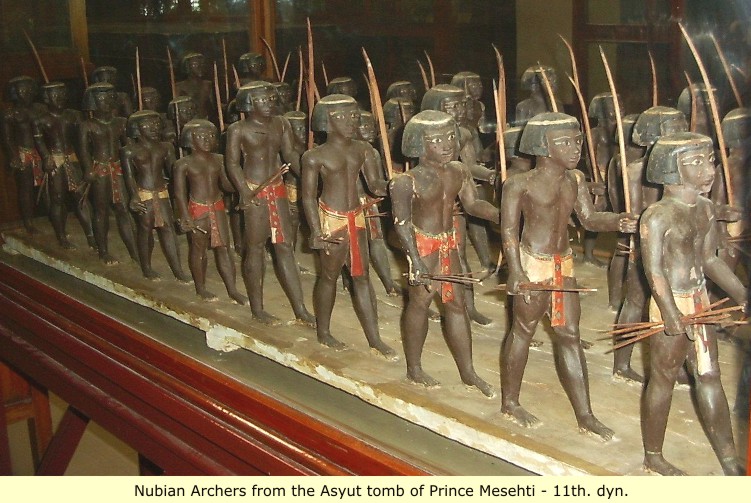
From earliest times, even from the time of unified Egypt's first Pharaoh - Narmer, Egypt's southern neighbor Nubia, {modern Sudan}, had always been treated as Egypt's private preserve for conquest, plunder and looting. The Nubians always rebelled, and always the rebellions were put down, sometimes brutally. This is best attested by the fact that the fortunes of the two countries were always the inverse: when Egypt was strong Nubia was weak, when Nubia was strong Egypt was weak. Yet at the same time, Nubia's culture was pretty much the same as Egypt's, Nubians were valued members of the Egyptian army, Pharaohs had Nubian wives and Nubians were found amongst Egypt's wealthy. One can only guess at the basis for this strange relationship, but surely it was buried in millennia.
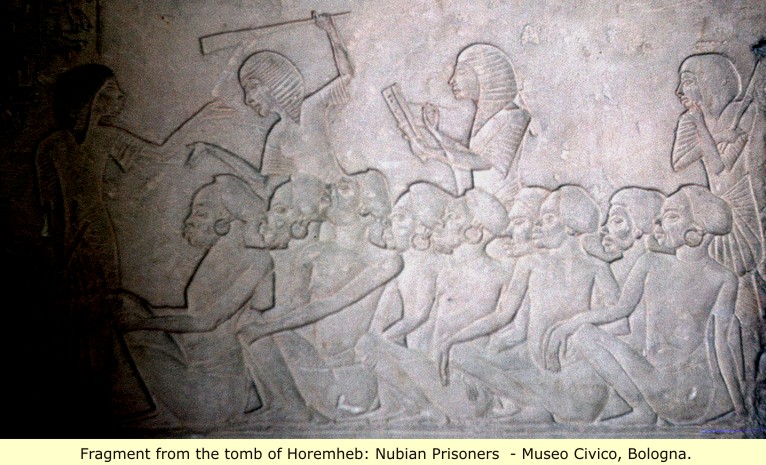 |
Considering this history, the Hyksos king Apepi I, could hardly have been blamed for trying to form an alliance with the Nubians against Egypt when king Kamose began his war against the Hyksos to reunify Egypt. But Nubia refused, and instead, was Egypt's steadfast ally, providing all that was needed for a successful campaign, and together Egypt and Nubia expelled the Hyksos from Egypt.
Now a thousand years later, a similar situation exists, northern Egypt is once again in the hands of foreign kings, and once again, Egypt's salvation lies in the hands of Nubia. This history perhaps explains Nubian King "Piye's", seemingly strong emotional ties with Egypt, which he obviously considered part of his motherland.
 |
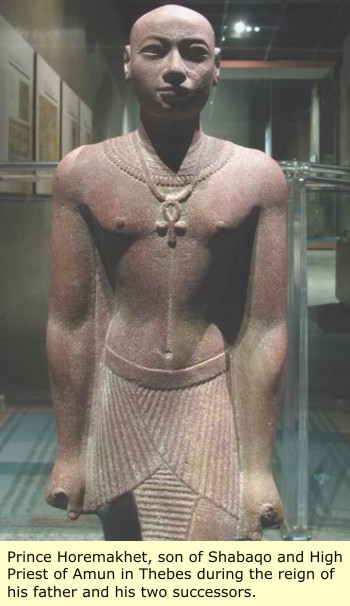
Accordingly, Piye decided to step in and fix Egypt's problems. He marched north and subdued almost all the rebellious elements in Egypt. Then after conquering Egypt, Piye simply went home to Nubia, and to our knowledge, never again returned to Egypt. But he did maintain oversight from his capital in Nubia/Kush. Though Piye chose to govern from Kush, his successor "Shabaka", after completing the total reunification of Egypt, chose to rule from the city of Waset in Egypt. Conventionally, there were five Nubian kings of Egypt, they ruled for about sixty years and comprise the 25th dynasty.
| Click here for the text of Piye's Victory Stela wherein he describes his conquest of Egypt. <<CLICK>> |
 |
 |
 |
The end of the Nubian 25th dynasty was brought on by two factors: first - the Egyptians had apparently tired of foreign rule, even if it was Nubian. Second - the full-scale invasion of Egypt by the Assyrians. By the time of Nubian king Pi'ankhy, Lower Egypt and part of Middle Egypt had already disintegrated into a number of petty princedoms, which were always ready to side with whichever of the two great powers (Nubia and Assyria), that would be the more likely to leave them with their independence.
 |
The smoldering hostility of the two great powers flared up afresh under Assyrian king Sennacherib (705-681 B.C.), whose third campaign in Canaan, started with the subjugation of the Phoenician coast-towns.
Trouble had arisen farther south however. The people of the Philistine city of Ekron had expelled their king Padi, on account of his loyalty to Assyria, but Hezekiah of Judah who had received and imprisoned him, became afraid and appealed to Egypt for help. The armies meant at Eltekeh, and a great defeat was inflicted on the Egyptian and Nubian forces.
Padi's throne was restored to him. Many towns of Judah were ravaged, though Jerusalem was not taken. To avoid this, Hezekiah submitted to pay a heavy tribute.
Upon the death of Sennacherib, his son "Esarhaddon" (680-669 B.C.), became Assyria's king. At the beginning of his reign, the Aramaean tribes were still allied with Elam against him, but Urtaku of Elam (675–664 B.C.) signed a peace treaty and freed him from campaigning there. This spelled trouble for Egypt.
 |
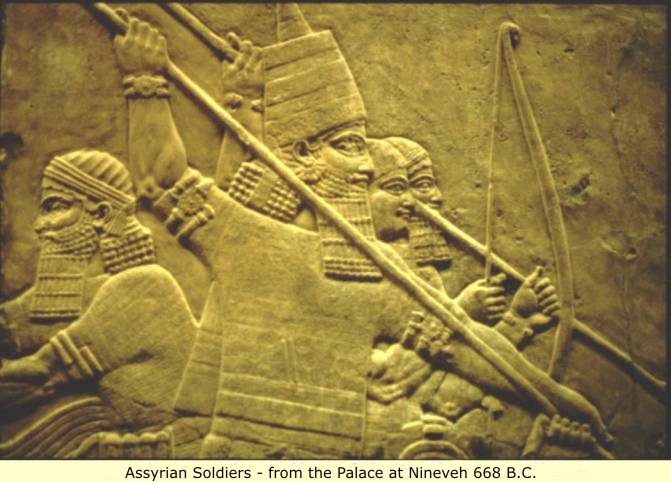 |
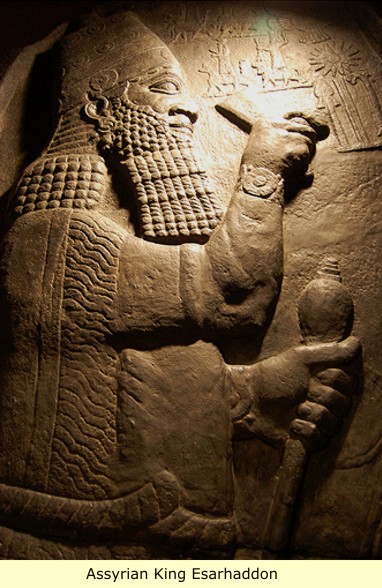
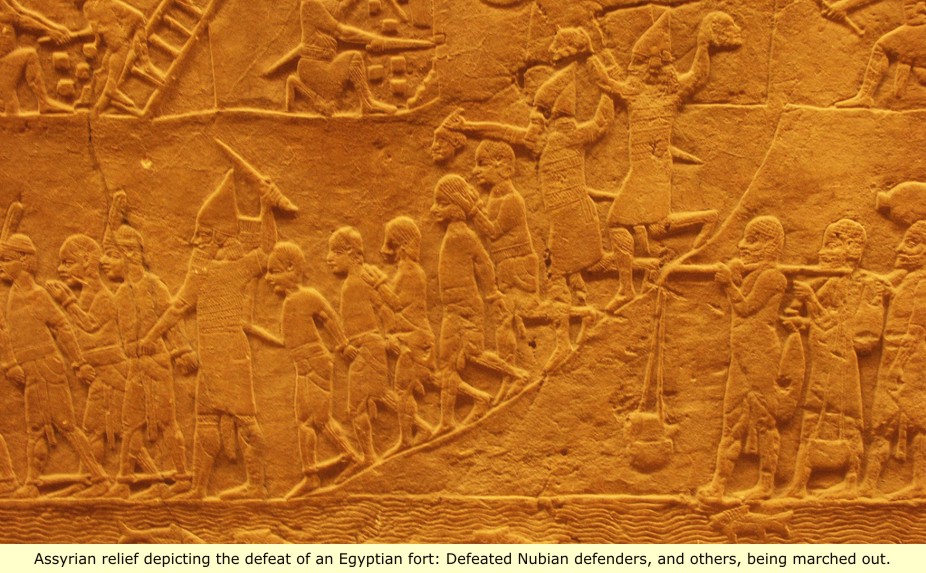
In 679 B.C. Esarhaddon stationed a garrison at the Egyptian border, because Egypt, under the Nubian king Taharqa, was planning to intervene in Arum. Esarhaddon then put down, with great severity, a rebellion of the combined forces of Sidon, Tyre, and other Canaanite cities. Now the time was ripe to attack Egypt, which was suffering under the rule of the Nubians and was by no means a united country. Esarhaddon's first attempt in 674–673 B.C. miscarried, in 671 B.C. however, his forces took Memphis, the Egyptian capital. Assyrian consultants were immediately assigned to assist the princes of the provinces, their main duty being the collection of tribute.
The Egyptian records are silent, but stele and tablets inscribed in cuneiform, give circumstantial accounts of the campaign in which Esarhaddon, after subjugating Canaan, drove Nubian king "Taharka" reeling back to the south.
Here is a shortened excerpt from the best preserved of his inscriptions:
From the town of Ishhupri as far as Memphis, a distance of fifteen days, I fought daily, very bloody battles against Tarky, king of Egypt and Nubia, the one accursed by all the great gods. Five times I hit him with the point of my arrows, inflicting wounds, and then I laid siege to Memphis, his royal residence. I destroyed it, tore down its walls, and burnt it down. (After mentioning the booty which he carried off to Assyria he continues): All Nubians I deported from Egypt, leaving not even one to do homage to me. Everywhere in Egypt I appointed new kings, governors, officers, harbor overseers, officials, and administrative personnel.
Esarhaddon reorganized the political structure in the north, establishing Nekau/Necho I (a Libyan) as first king of the 26th dynasty at Sais. Upon Esarhaddon's return to Assyria he erected a victory stele, showing Taharqa's young Prince Ushankhuru in bondage.
Tanwetamani (Assyrian Tandamane or Tantamani, Greek Tementhes, also known as Tanutamun) was Egypt's last ruler of the 25th Dynasty as well as the last Nubain (Kushite) Ruler, ruling from about 664 to 657 B.C. We are told his throne name was Ba-ka-re, meaning "Glorious is the Soul of Re He succeeded Taharqa though he was probably the son of that king's sister, queen Qalhata. His succession to the throne is recorded in a record known as the Dream Stela, (not to be confused with that of Tuthmosis IV). It was discovered along with the Victory Stela of Piye at Gebel Barkal in 1862, and now resides in the Nubian Museum in Aswan.
Tanwetamani may have served as a co-regent with Taharqa, but his parentage and family relationships are difficult. From his stele we find depicted two women, one of whom is referred to as "the royal sister, the Mistress of Egypt “Qalhata", while the other is "the royal sister, the Mistress of Ta-Seti, Pi-(ankh)-Arty". An analysis of the text associated with the stele would seem to indicate that Qalhata was Tanwetamani's mother, while the second woman was his wife. The fact that Qalhata was his mother is also supported by her tomb at Nuri in the modern Sudan, where she is given the title of "King's Mother". Foundation deposits also show that the tomb was build during the reign of Tanwetamani.
Of his father, K.A. Kitchen provides:
"The parentage of Tantamani is not absolutely certain; the 'Rassam Cylinder' of Assurbanipal calls him 'son of Shabaku', while Cylinder B makes him 'the son of his (Taharqa's) sister', cited above. It would be possible for Tantamani to have been a son of Shabako by an elder sister of Taharqa. This solution, however, would make Tantamani the son of an uncle/niece marriage; and most scholars prefer - perhaps correctly - to take the Assyrian 'Shabaku' as intended (or an error) for Shibitku. As the latter was a brother of Taharqa, Tantamani would then have been the offspring of a brother/sister match precisely like the marriages of Alara and Kasaqa, Kashta and Pebatma, Piankhy and three of his five wives, and Taharqa and two wives. So, provisionally, I adopt this latter solution here."
Therefore, most recent histories which discuss the 25th dynasty, identify Tanwetamani (Urdamani) as a son of Shabataka, Taharqa's brother, not of his uncle Shabaka as the Rassam cylinder annalist appears to suggest. The errant orthography can be explained by the fact that the name Shabaka is more properly vocalized as Shebitku. If so then the "t" in the doubled consonant "tk" in the name of Shebitku would easily be lost to a foreign ear. The annalist wrote what he heard and recorded Shabataku instead of Shabitku.

In the narrative of his stele, the king is referred to as "lord of valor like Montu, great of strength like a fierce-eyed lion". It goes on to explain that in the first year of his reign, Tanwetamani had a dream of two serpents, one on his right hand and one on his left. After waking, the king's advisors interpreted the dream, saying that, "the southland is already thin, seize the northland". Hence, he should bring Egypt back under control of the Kushite empire. After this passage, another states that Tanwetamani then "rose on the throne of Horus", a term which may be interpreted as his having ascended the throne. This is the primary evidence we have for his co-regency with Taharqa, but we are also told that Assyrian text provides that he did not do so until after Taharqa's death.
We assume that at the time of his accession, Tanwetamani was most likely inside Egypt proper, for the text on the stele states that "he went from where he was to Napata (Nubia), and there was none who stood up to oppose him". Hence, he went to the Temple of Amun and was acknowledged as god and king.
Other text within the stele confirms that he was at this time in control of southern, or Upper Egypt, but at the very least was not in control of parts of the north. After ascending the throne, he went north from Nubia, first stopping at Elephantine where he participated in a festival procession of the God Khnum From there he sailed further north to Waset (Thebes where he once again participated in the festival. However, after this, he goes further north to Memphis where we learn that:
"the sons of revolt rushed forth to fight against his majesty. His majesty made a great slaughter amongst them, and it was not know how many of them were killed."
Nekau (Necho) of Sais may have been killed in this battle, but his son, Psamtek who was loyal to the Assyrians fled to Asssyria. After this victory, Tanwetamani honored the God, Ptah -Sokar and his wife Sakhmet in the great temple of Memphis, and afterwards ordered the building of a chapel dedicated to Amun at Napata in Nubia. The temple, we know, was to be built of stone overlaid with gold, sections of cedar wood and the leaves of the door plated with electrum. This temple may be associated with parts of the great temple of Amun at Gebel Barkal.
Afterwards, he prepared to attack the Delta:
"His majesty sailed down the river...and he did battle with the princes of the Northland and they went into their huts as rats go into their holes. And his majesty passed many days by them, and not one of them came forth to do battle with his majesty; and his majesty made a sailing up the river to Memphis and he sat down in his palace to think out and plan how he could make his soldiers surround them with mounds. And one said to him: 'These princes have come to where the sovereign is.' And his majesty said, 'Have they come to do battle? Or have they come to pay fealty to me? If they come to pay fealty, they live from this hour'. They said before his majesty: 'They have come to pay fealty to the sovereign, our lord.'
His majesty said, 'Where are they at this moment?' They said 'They wait standing in the court.' Then his majesty went forth from his house and his appearance was like the shining of Re upon the horizon, and he found them prostrate upon their bellies, smelling the earth before him."
Tanwetamani apparently spared the lives of the Delta princes, sending them home, but this victory was short lived. The Assyrians mustered their army under their new king Assurbanipal, telling us that:
"In my second campaign, I made straight for Egypt and Kush. Tandamani heard of my campaign and that I trod the soil of Egypt. He abandoned Memphis and fled to Thebes to save his life. The kings, princes and mayors whom I had set up in Egypt came and kissed my feet. I took the road after Tandamani and marched to Thebes, his stronghold. He saw the approach of my terrible battle array and he fled to Kipkip. Thebes in its entirety I captured with the help of Assur and Ishtar. Silver, gold, precious stones, all the possessions of his palace, many colored clothing, linen, great horses, two obelisks of electrum, the door posts of the temple door I took from their bases and removed to Assyria. Great booty, beyond counting, I took away from Thebes. Against Egypt and Kush I let my weapons rage and I showed my might."
The "door posts of the temple" may refer to the great gate of electrum erected by Tuthmosis IV and renewed by Shabaka. This attack on Thebes was one of the great tragedies of the ancient world, and was remembered by a Jewish prophet fifty years later:
"Will you fare better than No-Amon? - She that lay by the streams of the Nile, surrounded by water, whose rampart was the Nile, waters her wall; Kush and Egypt were her strength, and it was boundless. Punt and the Libyans brought her help. Yet she too became an exile and went into captivity. Her infants too were dashed to the ground at every street corner. Her nobles were shared out by lot, and all her great men were thrown into chains."
Interestingly, Tanwetamani seems to have continued to be acknowledged as pharaoh in Thebes until his eighth year. There are inscriptions at Luxor that date the installation of priests by his name and the Kushites still maintained a large official presence in the city. Piye's daughter Shepenwepet II, we know as God's Wife of Amun, with Taharqa's daughter, Amenirdis II as her designated successor. Even in this year of Tanwetamani's reign, his cousin remained the high Priest of Amun, and we have other evidence of the Kushite's continued power within the region.
It is possible that Tanwetamani one again tried to assert control over Egypt, though the evidence is slight. In a brief passage in the work of Polyaenus from a 2nd Century (A.D.) text, we hear of a later battle near the temple of Isis at Memphis that may have involved Tanwetamani. He states that Psamtik, aided by Carian mercenary troops, defeated "Tementhes". A few Egyptologist believe, based on a hellenistic Jewish source, that Tanwetamani may have even retaken Memphis, but much of this is conjecture. In any case, Tanwetamani probably continued to rule in Nubia for at least a few more years, and was buried in the necropolis at Nuri.
 |
 |
 |
Egyptian King and Ruler listThe ancient Egyptian Kinglist is very fluid, as new attestations for previously unknown kings or Queens are discovered (such as newfound Serekhs or Cartouches), the list is updated. Chronological dates are educated guesses.
|
THIRD INTERMEDIATE PERIOD21st Dynasty
Herihor 1080-1074 Piankh 1074-1070 Pinedjem I 1070-1032 Masaherta 1054-1046 Menkheperre 1045-992 Smendes II 992-990 Pinedjem II 990-969 |
22nd Dynasty
23rd Dynasty
24th Dynasty
25th Dynasty
|
Please visit the "Additional Material Area" for many more photographs of each civilization, and related material <Click> |
|
NOT OUT OF AFRICA
Professor Mary Lefkowitz, Professor in the Humanities at Wellesley College Massachusetts is a Jewish woman from New York. It's been 28 years (1996) since her "Not Out of Africa" book was published, and we are amazed at the number of Black people who still don't know that it is PURE NONSENSE with her accusing Blacks of doing exactly what Albinos routinely do concerning history. AND WE DON'T LEGISLATE AGAINST TEACHING ALBINO CHILDREN ABOUT ALBINO ANCIENT HISTORY - THERE IS NONE! But Hey Gov. Ron DeSantis - sooner or later your Albino Children will learn the truth, what will you do then? In "Not Out of Africa" the Professor said that she "comprehensively" exposes how Afrocentrism became an excuse to teach myth as history."
As you can see she/they (Albinos) placed a picture of what they supposed was a WHITE GREEK man on the cover to show us what the REAL creators of Civilization looked like in "THEIR FANTASY'S" (we hope you can detect that it is a PLASTIC bust). Of course most Greeks were Black as were most people in ancient Europe, even after the Sea Peoples exodus. (We assume that you know that Africans started settling Europe after the "Last Ice Age" from about c.45,000 B.C.). If not, we cover it here in many different pages. Amazon review capsule: Not Out of Africa has sparked widespread debate over the teaching of revisionist history in schools and colleges. Was Socrates black? Did Aristotle steal his ideas from the library in Alexandria? Do we owe the underlying tenets of our democratic civilization to the Africans? Mary Lefkowitz explains why politically motivated histories of the ancient world are being written and shows how Afrocentrist claims blatantly contradict the historical evidence. Not Out of Africa is an important book that protects and argues for the necessity of historical truths and standards in cultural education. In other words, Mary is asking: “Who are you going to believe, me or your own lying eyes?” By Chico Marx - Jewish actor. From the Robert T. Carroll (a PhD) Book review quote: What is offensive about Afrocentrism is not that its advocates assert such things as that Socrates and Cleopatra were black Africans or that Aristotle stole his ideas from the library at Alexandria when he visited Egypt. What is offensive is not that they claim that the ancient Greeks took everything they are known for from the Egyptians, and that those Egyptians were black Africans. What is offensive is that these claims are put forth as articles of faith. Any challenge to them is seen as racist. CAN YOU BELIEVE THAT AT THIS "LATE" DATE, ALBINOS STILL BELIEVE THAT EGYPTIANS WERE WHITE?? Continue: What is offensive is that these claims are not based on scholarly research, evidence and argument from evidence. Nor are they based on a sincere desire to discover historical truth. They are based on unsubstantiated opinions of mythmakers and fiction writers. They are based on the possibility they are true. They are based on a desire for them to be true. They are based on a preconceived notion that white scholars have conspired from time immemorial to repress the truth that everything good about Western civilization came out of Black Africa. They are based on the desire to give African-American children self-esteem and pride. By Robert T. Carroll, November 27, 1996 OUR ANSWER IS QUITE SIMPLE: "A picture is worth a thousand words." That adage is believed to stem from an article by Fred R. Barnard in an advertising trade journal of 1921 promoting the use of images in advertisements". THAT IS WHY Realhistoryww has thousands of photos of Real ancient People and Real ancient Artifacts with written documents to back them up. Unlike Albino bullshit which they assume you will believe, just because they are ALL-KNOWING Albinos, or at least that is what you have been trained to believe. Quote: They are based on a preconceived notion that white scholars have conspired from time immemorial to repress the truth that everything good about Western civilization came out of Black Africa. Answer: YOU are Albinos, that is a disease; you are NOT normal nor natural, and you have NOT existed from time immemorial, your OWN scientists have set your time of existence at 6,000 - 12,000 years. Speaking to Blacks: Mary Lefkowitz is a Professor, Robert T. Carroll is a PhD, yet both of these "Ignoramuses" falsely believe that Albinos are native to Europe and that the Greeks, Romans, etc. were Albinos just like THEM - which of course is part of their nonsense history.
Was the above quote designed to give BLACKS: a desire to give African-American children self-esteem and pride - By Robert T. Carroll OR Albino children self-esteem and pride? The Smithsonian Institution is the world’s largest museum, education, and research complex, with 21 museums and the National Zoo—shaping the future by preserving heritage, discovering new knowledge, and sharing our resources with the world. The Institution was founded in 1846 with funds from the Englishman James Smithson (1765–1829) according to his wishes “under the name of the Smithsonian Institution, an establishment for the increase and diffusion of knowledge.” We continue to honor this mission and invite you to join us in our quest. People! The worlds greatest "EDUCATIONAL INSTITUTION" (he,he) wrote that nonsense below the little Albino girl putting on her Sun Block above, yet you still believe them?? In case you didn't know; CENTRAL ASIAN ALBINOS: Germanic's, Slavs, Turks, (who modern Albino liars call Greeks and Romans) entered Europe as ILLITERATE NOMADS; some as Slave Soldiers of Black Arabs called MAMLUKS! << See Wiki - The Migration Period >> |
| < Back | Home | Next > |


