In China, The first evidence of advanced farming and surplus food production appears related to the Yangshao culture, which was focused in the basin formed by the confluence of the Yellow River (Huang Ho), the Fen Ho, and the Kuei-Shui Rivers.
This Yangshao culture, which relates to the Xia Dynasty, is characterized by handsome painted pottery. This culture also includes cultivated millet, rice, kaoliang, and possibly soybeans, as well as domesticated pig, cattle, sheep, dog, chicken, and possibly the horse and silkworm. There was also “ceremonial” pottery vessels and elaborately worked objects in jade, flint, bone, and stone. This culture dates to about 3,500 B.C.
Note: There are several Pyramids in China, some quite large. However, because of the political situation, western archeologists have not been able to investigate them. Whatever information Chinese archeologists have uncovered, has not been made available.
Specifics of the ancient East African migrations which led to Modern Man's presence in China and colonization of the entire world, can be found here: Though as one would expect, when it comes to European and Anatolian (Turkey) settlement, it is not only inaccurate, it is downright Racist. But what would you expect? https://www3.nationalgeographic.com/genographic/atlas.html
|
This part relates to government at the beginnings of village living and agriculture:
To facilitate the needs of survival and development, a fair, upright and capable person was chosen to lead the people in their work and to organize their defenses against invasions. This became a process whereby Yao, for example, recommended Shun, Shun recommended Yu and Yu recommended Gaotao, and so on. Later generations named this method of selecting a tribal head The "Abdication System". This period, where egalitarianism was widespread, was characterized by peace, equality and the common ownership of wealth, historians referred to it as the Society of Great Harmony.
As population increased, some people inevitably broke away from their groups to form new clans. With improved productivity, an individual was able to produce more than he could consume. This meant that neighboring clan captives were kept alive as slaves instead of being killed. The slaves were then obliged to work, and their total output became the property of their owners. In this way, private ownership evolved. As more and more people became either owners or slaves, a class structure developed within the society, thereby replacing the former primitive Society of Great Harmony.
The Longshan Culture is a prime example of this period. To protect their own interests, the privileged classes abandoned the Abdication System and adopted a new political system and social regulations. After the death of Yu the Great, his son, Qi, killed the appointed successor and usurped power. In so doing, he established a new era of hereditary monarchy that subsequently ruled in China for nearly 4,000 years. This was when the Xia (21st-17th century B.C.), the first hereditary dynasty in China was born.
As the first slave dynasty in Chinese history, the Xia Dynasty began with the reign of Qi, the son of the Great Yu, and ended with the fall of Jie. With its capital located in Anyi (north of Xia County in mid-west Shanxi Province), the Xia was ruled by the descents of the Xiahou tribe. Altogether, there were 16 kings in 13 generations. {The Shang is referred to as the second slave dynasty}.
In their chronology, the Yangshao is indeed the original culture, but they attribute the Xia to the Longshan. Interestingly, no mention is made of different ethnicity's, and no evidence is offered to prove that the Xia enslaved the Mongols.
When visiting the Chinese governments Website, one would note that the Chinese still imply that they descent from Peking Man (Homo-Erectus), of course this is racist nonsense. A genetic study done by researchers from all over the world: China, Japan, U.S.A. U.K. and other countries, and published in 2001; definitively answered the question of Chinese origins. The findings were that the original Chinese were 100% pure Black African, with absolutely no outside admixture - But here again, we are talking about the original Black Chinese, modern Chinese are quite different. Click here for link to the Chinese governments history website |
|
The Yangshao culture is followed by the Lungshan, after which comes the Yin, or Shang, which dates to about 1,500 B.C, and is by far the better known.


 |
A note here: We have already made clear that dates should not be taken literally. A point of comparison: the Yangshao culture is dated conventionally at 3,500 B.C, yet just across the bay in Japan, the same type people (the ancient Jomon), who migrated "from" China to Japan, are known to have inhabited that area since about 35,000 B.C, so be careful what conclusions you draw from dates.
 |
 |
 |
 |


 |
 |
For many years, the Xia Dynasty was thought to be a mythical time that the Chinese tell about as part of their oral history. Though the Xia Dynasty existed in oral histories, there was no archaeological evidence found of it until 1959. Then excavations at Erlitou, in the city of Yanshi, uncovered what was most likely a capital of the Xia Dynasty. This site showed that these people, were direct ancestors of the Lungshan/Longshan culture. Radiocarbon dates from this site, indicate that it existed from 2100 to 1800 B.C. Despite this new archaeological evidence of the Xia, they are still not universally accepted as a true dynasty.
 |
 |
 |
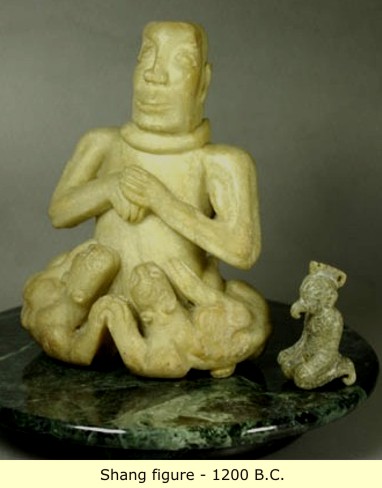
The Shang, rather than the Xia, are still considered by most, to be the first true dynasty of China. Like the Xia, the Shang were originally considered to be a myth. They were discovered because Chinese pharmacists were unknowingly selling oracle bones that the Shang had created; the pharmacists were selling the bones as dragon bones. These bones were first noticed in 1899, and by the 1920's, they were traced back to Anyang provence, where the last Shang capital was found and excavated. Excavations were halted in 1937, when Japan attacked China. In the 1950's, an even earlier Shang capital was found near present day Zhengzhou. Traditional Chinese history indicates that the Shang Dynasty consisted of 30 kings and seven different capitals.
Shang Chariot and horse burialsChariot horse burials are found from Greece to China, but they are relatively rare except in China and the bones are often very poorly preserved. The earliest chariots and chariot burials in China date to the Shang dynasty, at around 1250 BC (Linduff 2003). Their use in the Shang period mainly seems restricted to royalty. But during the succeeding periods the burial of chariots and horses became much more widespread. Most Shang chariots were driven by two horses. Chariots pulled by four horses did not become widespread until the Spring and Autumn period. In some situations horses were buried in pits with chariots either side by side or one in front of the other. Some pits contained only horses and others only chariots. Sometimes the horses were buried in the main tomb while the chariots where in separate pits, while at times the reverse was the case (Lu 1993). A Shang period (11th century BC) horse and chariot pit M52 from Guojiazhuang, (Anyang, (Henan). The men and horses had been killed and lain in the pit before the chariot was lowered into it (Zhongguo Shehui Kexueyuan Kaogu Yanjiusuo Anyangdui (CASS 1988; Bagley 1999). A Western Zhou period horse pit, Tianma-Qucun (Houma, Shanxi). The horses were apparently buried alive, with their feet tied together. |
 |
 |
Unfortunately there are no lifelike statues of the Xia in China, just these jade and bronze works, {that have been made available anyway}. However, there are lots of them in the Americas, and that's exactly where we are going.
 |
 |
(Albino Mongol)
 |
(Mulatto Mongol)
 |
(Black Caucasian)
 |
| Wiki: A 2008 study by Jilin University showed that the Yuansha population has relatively close relationships with the modern populations of South Central Asia and Indus Valley, as well as with the ancient population of Chawuhu. In 2007 the Chinese government allowed a National Geographic Society team headed by Spencer Wells to examine the mummies' DNA. Wells was able to extract undegraded DNA from the internal tissues. The scientists extracted enough material to suggest the Tarim Basin was continually inhabited from 2000 BCE to 300 BCE and preliminary results indicate the people, rather than having a single origin, originated from Europe, Mesopotamia, Indus Valley and other regions yet to be determined.[citation needed] In years 2009-2015, the remains of in total 92 individuals found at the Xiaohe Tomb complex were analyzed for Y-DNA and mtDNA markers. Genetic analyses of the mummies showed that the Xiaohe people were an admixture from populations originating from both the West and the East. The maternal lineages of the Xiaohe people originated from both East Asia and West Eurasia, whereas the paternal lineages all originated from West Eurasia. Mitochondrial DNA analysis showed that maternal lineages carried by the people at Xiaohe included mtDNA haplogroups H, K, U5, U7, U2e, T and R*, which are now most common in West Eurasia. Also found were haplogroups common in modern populations from East Asia: B5, D and G2a. Haplogroups now common in Central Asian or Siberian populations included: C4 and C5. Haplogroups later regarded as typically South Asian includedM5 and M*. The paternal lines of male remains surveyed nearly all – 11 out of 12, or around 92% – belonged to Y-DNA haplogroup R1a1, which are now most common in West Eurasia; the other belonged to the exceptionally rare paragroup K* (M9). The geographic location of this admixing is unknown, although south Siberia is likely. According to a comment posted on 18 July 2014 by one of study co-authors - prof. Hui Zhou - Xiaohe R1a1 lineages does not belong to R-Z93 branch and the study supports the "steppe hypothesis". It has been asserted that the textiles found with the mummies are of an early European textile type based on close similarities to fragmentary textiles found in salt mines in Austria, dating from the second millennium BCE. Anthropologist Irene Good, a specialist in early Eurasian textiles, noted the woven diagonal twill pattern indicated the use of a rather sophisticated loom and said that the textile is "the easternmost known example of this kind of weaving technique." Mair claims that "the earliest mummies in the Tarim Basin were exclusively Caucasoid, or Europoid" with east Asian migrants arriving in the eastern portions of the Tarim Basin around 3,000 years ago while the Uyghur peoples arrived around the year 842. In trying to trace the origins of these populations, Victor Mair's team suggested that they may have arrived in the region by way of the Pamir Mountains about 5,000 years ago. Mair has claimed that: The new finds are also forcing a reexamination of old Chinese books that describe historical or legendary figures of great height, with deep-set blue or green eyes, long noses, full beards, and red or blond hair. Scholars have traditionally scoffed at these accounts, but it now seems that they may be accurate. Chinese historian Ji Xianlin says China "supported and admired" research by foreign experts into the mummies. "However, within China a small group of ethnic separatists have taken advantage of this opportunity to stir up trouble and are acting like buffoons. Some of them have even styled themselves the descendants of these ancient 'white people' with the aim of dividing the motherland. But these perverse acts will not succeed". Barber addresses these claims by noting that "[The Loulan Beauty] is scarcely closer to 'Turkic' in her anthropological type than she is to Han Chinese. The body and facial forms associated with Turks and Mongols began to appear in the Tarim cemeteries only in the first millennium BCE, fifteen hundred years after this woman lived. Due to the "fear of fuelling separatist currents", the Xinjiang museum, regardless of dating, displays all their mummies, both Tarim and Han, together. |
Please note these scientific facts!
Some might wonder exactly WHY European and Asian populations have so little genetic diversity. The answer is quite simple: as fully explained in other articles, European populations derive mainly from just the Black Dravidian people of India, which is just one of the many ethnicities of India. The lack of diversity among Mongol people is much more complicated though: to begin with, we already know from the Chinese history that the original (OOA) Out of Africa people who went to china were ordinary Negroid phenotype Africans who we know today as the Xia, Jomon, and Ainu. But also with them were Mongol phenotype Africans, like the Himba and San. To "Try" to explain what happened in North-East Asia, we will cite two scientific studies.
As is usual with the work of European Albinos and Mongol Asians - NOWHERE is heard a word about the Black man - their Father. The reason for that is of course quite simple: if the Black man is mentioned, then his place must be given and explained. That would leave European Albinos and Asian Mulattoes with the very uncomfortable task of explaining their own place in the hierarchy of Human beings.In any event, the evidence seems to suggest that the Mongol phenotype Black Africans (such as some San people), produced the most Albinos: and in keeping with Albino behavior in the rest of the world, these Albinos, along with their Mulattoes, killed or "Absorbed" most of the Black East Asians (keeping in mind that the average Chinese is neither Black nor White, but rather a MULATTO!). This is consistent with current population surveys which find that the San of southern Africa have the "lightest" complexion of all Africans.Examples of these people are found in page (2). |
In 1923–27 during excavations at Zhoukoudian China, near Beijing (formerly "Peking") bones were found from a ~750,000 year old Humanoid dubbed "Peking Man". Many people, including some Chinese, claimed that the Chinese people descended from Peking Man; who in fact was actually a Homo-Erectus.
 |
 |
 |
^^^^^^^^Quote from above study: Therefore, the data do not support even a minimal "in situ" hominid contribution in the origin of anatomically modern humans in East Asia. |
 |
 |
|
THIS |
PLUS |
THIS |
EQUALS |
THIS |
 |
Please note; the Albino people, who once couldn't wait to lay terms and categories on other Humans, now can't be stopped from running away from their own former thinking. And even though their former thinking was mostly Albino supremacist nonsense; we still need terms to categorize Humans. As an example; there are almost two Billion Humans with "Epicanthic folds" around their eyes, but only about 1.2 Billion of them could be called "Han" Chinese. Therefore we need a broader word to encompass all of the people with "Epicanthic folds". So we go back to the old Albino word (Mongol). Note: Epicanthic fold - an epicanthic fold or epicanthus is a skin fold of the upper eyelid that covers the inner corner (medial canthus) of the eye.
Merriam-Webster: MONGOL.
3 : a member of a group of people formerly
considered to constitute a race (see race entry 1 sense 1a) of humans
having Asian ancestry and classified according to physical traits (such
as the presence of an epicanthal fold)
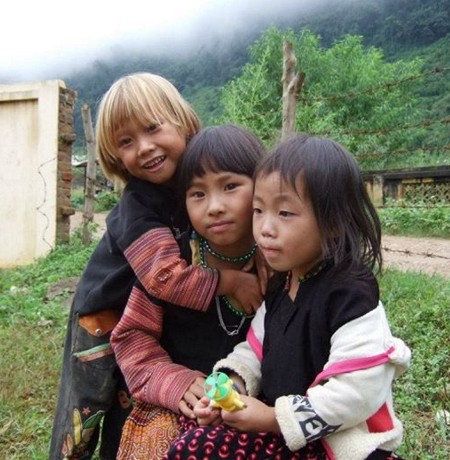
The Hmong people are a Mongol/Chinese Southeast Asian ethnic group living mainly in southern China, Vietnam, Laos, Thailand, and Myanmar; who have a marked increase in Albinism and or Blondism – which is partial Albinism.
|
Please visit the "Additional Material Area" for many more photographs of each civilization, and related material <Click> |
| < Back | Home | Next > |